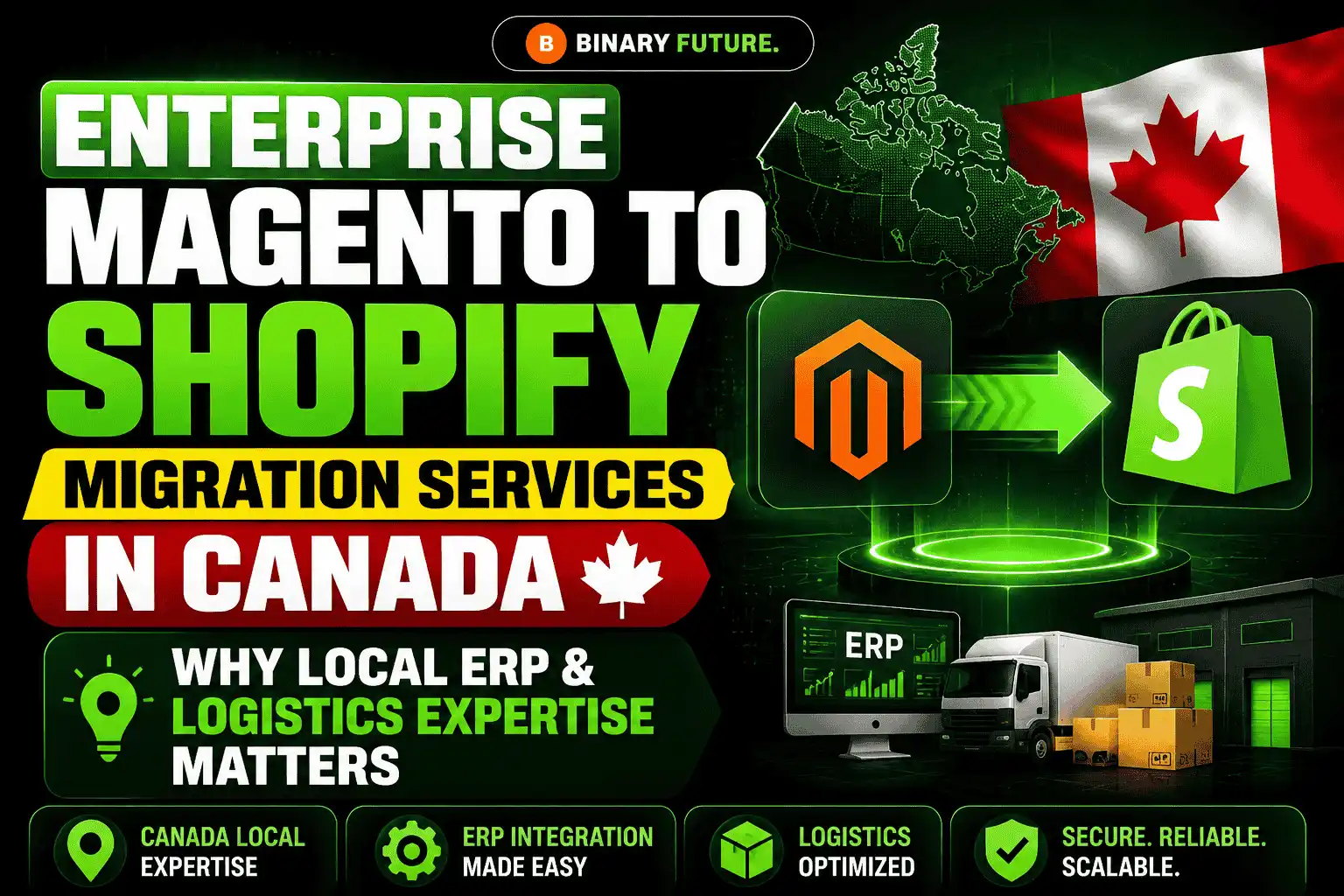
Enterprise Magento to Shopify Migration Services in Canada (2026 Guide)
Enterprise Magento to Shopify migration in Canada rarely fails on the catalog transfer. It fails on the local context a global agency does not know: Canadian tax across provinces, integration with the ERPs and logistics systems that actually run the business, and bilingual compliance. This guide explains why local expertise is the deciding factor and how to evaluate an enterprise Shopify Plus migration agency in Canada on the things that break replatforms.
For an enterprise Magento to Shopify migration in Canada, the storefront is the easy part. The risk lives in three local areas a global agency tends to underestimate: Canadian tax configuration (GST, HST, and separate PST by province), integration with the ERP and logistics systems that run fulfillment, and bilingual compliance for Quebec. A local partner treats these as core scope; a generic global agency treats them as edge cases and bills the difference later. Evaluate an enterprise Shopify Plus migration agency in Canada on proven ERP integration, Canadian tax and compliance fluency, and logistics experience, not on portfolio size.
Most enterprise replatforming guides focus on the migration mechanics. For a Canadian enterprise, the harder questions are local: does the agency understand provincial tax, can it connect Shopify to your existing ERP and 3PL, and can it meet Quebec’s language law.
The Hidden Risks of Hiring Generic Global Migration Agencies
A large global agency can move a catalog and rebuild a theme competently. The risk is everything around that, the local context that determines whether the migrated store actually works for a Canadian enterprise.
The failure pattern is consistent. A global agency scopes the visible migration and assumes Canadian tax is a setting, when it is three systems at once with destination-based rules. It treats your ERP and logistics integration as a later phase, when for an enterprise the back-office connection is the project. It does not know Quebec’s Bill 96, so French compliance surfaces after launch as a complaint, not a deliverable. Each gap is invisible in the pitch and expensive in production, and each is something a Canadian partner handles as a matter of course. The cheapest-looking global quote often becomes the most expensive once these local realities are billed as change orders.
3 Pillars of Localized Canadian Replatforming
1. Canadian tax fluency
There is no single Canadian sales tax. A correct migration configures the 5% federal GST everywhere, HST of 13 to 15% in the five harmonized provinces (Ontario 13%, Nova Scotia 14%, and New Brunswick, Newfoundland and Labrador, and PEI at 15%), and separate PST in British Columbia, Manitoba, and Saskatchewan, plus Quebec’s QST. Because tax follows the customer’s destination, the store must apply the right rate per buyer and file across jurisdictions. A local partner builds this in; a global one often discovers it mid-project.
2. ERP and logistics integration
For an enterprise, the migration is only successful if Shopify connects cleanly to the systems that run the business: the ERP (NetSuite, SAP, Microsoft Dynamics), the WMS, and Canadian 3PL and carrier logistics. This is bidirectional integration, orders flow out, inventory and fulfillment flow back, with real error handling. A partner who knows the Canadian logistics landscape and has shipped these integrations before scopes it correctly from the start, rather than treating it as a post-launch add-on.
3. Bilingual and regulatory compliance
Selling to Quebec means complying with Bill 96: commercial communications, product descriptions, checkout, support, and invoices, must be available in French of equal quality to English, and the requirement reaches businesses outside Quebec that sell to its residents. A localized replatform plans French coverage as a core deliverable and accounts for Canadian privacy and consumer-protection norms. A global agency unaware of these requirements leaves the enterprise exposed to complaints and fines.
Bridging the Gap: Legacy ERPs to Shopify Plus
The heart of an enterprise migration is reconnecting Shopify Plus to the back-office systems Magento was wired into. The table summarizes what that bridge involves across common enterprise systems.
| System | Migration challenge | What a local partner delivers |
| ERP (NetSuite, SAP, Dynamics) | Custom Magento connectors do not move to Shopify | Bidirectional sync of orders, inventory, pricing via middleware or native API |
| WMS / 3PL | Warehouse and carrier links rebuilt for Canadian logistics | Real-time fulfillment and stock flow with Canadian carriers and 3PLs |
| Tax engine | Provincial GST/HST/PST logic by destination | Place-of-supply tax configured correctly across provinces |
| PIM / catalog | EAV attributes and configurable products to remap | Clean mapping to Shopify metafields, variants, and B2B catalogs |
The common thread is that none of these connections survive a lift-and-shift; each is rebuilt against Shopify APIs with Canadian operational realities in mind. This is where enterprise replatforms are won or lost, and where local experience separates a partner from a vendor learning on your project.
Why Binary Future Is the Trusted Canadian Migration Partner
Binary Future is a Toronto-based Shopify Plus Partner built for exactly this work: complex Canadian enterprise migrations where tax, ERP, and logistics decide the outcome.
- Canadian by default. Provincial tax (GST, HST, PST, QST), Quebec Bill 96, and local logistics are core scope, not afterthoughts discovered post-launch.
- Deep ERP and logistics integration. Proven bidirectional connections to NetSuite, SAP, and Dynamics, plus Canadian WMS and 3PL links, with real error handling.
- Magento-specific engineering. EAV attributes, configurable products, and customer groups rebuilt as native Shopify metafields, variants, and B2B catalogs.
- SEO and data integrity guaranteed. Full 301 redirect mapping and data validation on every project, protecting rankings and revenue through the cutover.
See our Shopify migration services and Shopify Plus development for how we handle enterprise Canadian replatforms.
Planning an enterprise Canadian migration? Get a free 30-minute scoping session. We will map your ERP and logistics integrations, provincial tax needs, and Bill 96 obligations, and give you a costed migration plan built for Canadian operation.