Shopify Plus Multi-Store setup cost in Canada (2026): Taxes, Inventory & Compliance Explained
A detailed, Canada-specific breakdown of the Shopify Plus multi-store setup cost in 2026. Beyond the expansion-store fees, the real budget drivers are uniquely Canadian: provincial tax complexity (GST, HST, and PST), multi-location inventory sync, and Quebec’s French-language compliance under Bill 96. This guide calculates each layer so your multi-store budget reflects what Canadian operation actually costs.
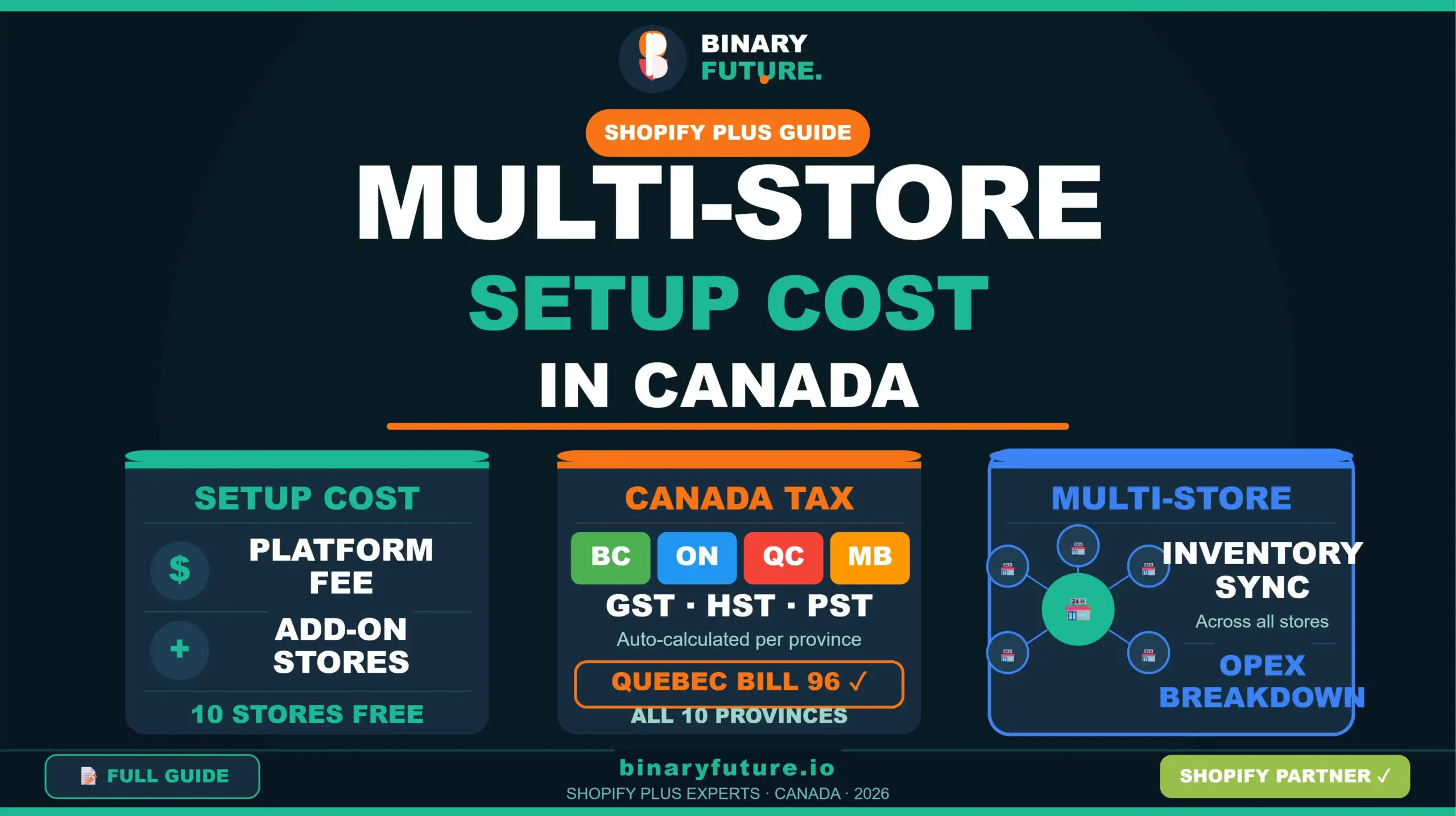
Your Shopify Plus subscription already includes the main store plus 9 expansion stores (10 total) at no extra per-store fee, so licensing is rarely the issue. In Canada, the real multi-store cost comes from three layers most teams underestimate: configuring tax across provinces (5% federal GST, HST of 13 to 15% in five provinces, and separate PST in BC, Manitoba, and Saskatchewan, plus Quebec’s QST), synchronizing inventory across stores and locations, and meeting Quebec’s Bill 96 French-language requirements on every customer-facing surface.
Budget for the build and compliance engineering, not just the platform fee.
Most multi-store budgets get the platform fee right and the Canadian specifics wrong. Tax, inventory, and language compliance are where projects overrun, each more complex in Canada than generic Shopify docs suggest.
Base Layer: Shopify Plus Expansion Store Fees in 2026
Start with what you already have. A Shopify Plus subscription (roughly CA$3,400 to CA$3,650 per month in Canada) includes your main store plus up to 9 expansion stores at no additional per-store fee, 10 storefronts in total. Additional stores beyond that run approximately US$250 to US$300 per month each.
For most Canadian projects the expansion-store fee is effectively zero, you are well within the included 10. The real question is not how many you can afford, but whether each region needs its own store at all, or whether Shopify Markets can serve multiple provinces and currencies from one storefront. The platform layer is the cheapest, most predictable part of the budget; the cost lives in the layers below.
The Canadian Tax Matrix: GST, HST, and PST Across Multiple Storefronts
Canadian sales tax is the layer that surprises teams used to a single rate. There is no one Canadian tax; there are three systems running at once, and a multi-store setup has to handle all of them correctly.
- GST (federal, 5%). Applies everywhere as a baseline.
- HST (harmonized, 13 to 15%). Five provinces fold the federal and provincial portions into one rate: Ontario 13%, Nova Scotia 14% (reduced from 15% in April 2025), and New Brunswick, Newfoundland and Labrador, and PEI at 15%.
- GST + separate PST. British Columbia (PST 7%), Manitoba (7%), and Saskatchewan (6%) charge a provincial tax on top of the 5% GST, calculated separately. Quebec adds QST (9.975%) administered by Revenu Québec. Alberta and the three territories charge only the 5% GST.
The critical rule is place of supply: tax follows the customer’s destination, not your store’s location. A multi-store architecture must apply the right rate per customer, file correctly across jurisdictions, and keep separate PST, which is not recoverable as an input tax credit and is therefore a hard cost, configured per province. Getting this wrong means over- or undercharging customers and CRA paperwork to fix it. This is configuration and tax-logic work on every storefront, and it is a real line in the multi-store budget.
Multi-Location Inventory Synchronization: Cost Options
Expansion stores are independent instances; they do not share inventory by default. If your stores draw on shared stock, you need a deliberate sync approach. The three common options trade cost against capability.
| Sync approach | Best for | Cost and trade-off |
| Native Shopify tools | Few stores, simple shared stock | Lowest cost, but limited logic and no deep ERP link |
| Third-party sync app | Mid-size, standard inventory rules | Moderate monthly fee, faster setup, less flexibility |
| ERP/PIM + middleware | Complex, multi-location, high volume | Highest build cost, full control and a single source of truth |
The right choice depends on how many locations share stock and how complex the rules are. A two-store setup with separate inventory may need almost no sync; a multi-region operation drawing on shared Canadian warehouses needs robust, real-time synchronization, usually through an ERP or PIM as the source of truth. Underbuilding here produces overselling and stockouts; overbuilding wastes budget on sync you do not need. It is the single most important engineering decision in a Canadian multi-store project.
The Bilingual Compliance Factor (Quebec Bill 96)
If you sell to Quebec, French is not optional. Quebec’s Bill 96, which strengthens the Charter of the French Language, requires commercial communications to be available in French, and the requirement reaches businesses outside Quebec that sell to Quebec residents. In practice, every customer-facing surface, product descriptions, checkout, customer support, invoices, and marketing, must be available in French of equal quality to the English.
For a multi-store build, this is a concrete cost and architecture decision. You can serve French through Shopify’s native translation and Markets, or through a dedicated French storefront, and the choice affects both build and maintenance. Provisions on product inscriptions and signage came into force on June 1, 2025, and the registration threshold with the OQLF now reaches businesses with 25 or more employees, with fines for non-compliance reported up to CA$100,000. Treating French as a core deliverable, not a later add-on, is both a compliance necessity and a budget line. This is not legal advice; confirm your specific obligations with a Quebec-qualified advisor.
Engineering Scalable and Compliant Multi-Store Systems with Binary Future
Binary Future is a Toronto-based Shopify Plus Partner that builds Canadian multi-store systems to be both scalable and compliant from day one, not retrofitted after a tax error or a Bill 96 complaint.
- Canadian tax configured correctly. We set up GST, HST, PST, and QST with place-of-supply logic across every storefront, so the right rate applies to every customer.
- Inventory sync designed to fit. We match the sync approach to your real needs, native, app, or ERP/PIM middleware, so you neither oversell nor overspend.
- Bill 96 compliance built in. French-language coverage across customer-facing surfaces is architected into the build, not bolted on after a complaint.
- TCO over three years. We forecast the full cost of running compliant Canadian stores, so the budget holds beyond launch.
See our Shopify Plus development and Shopify headless development for how we engineer multi
Planning a compliant Canadian multi-store build?Get a free 30-minute architecture session. We will map your tax jurisdictions, inventory sync needs, and Bill 96 obligations, and give you a costed plan and 3-year TCO in Canadian dollars.