Agentic Commerce on Shopify: Study Hall Recap | Binary Future
Mike Bashkatov, founder of Binary Future
On May 19 I attended Shopify Study Hall — a closed partner event focused on a single theme: how stores will sell inside AI chats. Not “someday,” but now. Here’s what mattered most.
The core shift: from being found to being recommended
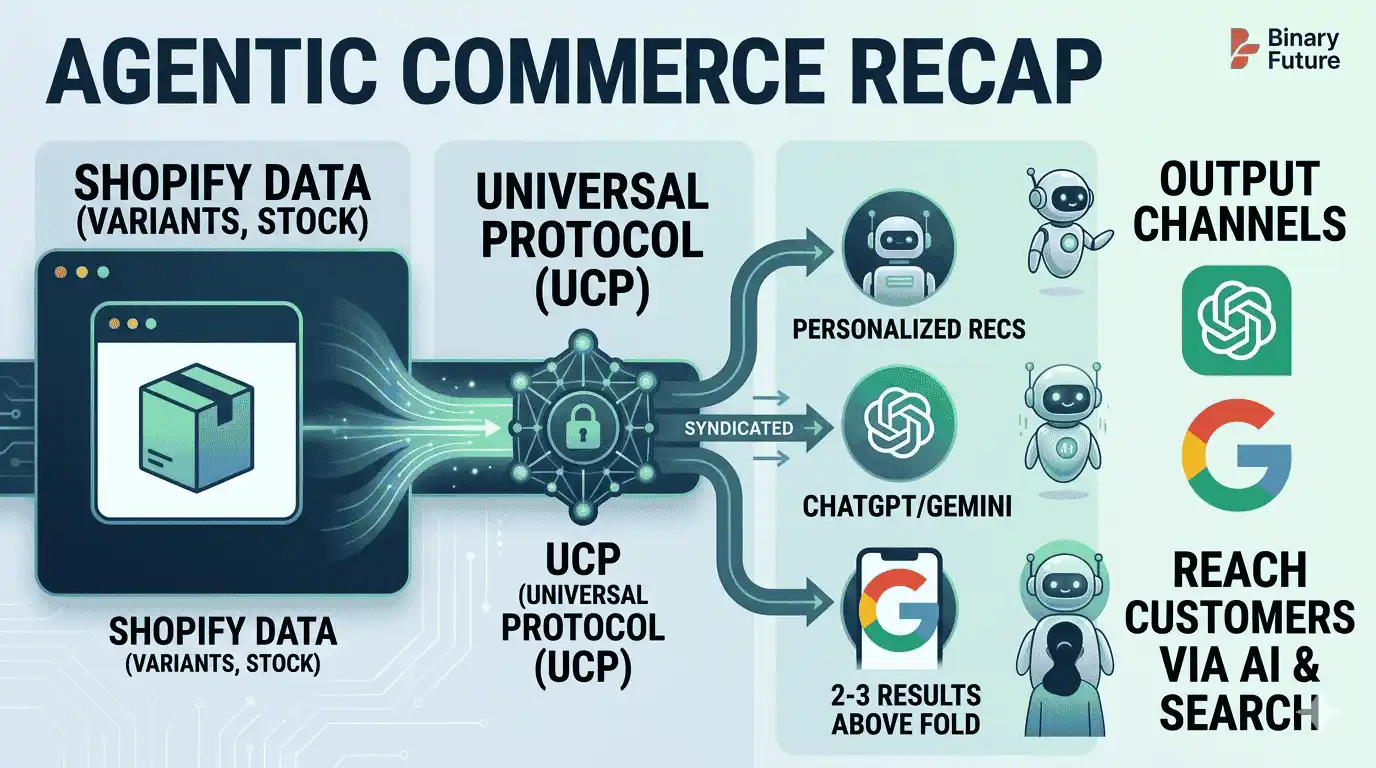
SEO used to mean ranking at the top of search results. Now buyers increasingly skip opening ten tabs and instead ask ChatGPT, Gemini, or Copilot: “find me a lightweight carry-on with a hard shell.” And the AI shows two or three results, not ten. According to Shopify, an agentic result set typically has only three positions “above the fold,” versus ten or more in traditional search.
The takeaway for business is simple and unforgiving: if your product isn’t in those three, you’re not there at all. There’s no middle ground anymore.
What Shopify says it has already done for us
The most useful part of the event was understanding where the line falls between “the platform handles it” and “the agency or owner handles it.”
According to Shopify, a lot already works out of the box: server-side rendering for AI crawlers, direct partnerships with ChatGPT, Google AI Mode, Gemini, and Microsoft Copilot, plus Shopify Catalog — a search API that agents use to query merchants’ catalogs. They also showed Agentic Storefronts: you set the store up once in the admin, and product data is syndicated across AI platforms. Importantly, the owner remains the merchant of record — the customer, the data, and post-purchase service all stay with them.
Underneath all of this, Shopify says, sits UCP (Universal Commerce Protocol) — an open standard they’re developing with Google so any agent can transact with any merchant through a single common “language.” Shopify named Etsy, Target, Walmart, Wayfair, and a number of payment providers among those adopting it. To be straight: some of these are Shopify’s own claims from the stage, and details are still being finalized. But the direction is clear.
Where our work is: the data
The platform provides the rails. What runs on them is the store’s data — and that’s where everything rests on us, the partners and owners.
AI answers a buyer based on what you’ve uploaded. Incomplete fields, broken taxonomy, duplicate products, empty descriptions — and the agent either won’t find your product or will show a competitor instead. Shopify walked through the required and recommended fields: title, description, images, price, availability (a product with zero inventory is simply excluded from AI results), weight, plus barcodes, alt text, and categories. It’s routine work, but it now directly determines whether you sell or not.
The second layer is non-product questions. “Do you ship to the UK?” “What’s your return policy?” “Do you offer local pickup?” Shopify is launching a Knowledge Base — a base of answers about the store itself that complements the catalog. Filling it in, keeping it current, adding the brand story — that’s again the work of the owner and the team.
Don’t tie yourself to one platform
One point resonated with me in particular: don’t invest fanatically in a single AI platform. These partners ship major changes nearly every month. Chasing every update leads nowhere.
What matters far more is staying anchored to the buyer. People still trust the same sources — reviews, niche communities, Reddit — and care about the same things. AI has simply made that information faster to reach. This is, in essence, what good businesses have always done, only the stakes are higher now.
What this means for our clients
I left the event with one clear thought: the first-mover window is open right now. The baseline infrastructure for AI commerce is already switched on inside store admins. The winners won’t be those who simply “have Shopify,” but those who clean up their data, build out their Knowledge Base, and establish a presence where AI looks for trust — while competitors are still getting used to the very idea of AI search.
At Binary Future, we’re already working out how to build data audits for agentic discovery into our projects. If you sell on Shopify and want to know whether your store is ready to sell inside AI chats, get in touch and we’ll take a look together.