Magento to Shopify plus migration price in Canada: Hidden Costs That Increase Your Real Budget
The headline Magento to Shopify Plus migration price in Canada is rarely what you actually pay. The quote covers the visible build; the overruns come from data, SEO, and integrations under the waterline. This guide names the four hidden costs that blow budgets, shows how each one enters the invoice, and gives you a mitigation checklist to protect your number, plus the TCO view your CFO will ask for.
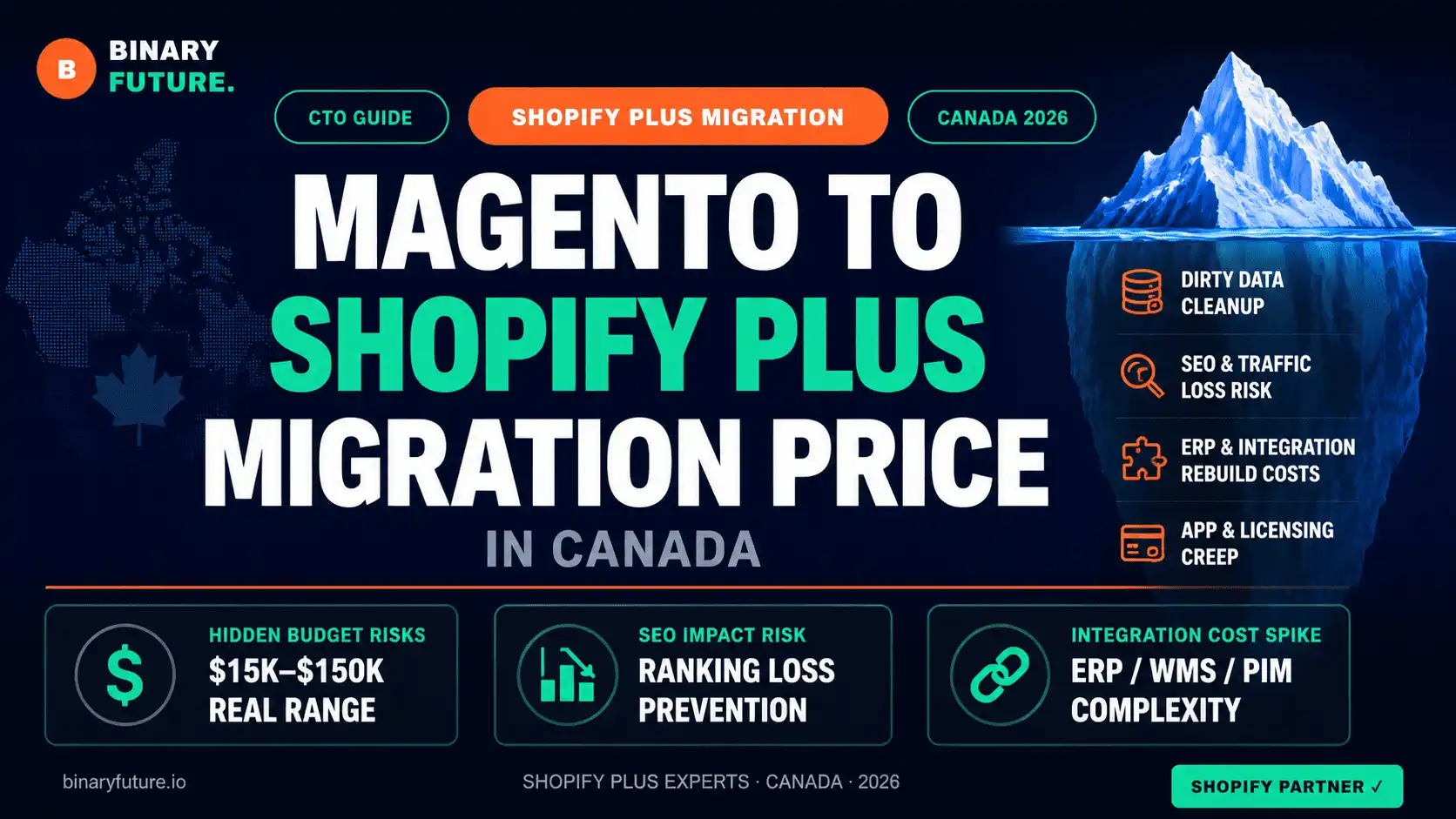
Most Magento to Shopify Plus budget overruns trace to four hidden costs: dirty data cleanup, SEO and traffic loss at cutover, custom integration rebuilds (ERP, WMS, PIM), and app or licensing creep. None of them appear in a typical fixed quote, yet together they can add 20 to 40% to the real price. The fix is not a cheaper quote; it is a scope that surfaces these costs before you sign. Always evaluate the move on total cost of ownership in Canada over three years, not the migration invoice alone, where Shopify Plus usually wins against a self-hosted Magento stack.
In our companion guide we broke down the three core pillars of the Magento to Shopify Plus migration price in Canada. This article goes one level deeper, into the costs that do not appear on the first quote and are the most common reason a clean-looking budget overruns. For a CTO, knowing these in advance is the difference between a forecast you can defend and a mid-project conversation with finance you would rather avoid.
The “Iceberg” of Replatforming: Quote vs. Reality
A migration quote is the tip of the iceberg. Above the waterline sits the visible work: theme build, catalog transfer, basic configuration. That is what most agencies price quickly and confidently. Below the waterline sits the mass that sinks budgets: untangling years of Magento data, preserving search rankings through the cutover, and rebuilding integrations that the old platform held together with custom code.
The reason the gap exists is structural. Magento is self-hosted and endlessly customized, so two stores that look similar from the front can be wildly different underneath. An agency cannot fully price the underwater mass until it inspects your data and integrations, so the first quote often assumes a best case. When reality differs, the difference is billed as change orders. Understanding this upfront lets you ask for the inspection before the quote, not after, which is the single most effective way to keep the final price close to the original.
Top 4 Hidden Costs in a Magento to Shopify Plus Migration
1. Dirty data cleanup
This is the largest and most common overrun. Years on Magento accumulate incomplete attributes, inconsistent taxonomy, duplicate SKUs, and orphaned records. None of it transfers cleanly, and every exception is manual work. Because the mess is only visible once migration starts, it is almost always billed as unplanned rework. A catalog that looked like a routine transfer can add weeks once the team starts mapping EAV attributes to Shopify metafields and reconciling variant logic.
2. SEO and traffic loss at cutover
URL structures differ between Magento and Shopify. Without a complete 301 redirect map, you lose rankings, and lost rankings are lost revenue, often for months. The hidden cost is twofold: the engineering hours to build and test a full redirect map, and the revenue dip if it is done poorly. This is the overrun that does not show on the invoice at all; it shows in the analytics three weeks after launch. Treating SEO preservation as a core deliverable, not an add-on, is what prevents it.
3. Custom integration rebuilds
On Magento, connections to your ERP, WMS, PIM, or CRM are often held together with bespoke code or aging extensions. None of that moves to Shopify as-is; each integration has to be rebuilt against Shopify APIs and middleware. This is where a quote that looked mid-market quietly becomes enterprise. The cost scales with the number of connected systems and how custom the original logic was, and it is easy to under-scope because the integrations are invisible from the storefront.
4. App and licensing creep
Features that were free custom modules on Magento often become paid Shopify apps, each with its own monthly fee. Subscriptions, advanced search, B2B tooling, and reviews can quietly add hundreds per month. Individually small, collectively they reshape your run-rate. This cost does not hit the migration invoice; it hits every monthly bill afterward, which is exactly why it belongs in a TCO calculation rather than a one-time budget.
Mitigation Checklist: How to Protect Your Budget
Each hidden cost has a concrete countermeasure. Use this checklist when scoping and when comparing agency quotes.
| Hidden cost | Warning sign | How to protect your budget |
| Dirty data cleanup | No data audit before the quote | Require a paid or free data audit upfront; clean source data before migration begins |
| SEO and traffic loss | Redirects listed as optional | Make a full 301 redirect map and SEO validation a fixed deliverable, not an add-on |
| Integration rebuilds | Integrations not itemized | List every ERP, WMS, PIM, and CRM connection in scope and price each explicitly |
| App and licensing creep | Only one-time cost quoted | Get a projected monthly app and license total, and fold it into a 3-year TCO |
One rule covers all four: insist on inspection before the number. An agency that quotes a complex Magento migration without first looking at your data and integrations is quoting a best case you will not get to keep.
Transparent Pricing with a Top Canadian Shopify Plus Agency
Binary Future is a Toronto-based Shopify Plus Partner focused on complex migrations, the projects where the underwater mass is largest. Our pricing model is built to remove the hidden costs above, not to hide them in change orders.
- Audit before quote. We inspect your Magento data and integrations first, so the number you sign reflects the real underwater mass, not a best case.
- SEO and data integrity built in. Full 301 redirect mapping and data validation are core deliverables on every project, never optional line items.
- Integrations itemized. Every ERP, WMS, PIM, and CRM connection is scoped and priced explicitly, so nothing migrates from mid-market to enterprise mid-project.
- TCO, not just invoice. We give you a projected 3-year total cost of ownership in Canada, including monthly apps and platform fees, so finance sees the whole picture.
See our Shopify migration services and Shopify Plus development for how we scope complex replatforms.
Worried about hidden costs in your migration budget? Get a free 30-minute scoping audit. We will inspect your Magento data, redirects, and integrations, and give you a costed plan with the hidden costs surfaced upfront, not after you sign.