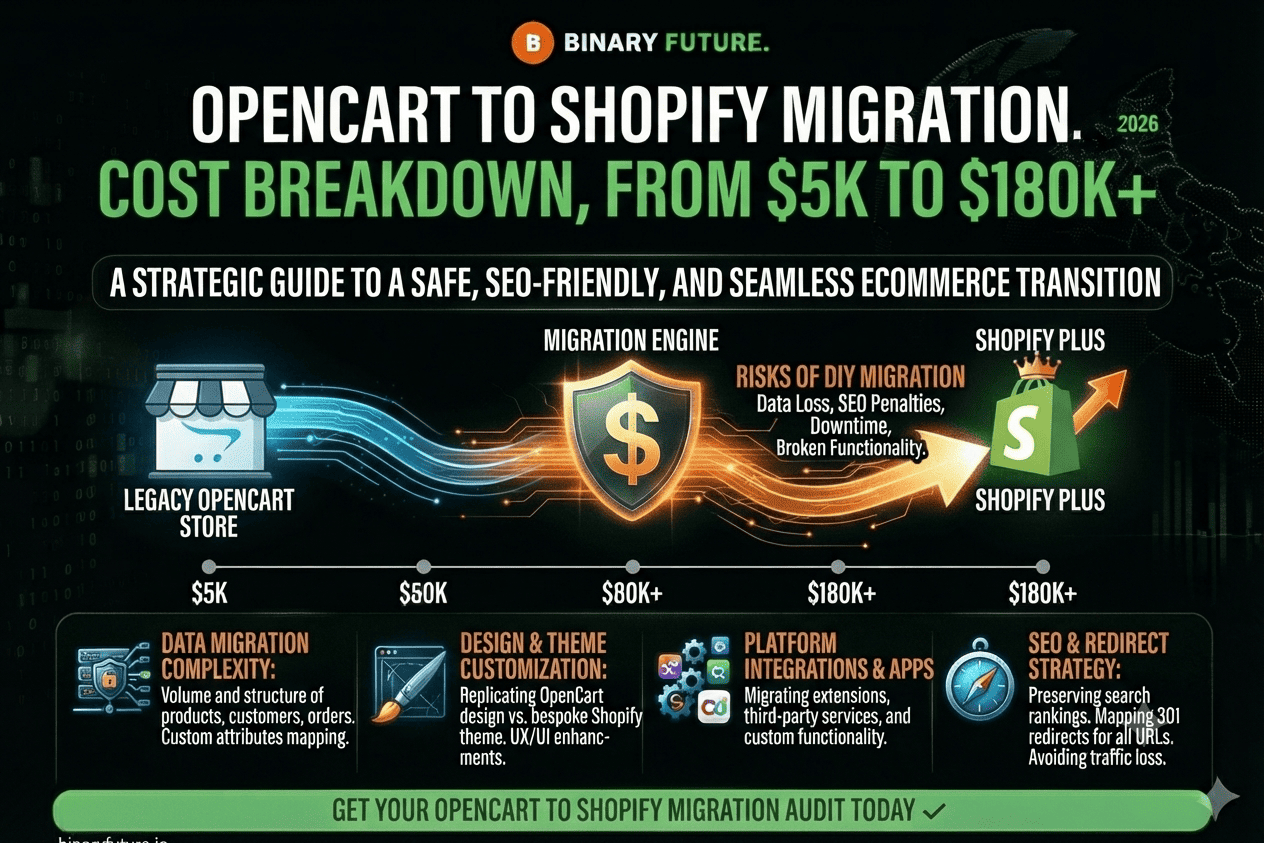
OpenCart to Shopify Migration Cost breakdown from $5K to $180K+, including key factors, timelines, risks, and how professional migration ensures a safe and SEO-friendly transition to Shopify.
Has your OpenCart become a “bottleneck” for your business? At Binary Future, we often see the same picture: the brand is growing, but the site architecture is stuck in the era of custom PHP edits. Your profit potential is 100% limited by the platform foundation. If every new module update in OpenCart causes a “cascade of errors” and mobile conversion is stagnating, it’s time for a radical replatforming. Shopify Plus is now chosen by over 5 million brands precisely for the opportunity to forget about the “hardware” and focus on marketing innovations.
In this article, we’ll break down how to break free from the constraints of open source and turn your Shopify migration into a manageable process with guaranteed ROI.
Why brands choose to replatform to Shopify Plus: a quick breakdown
OpenCart is a freedom that becomes a burden over time. When the costs of infrastructure maintenance and security start to outweigh the benefits of new features, Shopify Plus offers a gateway to the world of SaaS efficiency.
Ecosystem vs. isolated development
Shopify provides access to 8,000+ apps that integrate in a few clicks. In OpenCart, similar functionality often requires weeks of development and compatibility testing. The Shopify Plus model allows the marketing team to be autonomous: launch loyalty programs, AI-personalization, or complex promotions without waiting for a window in the programmers’ schedule.
Avoiding “technical debt” and hosting
The main value of migration is that it puts the responsibility for stability on the platform. You get 24/7 support and an infrastructure that can handle any traffic spikes. This is in stark contrast to the OpenCart model, where you are responsible for security patches, PHP versions, and server speeds.
Phase 1: Strategic Planning and Data Sanitization
Migration is the perfect time to “take out the trash.” Working with your data before the move determines the speed of your new site and the cleanliness of your analytics.
Architecture audit and logic documentation
Binary Future recommends starting with a deep inventory. You need to capture not only the products, but also the underlying logic:
Attribute structure:How OpenCart custom fields map to Shopify metafields.
Customer base and history:pure segmentation for further retention marketing.
Functional extensions:which OpenCart modules are critical and which can be replaced with native Shopify features.
Be sure to make a full backup of your database and media files via FTP. This is your “zero step” for security.
Preventive SEO audit: protecting capital in SERPs
Losing organic traffic is a major fear when migrating. We use Screaming Frog and Google Search Console to create a “heat map” of the most important URLs. Your task is to identify the pages with the most backlinks and prioritize them when setting up redirects.
Phase 2: Technical migration and entity synchronization
Site migration requires technical expertise. Mistakes at this stage can lead to vulnerabilities or “wrong” inventory balances.
Secure export and tool selection
OpenCart data is exported in CSV/XML format. For larger projects, we use custom API scripts or proven services like Matrixify. The main challenge is to preserve the parent-child relationships for configured products so that they are correctly displayed as options in Shopify (given the 3-option limit).
Moving from categories to smart collections
At Shopify, we abandon the rigid hierarchy of OpenCart in favor of tags and automated collections. This makes navigation flexible: one product can belong to a dozen collections without duplicating content. Smart catalog organization at the import stage is the key to high search speed on the site.
Phase 3: Maintaining SEO weight and optimizing speed
It is important that Google perceives the move as an “improvement” and not as the disappearance of the old resource.
Implementing 301 redirects and metadata mapping
Creating a 301 redirect map is your insurance against 404 errors. We carry over all meta titles and descriptions, ensuring that the pages are relevant. It is also important to set up canonical tags correctly to prevent duplicate content due to the new URL structure in Shopify.
Fighting for milliseconds (Core Web Vitals)
Shopify Plus delivers speed out of the box, but we go further. Optimizing images, lazy loading scripts, and choosing a fast theme are investments in user experience that will directly impact your rankings in 2026.
Phase 4: Ecosystem Customization and Connectivity
This stage is dedicated to tuning your new “engine” to achieve business goals.
Application stack and ERP integration
The Shopify App Store allows you to assemble a unique set of tools:
- Retention: Klaviyo or Omnisend for smart mailings.
- Operations: synchronization with NetSuite, Microsoft Dynamics or other ERPs.
- Support: AI assistants based on Gorgias to automate responses.
Proper stack selection can reduce operating costs by 40% in the first months.
Checkout and logistics setup
Payment and shipping flexibility is the final step to conversion. With Shopify Plus, you can set up complex shipping zones and automatically calculate taxes based on your customer’s location. This creates a local service feel for a global brand.
From theory to implementation
Replatforming from OpenCart to Shopify Plus is a complex marathon that requires professional training. The testing (QA) stage includes testing every scenario: from successful payment to product return logic. Binary Future recommends starting with a “soft launch” for a limited group of users to collect feedback in real-world conditions.
Remember: launching a website is just the beginning. Continuous optimization based on GA4 data and customer feedback is what will make your store a leader in its niche. Our team will ensure not just a data migration, but a seamless transition of your business to a higher orbit of profitability.
Ready to transform your store to Shopify Plus?
Book a free consultation with our technical director