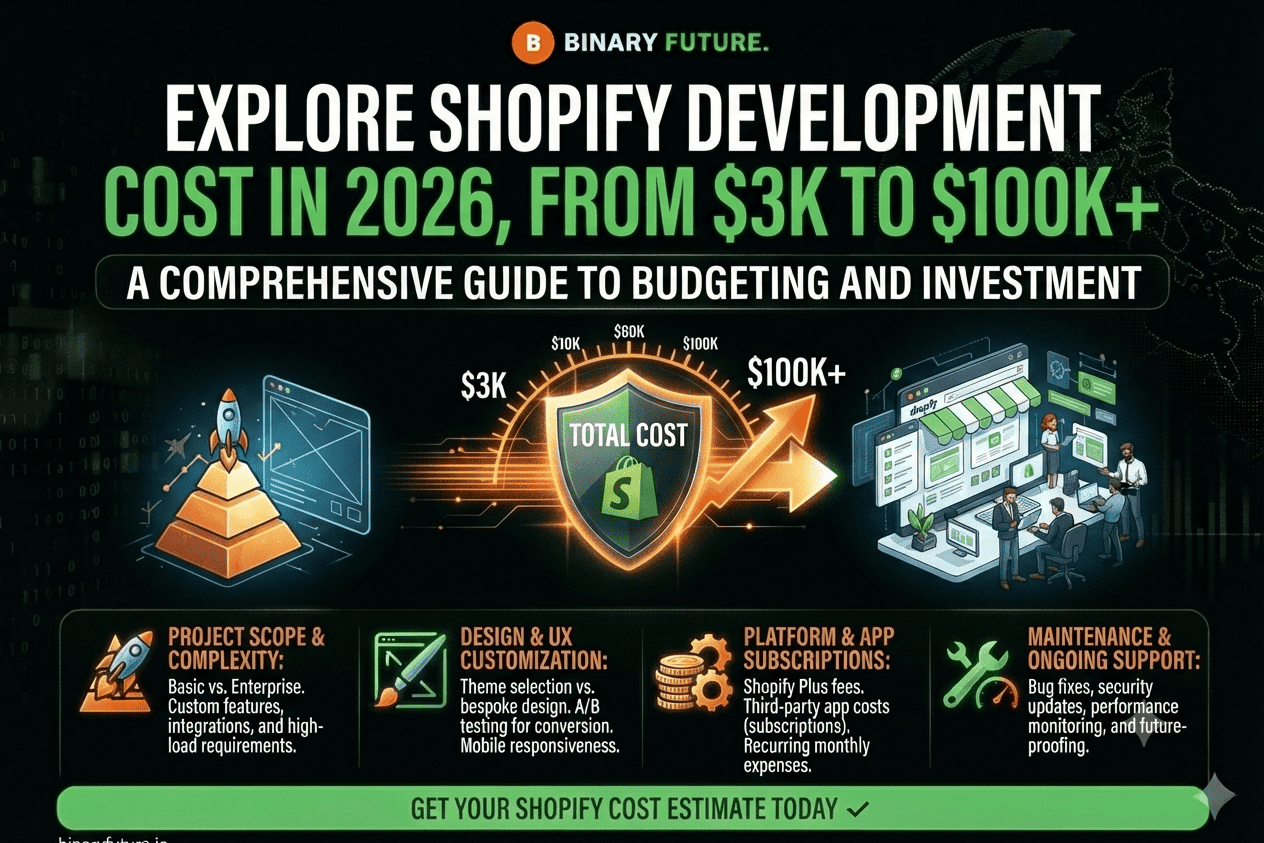
Explore Shopify Development Cost in 2026, from $3K to $100K+, including pricing factors, hidden expenses, and what impacts the total cost of building a Shopify store.
Creating an online store on Shopify often seems like a simple task until you get into the real budgeting. At Binary Future, we believe that the key is not just to launch a website, but to make the investment effective and scalable. In 2026, the e-commerce market demands not only a pretty picture, but also technical excellence: speed, personalization and seamless integrations. That’s why understanding where every dollar of investment goes is critical to the success of your brand.
In this article, we offer a transparent pricing guide based on hundreds of completed projects so you can accurately plan your budget and avoid hidden costs.
Shopify development cost calculation: a quick breakdown
The cost of developing a store varies significantly depending on the level of customization and required functionality. Don’t try to build everything at once – start by clearly defining your business goals.
Typical cost ranges and timelines
Basic Shopify Store ($3,000 – $10,000):Using a premium theme, basic setup of products, payments, and necessary applications. Implementation time: 1–3 weeks.
Custom designed store ($10,000 – $40,000):Custom theme development, advanced product filtering, customized checkout, and deep app integration. Time frame: 3–10 weeks.
Shopify Plus Store ($40,000 – $80,000+):Enterprise solution with advanced checkout, multi-market approach, B2B features, and private applications. Lead time: 10–20 weeks.
Headless Shopify ($80,000 – $100,000+):Frontend on Hydrogen or Next.js for maximum flexibility and performance. Timeframe: 16–24 weeks.
Cheap solutions can cost more in the long run
Choosing the cheapest contract often leads to technical debt: “heavy” code slows down the site, and incorrectly configured applications conflict with each other. Professional development from Binary Future may cost a little more up front, but it saves thousands of dollars in the future due to better conversion and system stability.
Key factors affecting the price of development
The cost of a project is a puzzle, where each element has its own impact on the final amount.
Theme customization and design
This is the biggest cost driver. Free themes cost nothing but limit your brand. Premium themes ($180–$350) are the golden mean. However, for unique positioning, you need to develop your own theme ($8,000–$25,000) that will be fully optimized for your conversion scenarios.
Tariff plan and integrations
Your choice of plan (from $39 to $2,300+/month for Plus) determines access to B2B features and checkout customization options. In addition to the monthly fee, consider integrations: basic marketing and feedback apps cost from $50 to $500 per month, while custom apps for specific business needs can cost upwards of $5,000 per unit.
Migration and localization
Migrating from WooCommerce or Magento adds $3,000 to $15,000 to your budget, depending on the amount of data. If you plan to expand internationally, setting up Shopify Markets with localized content and pricing will also require an additional investment of $5,000 to $15,000.
Where the budget goes: project resource allocation
Effective store development requires a clear allocation of finances across development stages.
- Strategy and Setup (10%): Plan selection, application stack audit, structure planning.
- Design (25%): Work on visual identity and UX prototypes.
- Technical development (35%): Coding, API integration, functionality customization.
- Content and SEO (15%): Filling in product cards, organizing collections, optimizing metadata.
- QA and Launch (15%): Payment testing, mobile responsiveness, speed testing.
Hidden costs that are often forgotten
Creating a website is just the first step. Binary Future recommends taking into account ongoing operating costs in advance:
- Transaction fees: 0.5% to 2% unless you use Shopify Payments.
- App Subscriptions: Most stores spend between $100 and $500 per month on necessary software.
- Payment processing: Standard bank and gateway fees (2.4%–2.9% + 30¢).
- Maintenance: Theme and plugin updates can break custom code, requiring regular developer support.
How to cut costs without sacrificing quality
- Reducing costs is not about saving on quality, but about smart prioritization.
- Start with an MVP: Use a premium theme instead of a full development from scratch at the start – this will save over $10,000.
- Native features above all else: Make the most of Shopify’s built-in tools (Inbox, Email, Blogs) before purchasing third-party services.
- Optimize your app stack: Avoid installing apps “just in case” – each of them slows down your site and increases your bill.
From theory to implementation
Shopify development costs are an investment in your future revenue. Plan your budget realistically, including a 15–20% contingency for unforeseen changes in workload. The most effective brands start with a proven MVP, gradually increasing the complexity of the system as revenue grows.
The right development strategy and a reliable partner will help you create a store that doesn’t just “exist” online, but becomes a powerful engine for your business in 2026.
Ready to get an accurate quote for your project?
Book a free consultation with our technical director