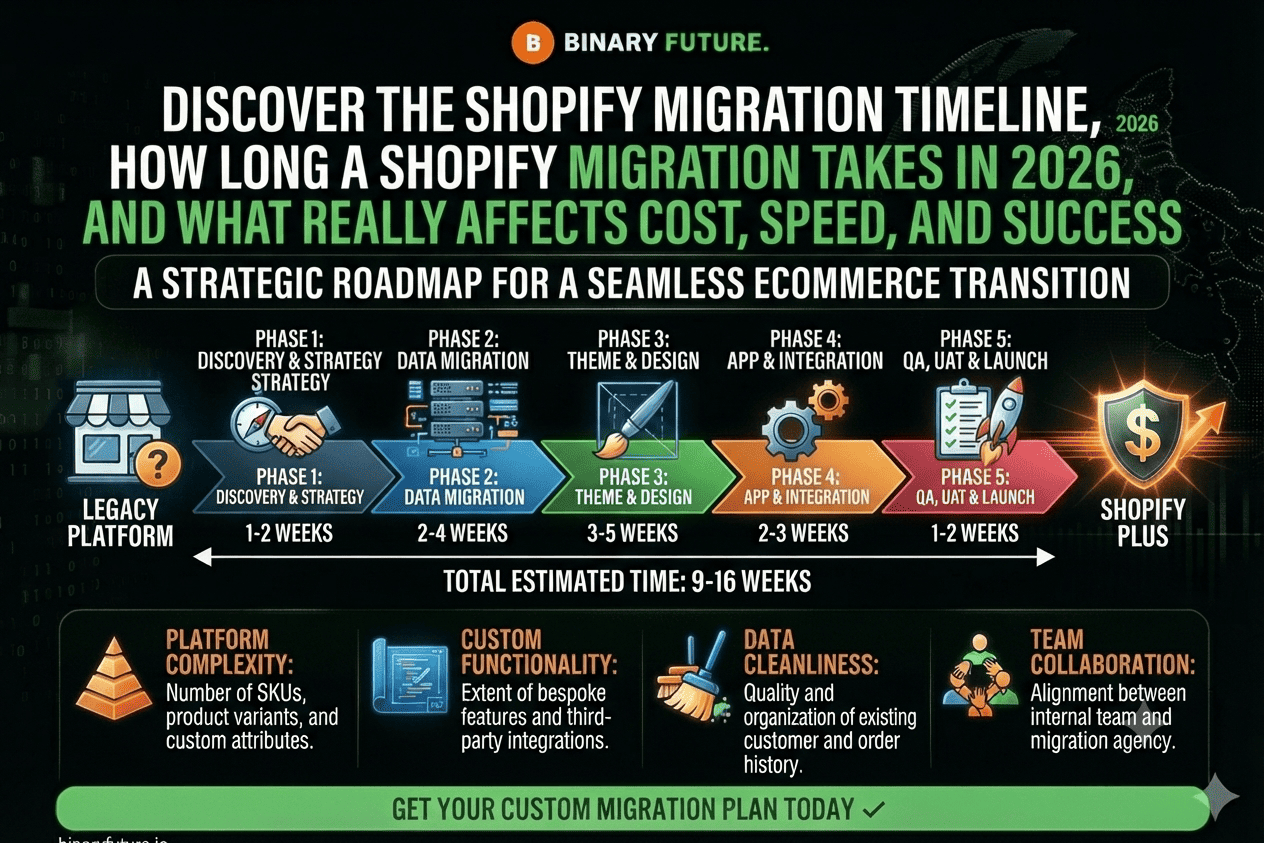
Discover the Shopify Migration Timeline, how long a Shopify migration takes in 2026, and what really affects cost, speed, and success of your store migration.
Launching a Shopify migration without a clear understanding of the timeframe is a direct path to organizational chaos. At Binary Future, we often encounter the question: “Can we launch in two weeks?” The short answer is yes, if you’re migrating an empty catalog. But for a real business with order history, integrations, and SEO capital, the process requires strategic planning. In 2026, the average migration takes between 2 and 6 months, depending on the complexity of your technology stack.
In this article, we’ll break down the development stages, factors that slow down the process, and a realistic timeline to help your team prepare for release.
Migration timing calculation: instant analysis
The time required to migrate is not a linear quantity. It depends on the “cleanliness” of your current data and the depth of customization you plan to implement on the new platform.
Catalog scale and data complexity
SKUs are just the tip of the iceberg. The real challenge is mapping complex attributes and migrating years of customer order history. If your data in a legacy system (e.g. Magento or custom PHP) requires manual cleaning before importing, add at least 2-4 weeks to the timeline.
Integrations with third-party systems (ERP/CRM)
If your Shopify Plus is to become part of an ecosystem with NetSuite, SAP, or Microsoft Dynamics, this stage will determine the final launch date. Building stable API connections and testing real-time balance sync typically takes 4 to 8 weeks of intensive developer work.
Key project phases and their duration
The migration process in Binary Future is divided into logical stages, each of which has its own critical points.
Research and technical design (2–3 weeks)
This is the “blueprint” phase. We analyze the current architecture, agree on field mappings, and select the application stack. Without this phase, you risk running into technical limitations in the middle of the development process, which will lead to costly delays.
Theme development and customization (4–10 weeks)
The duration of this stage depends on your choice: adapting a ready-made premium theme is faster, while developing a unique UX/UI design or implementing a headless architecture requires significantly more time for layout and testing.
Data migration and SEO setup (3–5 weeks)
This is the “migration” phase. It includes importing products, customers, and creating a 301 redirect map. It’s important to not just migrate your data, but to audit each URL so that Google doesn’t “lose” your store after the platform change.
Realistic graphs depending on the scale of the business
We have divided migration projects into three categories so that you can find your bearings.
| Project scale | SKU count | Integration complexity | Typical term |
| Standard (Small Business) | < 1 000 | Standard (Apps) | 6 – 10 weeks |
| Advanced (Mid-market) | 1 000 – 10 000 | ERP / Complex APIs | 3 – 5 months |
| Enterprise (Plus) | 10 000+ | Multi-warehouse / Global | 6 – 9 months |
Factors that can speed up the launch
Using native Shopify tools and limiting custom code allows for much faster time-to-market. A phased approach also helps: launching a minimum viable product (MVP) with basic functionality, followed by iteratively adding complex features.
Hidden delays: what is time disappearing for?
Even perfectly planned projects can be hampered by factors that are often underestimated.
1. Data Verification and Validation (QA)
Testing is not just “reviewing the site.” It’s checking every scenario: from the correctness of tax calculations in different regions to the logic of writing off bonus points in a loyalty program. This stage cannot be shortened without risking the brand’s reputation.
2. Content and design approval
Internal approval processes within your company often take up to 25% of the total project time. Binary Future recommends appointing a single responsible person (Product Owner) who will have the authority to make final decisions regarding the interface and functionality.
3. Reactivation of client accounts
Since passwords do not migrate, preparing and launching an email campaign to reactivate your customer base should be planned in advance so that you are not left without active buyers on release day.
From theory to implementation
Shopify migration timelines are a balance between speed and quality. A quick launch in a month is possible, but it often leaves behind technical debt that will take years to fix. Instead, a balanced approach (3–5 months for a medium-sized business) allows you to build a system that will run smoothly and generate revenue from the first minute after the domain transfer.
Remember that migration is a marathon, not a sprint. The key to success is choosing a reliable partner who sees beyond the code and your brand’s business goals. Proper timing will allow your team to transition to a new platform without stress or traffic loss.
Would you like to receive a customized schedule for your migration?
Order a free consultation with our technical director.