Large Catalog Shopify Plus migration 2026
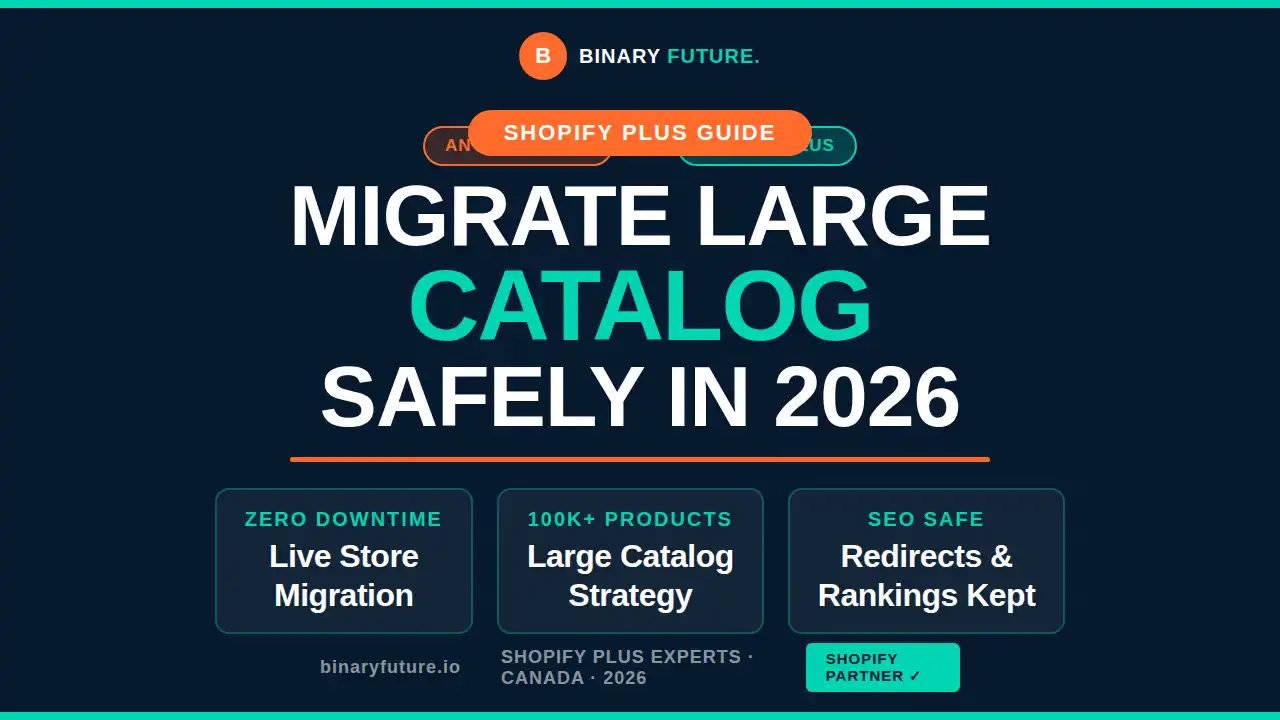
If your catalog has over 10,000 SKUs, forget the word “redesign.” Moving to Shopify Plus at this scale is, first and foremost, a business continuity operation. A beautiful storefront is just the tip of the iceberg. The real risks hide deep under the hood: URL history, complex variant logic, inventory ownership, ERP/PIM connections, and, of course, visibility for AI search engines.
For a small store, migration is just a sequence of tasks. But when thousands of products are involved, the process feels more like running an airport’s air traffic control tower.
Brief Summary A safe migration takes 12 to 32 weeks and requires strict control over 6 workstreams: SEO continuity, product architecture, inventory management, integrations, QA (performance testing), and GEO readiness (optimizing for generative AI).
Why is a Large E-Commerce Migration Different?
Scaling mistakes are expensive. The main differences of a large catalog include:
- URL Volume: A large store can generate 50,000 to 500,000 indexable links (products, categories, filters, tags). Traffic, backlinks, and real revenue are tied to them. You can’t just delete them.
- Deep Integrations: At high volumes, Shopify Plus doesn’t operate in isolation. The platform embeds into an ecosystem of ERP, PIM, CRM, OMS, and WMS systems.
- Multi-location Inventory: Syncing stock across warehouses, 3PL partners, and offline stores is critical. If the old and new platforms try to manage inventory simultaneously during the transition, overselling (selling out-of-stock items) is inevitable.
How to Preserve SEO Traffic During Migration (Checklist)
SEO mistakes are the most expensive part of a migration because the damage compounds quietly. Visually, the site might work perfectly, while Google stumbles upon broken links and duplicate pages. To protect your rankings, follow this plan:
- Compile a full URL database: Don’t rely solely on the sitemap. Use crawling, Google Search Console exports, and server logs to find all pages driving traffic.
- Set up an exact 301 redirect map: Products must point to products, categories to similar collections, and old blog articles should retain their topical relevance.
- Preserve metadata: Don’t rewrite all your copywriting at the same time you migrate. Title, Description, H1, and canonical tags should carry over unchanged.
- Transfer structured data: Product, Review, FAQPage, BreadcrumbList, and Organization markup is mandatory for proper parsing by neural networks (AEO/GEO).
Product Architecture: Variants vs. Metafields
Importing an old catalog “as is,” hoping the new platform will automatically figure it out, is a classic mistake. Product attributes must be thoughtfully divided:
| Attribute Type | Examples | Where to store in Shopify | Role in the system |
| Purchasing | Size, color, compatibility | Variants | Directly affect the purchasing decision |
| Filtering | Brand, category, price, certification | Metafields | Help users narrow down choices in the catalog |
| Informational | Ingredients, warranty, care instructions | Metafields / Schema.org | Build trust, help AI understand the catalog |
Inventory Control and Integrations
During the transition, two systems cannot simultaneously act as the “source of truth” for stock levels—that’s a direct path to discrepancies. How to set up processes:
- Single Source of Truth: Before the transition begins, clearly define which system owns the inventory (Shopify, ERP, or WMS); all other systems should only read this data.
- Inventory Buffer: Leave a 5-10% reserve buffer for each SKU during the first 72 hours post-launch to smooth out potential mismatches.
- Real Order QA: Before launch, rigorously test warehouse fulfillment, dropshipping, split shipments, and international orders.
Migration Costs and Stages
For catalogs above 5,000 SKUs, budgets and resources fall into three tiers:
- Mid-Complexity ($80,000 – $150,000): 5,000 to 20,000 SKUs, basic ERP/CRM integration, custom Plus theme, and SEO migration.
- High-Complexity ($150,000 – $300,000): 20,000 to 100,000 SKUs, B2B catalogs, multi-region sales (Shopify Markets), deep ERP/PIM integration, and complex testing.
- Enterprise / Headless ($300,000 – $1,000,000+): Over 100,000 SKUs, multiple storefronts, microservice architecture (middleware), and custom commerce logic.
Bottom Line: More Than Just a Platform Change
Moving a large store is the perfect excuse to completely rebuild your business’s operating model. How products are structured, how systems exchange data, how your brand is read by search engines and AI models—all of this can be built from scratch to meet modern realities.
Experience shows: the safest migrations aren’t the ones promising unrealistically fast launches. They are the projects where SEO, data, integrations, and GEO-readiness are treated as the absolute foundation from day one. At Binary Future, we recommend taking your time and meticulously planning every step—the cost of a mistake at large volumes is simply too high.