What is headless commerce on Shopify?
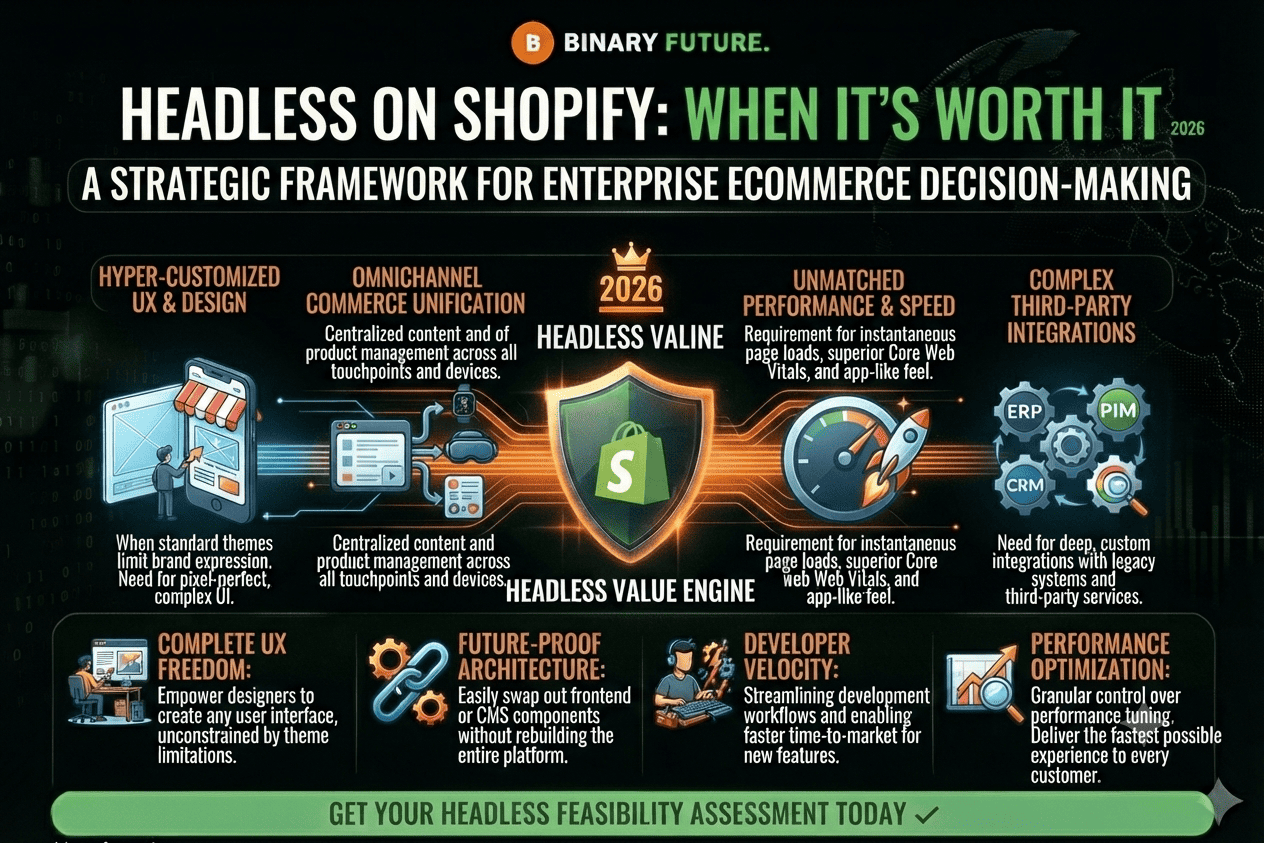
Headless commerce decouples the frontend from the backend. Shopify’s commerce engine (orders, products, inventory, checkout, payments) stays in place. The storefront, the part the customer sees, runs on a separate codebase using React, Vue, Next.js, or Gatsby, communicating with Shopify through APIs.
The two paths brands take:
- Hydrogen + Oxygen. Shopify’s official headless framework and hosting. Native Shopify, opinionated, fastest to deploy.
- Custom stack. Next.js or Nuxt on Vercel, Netlify, or AWS, with the Shopify Storefront API. Maximum flexibility, more engineering.
Headless on Shopify is not the same as a separate website pulling Shopify data. It is a programmable storefront with full control over performance, design, and integration, while Shopify handles what it does best: commerce operations and PCI-compliant checkout.
When does headless on Shopify actually pay off?
Five signals, in order of strength. Two or more landing on you means headless deserves a serious evaluation.
- Annual GMV above $5M. Headless is a significant investment. It only pays back when revenue growth from speed and UX improvements covers the development cost. Brands at $5M+ with healthy margins typically see 1-2% conversion lift cover the full build within 12-18 months.
- Mobile PageSpeed below 60 with theme already optimized. If your current Shopify Plus theme is fully tuned (image optimization, app stack reduced, Liquid cleanup, lazy loading) and you are still under 60 on mobile, you have hit the monolith ceiling. Headless is the next move.
- Omnichannel ambitions. You want to sell not only through a website, but through a native mobile app, in-store kiosks, IoT devices, B2B portals, or marketplaces, all backed by one inventory and pricing source. Headless is the only architecture that scales here.
- Complex B2B logic. Custom RFQ forms, multi-level discounts tied to specific accounts, account-specific catalogs, custom checkout for net-terms wholesale. When B2B logic exceeds Plus extensibility, headless gives you full frontend control while keeping Shopify’s commerce engine.
- External CMS or PIM in the stack. Brands with complex multilingual content often run Contentful, Sanity, or Storyblok as CMS, with Akeneo or Plytix as PIM. Headless lets you pull content from the CMS and product data from Shopify into one experience without compromise.
If only one signal lands, the answer is almost always “stay on a Plus theme and exhaust its capabilities first.”
Headless on Shopify vs Plus theme: side-by-side comparison
| Parameter |
Plus theme + Checkout Extensibility |
Headless on Shopify |
| Initial build cost |
$20,000 to $80,000 |
$80,000 to $300,000+ |
| Time to launch |
4 to 12 weeks |
12 to 32 weeks |
| Mobile PageSpeed ceiling |
60 to 85 with heavy tuning |
90 to 100 |
| LCP target |
2 to 3 seconds |
under 1 second |
| Frontend flexibility |
bounded by Liquid and Shopify themes |
unlimited |
| Checkout customization |
Checkout Extensibility + Functions |
Cart Transformation API + custom UI |
| Omnichannel support |
web only |
web + native app + kiosk + IoT |
| CMS / PIM integration |
possible, friction-heavy |
native, low-friction |
| Team requirement |
Shopify dev or agency |
full-time React/Next.js team or partner |
| Maintenance cost |
$1,000 to $5,000 per month |
$5,000 to $25,000 per month |
| Best for |
DTC at $1-10M GMV, single channel |
$5M+ GMV, omnichannel, complex B2B |
The right framing: Plus + Checkout Extensibility is for brands that have a commerce problem. Headless is for brands that have a brand experience problem.
What are the business signals you are ready for headless?
Sales above $5M annual GMV
Headless is a real investment. It only starts paying off when revenue growth from acceleration and UX improvements covers the development costs. Brands above $5M GMV with healthy margins, where 1-2% conversion lift translates into six-figure revenue, are the natural candidates.
PageSpeed and Core Web Vitals as a growth ceiling
Page speed is a confirmed factor in Google rankings and conversion. Studies consistently show conversion drops of 5-7% per second of load delay.
If your current Shopify Plus theme has been fully optimized (image compression, app reduction, Liquid cleanup, lazy loading) and mobile PageSpeed is still under 60, you have hit the monolith ceiling. Headless lets you build a storefront that scores 90+ consistently. This is the most direct path to better rankings.
Omnichannel and custom sales channels
If your goal is to sell not only through a website but through native mobile apps, interactive kiosks, IoT devices, or unique B2B portals, headless is the only flexible architecture. The Shopify Storefront API feeds data into all sales channels, ensuring real-time inventory and pricing synchronization across surfaces.
International and multi-region complexity
When you run multiple regions, languages, and currencies, the complexity outpaces standard themes. Headless lets you serve region-specific experiences, hreflang setups, and localized content from a unified backend without managing 9 separate theme codebases.
Brand experience requirements
Some brands need experiences that themes cannot deliver: animated product configurators, AR try-on, personalized landing pages by segment, conversational commerce surfaces. When the design team is consistently blocked by theme limitations, that is a business signal, not a technical one.
Where does the monolith actually break?
Headless unlocks its full potential on Shopify Plus thanks to the API capabilities and advanced functionality. Three concrete bottlenecks that push brands across the line.
Complex B2B logic and custom checkout
Standard Shopify Checkout limits customization. For large B2B operations, you need:
- Custom forms. Request for quotation (RFQ), complex fields for bulk orders, approval flows.
- Unique discount logic. Multi-level discounts tied to a specific account, contract pricing, volume breakpoints.
- Account-specific catalogs. Different SKU visibility per buyer, region, or channel.
- Custom validation. Credit limits, MOQ enforcement, regional compliance checks.
Headless gives you full control over the frontend, allowing you to implement these features using the Shopify Plus Cart Transformation API combined with a custom UI. This is one of the four areas where we deliver the highest-value work for B2B-heavy Plus brands.
ERP, CRM, and PIM integration depth
Complex commerce operations rarely live on Shopify alone. ERP for inventory and orders (NetSuite, SAP, Microsoft Dynamics). CRM for buyer relationships (HubSpot, Salesforce). PIM for catalog data (Akeneo, Plytix, Contentful). Headless makes these integrations cleaner because the frontend can pull from each system natively, rather than forcing every data path through a Liquid theme.
For ERP/CRM-heavy stacks, we run integration as a parallel workstream during the headless build, not an afterthought.
PWA and native app sync
If you are investing in a Progressive Web App to improve retention and reduce App Store dependency, headless is the foundation. PWAs require maximum speed and flexibility that a monolith cannot provide. Same architecture supports a synced native app via React Native or Flutter, sharing the same Storefront API as the web experience.
For full mobile coverage, see our Shopify Mobile App Development services.
Conversion rate ceiling
Storefront speed gains from headless typically lift conversion by 1-5%. The math is direct:
ROI formula: take annual revenue, multiply by projected CR lift (1-5%), and check whether the resulting incremental revenue covers development costs within 12-18 months. If yes, headless is justified. If no, it is not.
For a $5M brand, 2% lift equals $100,000 incremental annual revenue. Against a $150,000 build, that is a 12-18 month payback, exactly the threshold most boards approve.
How does the headless ROI math actually work?
Three components determine whether headless pays back.
Conversion lift from speed. Sub-1-second LCP versus 3-4-second LCP typically delivers 1-5% conversion lift, depending on baseline. Brands with already fast themes see less; brands with sluggish ones see more.
SEO lift from Core Web Vitals. Faster pages rank better and earn more organic traffic. The compounding effect over 12-24 months is often larger than the direct conversion lift.
Operational savings. Replacing a tangled app stack with custom integrations often cuts $500-2,000 a month in app subscriptions. Faster development cycles save dev hours.
A worked example for a $10M GMV brand:
- 2% conversion lift on $10M GMV = $200,000 incremental annual revenue.
- 15% organic traffic uplift from Core Web Vitals over 18 months = $300,000-500,000 cumulative.
- $1,200/month app stack reduction = $14,400 annually.
- Total estimated 18-month upside: $500,000-800,000.
- Build cost: $150,000-250,000.
That math works. For a $1.5M GMV brand, the same percentages produce $30,000-50,000 in lift against a $150,000 build, and the project does not pay back. This is why GMV threshold matters more than any other factor.
What does a headless build on Shopify cost in 2026?
Three brackets, driven by complexity:
$80,000 to $150,000: Hydrogen-based starter. Hydrogen + Oxygen, single region, single language, standard Storefront API integration, custom design but no deep CMS/PIM integration. Suitable for $5-15M DTC brands wanting speed and brand control.
$150,000 to $300,000: Custom Next.js with CMS. Next.js on Vercel, Contentful or Sanity as CMS, multi-region, multi-language, custom B2B logic, deep ERP integration, mobile PWA. Mid-market norm.
$300,000 to $1M+: Enterprise headless platform. Full omnichannel: web + native app + kiosk + B2B portal, multiple expansion stores, complex middleware, ERP/PIM/CRM full stack, custom commerce logic. 9-18 month projects with permanent engineering teams.
What is not in those numbers but should be:
- Ongoing maintenance. $5,000 to $25,000 per month, depending on stack complexity and update cadence.
- Hosting. Vercel/Oxygen runs $200-2,000+ per month based on traffic.
- CMS subscription. Contentful or Sanity at $300-3,000 per month at scale.
- Engineering team. Either an in-house React/Next team (2-5 engineers) or a long-term agency partnership.
- Post-launch optimization. Typically 10-15% of build cost in the first 90 days.
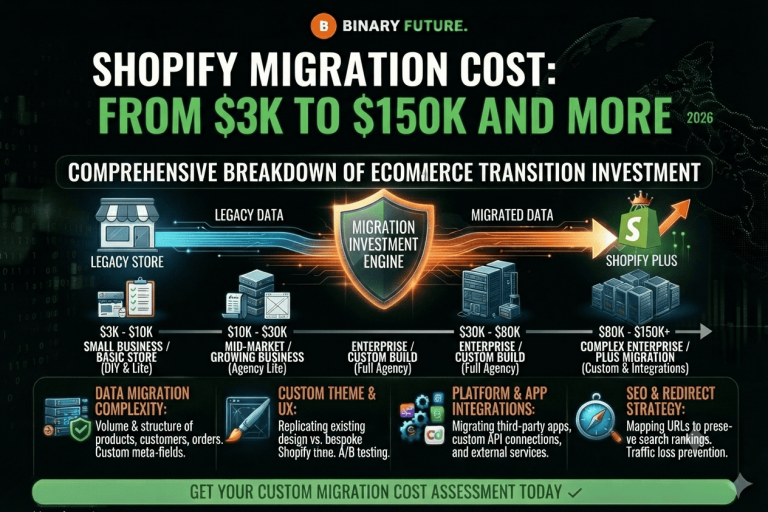
For a deeper line-item breakdown across migration scenarios, see our Shopify migration cost guide.
What are the risks and hidden costs of going headless?
The transition to headless brings challenges most brands underestimate.
Growing technical complexity and team requirements
You no longer rely on Shopify’s built-in features. You need a skilled in-house or partner team specialized in modern frameworks (React, Next.js, Vue) and API integration. The bus factor matters: a single departing senior engineer can stall a custom headless build for months.
SEO management
While headless can improve technical SEO, the operational side becomes more complex. Managing meta tags, 301 redirects, and SEO audits now happens through an external CMS rather than the standard Shopify interface. Without a clean process and ownership, regression is common.
Custom Shopify app development
Headless typically demands custom Shopify apps to bridge the gap between commerce and frontend logic: admin extensions for content editors, middleware for ERP/CRM sync, custom analytics. We treat this as a parallel workstream in every headless project. See our custom Shopify Plus development services for scope examples.
Checkout governance
Even on headless, Shopify owns checkout for PCI compliance. Custom checkout logic flows through Checkout Extensibility, Shopify Functions, and the Cart Transformation API. Misunderstanding this boundary is the most common architectural mistake in early headless projects.
Vendor lock-in to your engineering choices
A custom Next.js storefront on Vercel with Contentful is hard to undo. Switching CMS or hosting later means rebuilding significant parts of the stack. Choose foundational tools deliberately.
How does the migration to headless on Shopify work?
A typical headless project runs in seven phases.
- Discovery and architecture. Audit current performance, content models, integrations, traffic, and team capacity. Define which parts go headless and which stay native.
- Stack selection. Hydrogen vs Next.js vs Nuxt. CMS choice. Hosting. Image and video pipeline. CDN strategy.
- Design and design system. Component library, design tokens, accessibility compliance, motion system.
- Frontend build. Storefront pages, product templates, collection logic, search, navigation, internationalization.
- Integration build. Storefront API, CMS, PIM, ERP, CRM, analytics, marketing tools. Custom Shopify apps where needed.
- Checkout and Cart Transformation. Custom checkout logic via Checkout Extensibility and Cart Transformation API. SEO migration: 301 redirects, metadata preservation, sitemap.xml.
- QA, load testing, launch. Lighthouse audits, accessibility tests, load tests at peak-equivalent traffic, gradual DNS cutover.
Typical timeline: 12-32 weeks. Brands that skip the SEO migration step typically lose 30-60% of organic traffic in month one. Brands that handle it properly see less than 10% dip and recover within 30-60 days.
We run headless builds end-to-end as our Shopify Headless Development service, with explicit guarantees on data integrity and SEO preservation.
When headless is the wrong answer
Honest answer: most brands considering headless should not go headless yet.
Skip headless if:
- Annual GMV is below $3-5M. Build cost will not pay back in any reasonable horizon.
- Your current theme has not been fully optimized. Most “we need headless because of speed” cases turn out to be unoptimized themes plus heavy app stacks. Fix that first.
- You do not have an in-house engineering team or a long-term agency partner. Headless without ongoing engineering is a slow-motion failure.
- Your problem is conversion, not speed or omnichannel. Conversion problems are usually solved by checkout optimization, not architecture.
- Your roadmap is single-channel and likely to stay that way for 24+ months.
- Peak season is in 12 weeks. Headless launches in Q4 are the most common cause of disaster we see.
A common pattern: brands consider headless because peers did. The right question is not “should we go headless?” It is “which specific business outcomes will headless deliver in the next 12 months that Plus extensibility cannot?” If you cannot name three, you are early.