Shopify migration cost calculation: a quick breakdown
Price varies with the architecture you are leaving, not just the one you are arriving at. Understanding the scope before signing is what stops the budget inflating mid-project.
Store size and complexity as a basis for pricing
Volume of data is the first driver, but messiness matters more than count. A thousand clean SKUs migrate faster than three hundred with inconsistent attributes, orphaned images, and variants that exist in the ERP but not on the storefront. Enterprise projects with hundreds of thousands of orders, complex attributes, and B2B structures sit at the top of any range for that reason.
Migration method: independent versus professional
Self-migration through plugins is cheap and covers the mechanical part: products, customers, and orders moved from A to B. What it does not cover is preservation of search positions, validation of data integrity on both sides, or the custom logic that made the old store work. Those are the parts that surface later as lost traffic and support tickets.
Cheap move can cost three times as much
The failures follow a pattern, and each one is more expensive after launch than before it.
- Loss of organic traffic from an incomplete or incorrect redirect map, usually because it was built from the old sitemap rather than a full crawl.
- Errors in order history and customer records, which surface when a customer asks about an order that did not come across.
- Apps and theme that do not fit together, chosen before anyone confirmed compatibility.
What actually goes wrong and in what order is set out in our account of moving a premium brand, and the pre-move sequence in the Shopify migration checklist.
Key factors in Shopify migration cost
Four technical blocks carry most of the number.
Data migration and SEO preservation
The most time-consuming stage and the one with asymmetric risk. Getting it right produces no visible gain, because the traffic simply continues. Getting it wrong produces a loss that can take quarters to recover, and sometimes does not fully recover.
The work is manual URL auditing, structured data setup, and post-launch monitoring for at least a quarter. Treat an agency that quotes SEO migration as a fixed small line as a warning sign rather than a saving. The mechanics are in strategic Shopify data migration.
Frontend design and development
This band moved down in 2026 and it is worth saying so. Block-based themes made most layout, section, and template work editable rather than coded, so a large share of what used to be quoted as custom design is now configuration. A premium theme with real customisation now covers what a bespoke build used to.
Custom frontend work still earns its cost when the theme layer genuinely cannot express the experience, or when several storefronts run off one backend. Outside those cases, ask what specifically the theme cannot do before paying for a rebuild.
Integrations with ERP, CRM, and WMS
This is the swing factor. In our scoping, connections to SAP, NetSuite, Microsoft Dynamics, or a warehouse system are routinely the largest single line and the one most often absent from a first estimate, because the first estimate was based on page count. What drives it is not the number of systems but the number of conflicts you have to resolve: which system owns price, what happens when a sync fails mid-order, and how inventory reconciles across locations. That design work is Shopify CRM and ERP integration rather than migration.
The 2026 line items most quotes still omit
Three items changed the shape of migration budgets this year, and quotes written before 2026 do not contain them. Shopify Scripts stopped executing on June 30, 2026, so discount, shipping, and payment logic has to be rebuilt on Shopify Functions rather than moved. Legacy customer accounts were deprecated on February 26, 2026, with Multipass unsupported on the replacement, so shared sign-in needs redesigning around the Customer Account API. And a source store that predates checkout extensibility needs its checkout upgraded as part of the move rather than after it.
None of these are optional and none of them are migration in the transfer sense. Budget them as development.
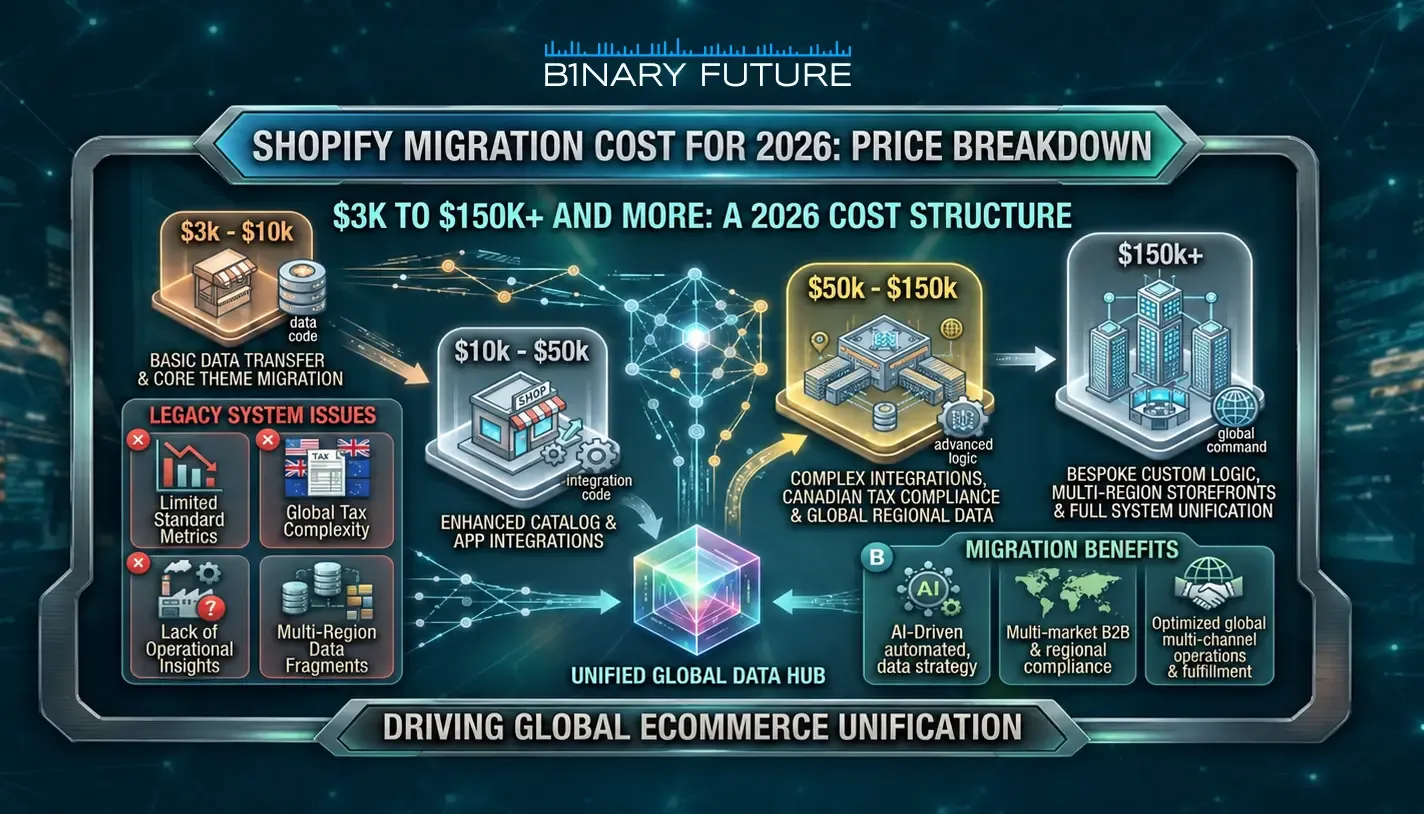
Migration types and indicative pricing
These are estimated ranges from our scoping practice, not a rate card. Every project we have quoted has moved within its range based on the factors above.
| Migration type | Main feature | Estimated range |
|---|---|---|
| Standard (small business) | Basic data transfer, configured premium theme | $2,000 to $7,500 |
| Advanced (mid-market) | Full SEO migration, custom features, marketing stack | $10,000 to $50,000 |
| Enterprise (Plus) | Complex APIs, ERP integration, B2B, multi-store | $80,000 to $150,000+ |
Standard level: quick start
For small stores moving from WooCommerce, Wix, or a similar platform. Data transfer plus a configured premium theme. This is the minimum viable entry into professional ecommerce, and with block-based themes it now covers more than it did a year ago.
Advanced level: growth focus
Where personalisation and marketing infrastructure enter the scope: customer segmentation, email and loyalty platforms, a full audit of site structure, and custom features the theme cannot express.
Enterprise level: scaling without limits
Built on Shopify Plus, and driven by ERP integration, B2B account structures, process automation, and multi-store across markets. One check worth doing before assuming this tier: since April 2026 native B2B works on every paid plan, so a wholesale requirement no longer automatically implies Plus. Where the line actually sits is in Shopify Plus vs Shopify, and current plan pricing on Shopify’s pricing page.
Hidden costs that are important to consider in your budget
Initial development is one part of the number. These are the lines that appear after the invoice.
Content cleaning and optimization
Outdated descriptions, unoptimised images, and inconsistent attributes slow the new store exactly as they slowed the old one. Cleaning before migration takes expert time and is the cheapest moment to do it, because doing it afterwards means doing it twice.
Apps and API costs
Shopify is an app ecosystem and app subscriptions compound. A mid-sized brand routinely pays more in monthly app fees than in plan fees. Count the stack you intend to keep, not the one you have, and cancel what the platform now does natively.
Training and change management
Your team needs time on the new platform. Written instructions and a workshop for administrators are a small line that prevents a large one, because a team that works around the system rather than with it produces data problems that surface months later.
From theory to implementation
Before signing anything, get an honest assessment of your data and your integrations, because that is where the range narrows. A quote produced without that assessment is a guess presented as a number. Timelines follow the same drivers and are broken down in the Shopify migration timeline. If you are budgeting a build rather than a move, the drivers differ and are covered in Shopify development cost. Binary Future scopes this work as Shopify migration services, and the enterprise tier as Shopify Plus development.