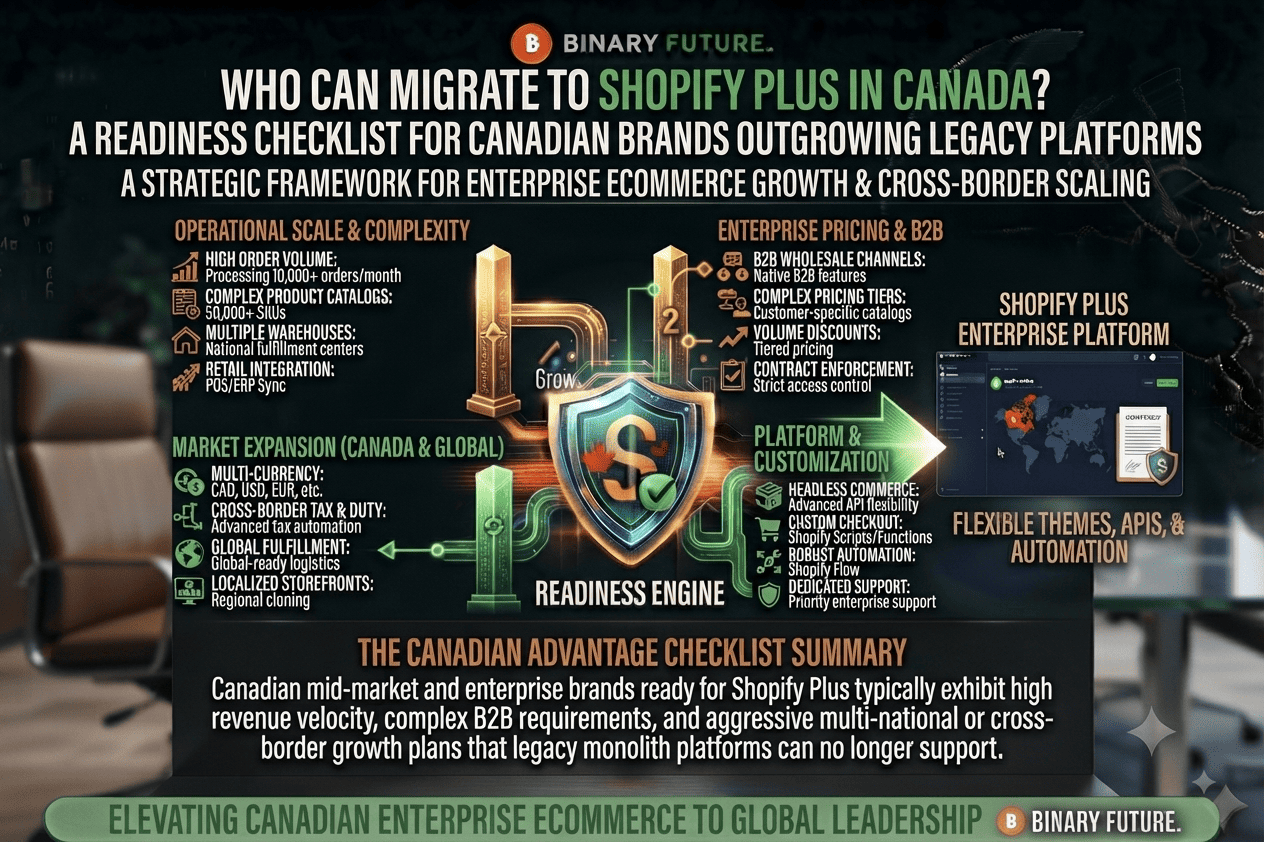
If your store is straining against its current platform, the question is not just whether you can move to Shopify Plus, but whether you are ready. This readiness checklist helps Canadian brands outgrowing legacy platforms decide if Shopify Plus is the right next step, across volume, technical, and operational signals specific to the Canadian market.
Outgrowing Your Tech Stack: Signs It’s Time to Move to Shopify Plus
Most brands do not decide to replatform; their current platform decides for them by failing in visible ways. The clearest signals that you have outgrown a legacy platform are these.
- Performance breaks under load. Your site slows or crashes during flash sales, peak season, or traffic spikes, costing revenue at the worst possible moment.
- Every change needs a developer. Routine updates, promotions, or new pages require custom code and long dev cycles, slowing your team to a crawl.
- Integrations are brittle. Connecting your ERP, PIM, or 3PL is held together with fragile custom code that breaks on every update.
- Rising maintenance and security cost. You are paying more each year for hosting, security patches, and developer retainers just to keep the lights on.
If two or more of these sound familiar, you have likely outgrown your platform. The next question is whether your volume, tech, and team metrics point specifically to Shopify Plus.
The Shopify Plus Readiness Framework: Volume, Tech, and Team Metrics
Shopify Plus is the enterprise tier, so readiness is best assessed across three dimensions. Use the table as a quick self-check; the more rows where you sit in the right column, the stronger the case.
| Dimension | Standard platform fits | Shopify Plus territory |
| Volume | Modest GMV, stable traffic | High GMV, traffic spikes, large or complex catalog |
| Technical | Off-the-shelf apps suffice | ERP, PIM, custom checkout, tax automation needed |
| Team | Small team, simple workflows | Multiple roles, staff accounts, approval workflows |
| Growth | Single market, one storefront | International, B2B, or multi-store expansion planned |
This framework is directional, not a hard gate. But if your brand lands in the right column on volume plus at least one of technical or growth, you are squarely in Shopify Plus territory.
Technical Checklist: ERPs, Canadian Tax Automation, and PIM Synchronization
The technical case for Shopify Plus usually comes down to integrations your current platform cannot sustain. Work through this checklist.
- ERP integration. Do you need real-time, bidirectional sync between your store and an ERP (NetSuite, SAP, Dynamics)? Shopify Plus supports this cleanly via API and middleware, where legacy platforms often rely on brittle connectors.
- PIM synchronization. If a large or complex catalog is managed in a PIM, you need reliable product-data sync into metafields and variants, not manual re-entry.
- Canadian tax automation. Do you sell across provinces with GST, HST, and PST, plus Quebec’s QST? You need destination-based tax applied per customer, configured correctly, not patched after launch.
- Custom checkout. Do you need checkout logic, B2B rules, or custom discounts beyond a standard plan? Shopify Functions and checkout extensibility on Plus enable this.
Each yes strengthens the Plus case. Two or more, especially ERP or tax, usually means a standard plan will keep fighting you.
Operational Checklist: International Expansion and Quebec Bill 96 Compliance
Beyond the technical, Shopify Plus readiness is also about where the business is going. Run this operational checklist.
- International expansion. Planning to sell across borders or run multiple regional storefronts? Plus supports multi-store and Shopify Markets for currencies, languages, and regional pricing.
- B2B and wholesale. Need company accounts, buyer-specific pricing, and self-service wholesale ordering? These are native Plus capabilities, not bolt-ons.
- Quebec Bill 96 compliance. Selling to Quebec means French content of equal quality to English across the storefront, checkout, support, and invoices, and the requirement reaches businesses outside Quebec. Plan this as a deliverable. Confirm specifics with a Quebec-qualified advisor.
- Team and workflow scale. Multiple staff accounts, roles, and approval workflows signal an organization that has outgrown a single-admin platform.
If your roadmap includes international, B2B, or selling into Quebec at scale, the operational case for Plus is usually decisive on its own.
Evaluating the Next Step: Partnering with a Certified Canadian Shopify Plus Agency
Readiness tells you Shopify Plus fits; a certified partner turns that into a safe migration. Binary Future is a Toronto-based Shopify Plus Partner that helps Canadian brands move off legacy platforms without losing data, rankings, or momentum.
- Readiness assessment. We validate your volume, technical, and operational signals against what Plus actually delivers, so you migrate for the right reasons.
- Canadian by default. Provincial tax, Quebec Bill 96, and local logistics are core scope, not afterthoughts discovered post-launch.
- Deep integration work. Proven ERP, PIM, and 3PL connections with real error handling, the heart of an enterprise migration.
- SEO and data integrity guaranteed. Full 301 redirect mapping and data validation on every migration, protecting the traffic and revenue you have built.
See our Shopify Plus development and Shopify migration services for how we move Canadian brands onto Plus.