Where Native Shopify Stops
Draft orders are the closest native thing to a quote, and they are genuinely useful. They are also a sales tool rather than a buyer tool, which is the whole distinction.
- What draft orders do. A staff member builds an order at a custom price, sends an invoice, and the buyer pays through a checkout link. Deposit fields are now exposed through the GraphQL Admin API and the Customer Account API.
- What they do not do. The buyer cannot open a request. There is no revision history, no approval step, no expiry date, and no way to compare version two against version four.
- What is Plus only. Deposits and partial payments, which is where made to order and freight heavy quoting usually lands.
- Why it matters. The manual route scales to about the point where one person stops remembering which price they last sent to whom.
If that description matches your operation, an app is not premature, it is overdue.
Three Routes, and What Each One Costs You
Choose the route first, then the vendor. Most bad quote projects are a vendor chosen before the route.
| Route | When it fits | Where it stops |
| Draft orders only | A few quotes a week, one person handling them | The buyer cannot start it, and nothing is versioned |
| A quote request app | Catalog wholesale with list prices and simple revisions | Configured products, freight, and ERP priced lines |
| A custom quote workflow | Quotes that depend on configuration, freight, or an ERP price | Nothing, but it carries an ownership and maintenance cost |
The middle row covers most Canadian catalog wholesalers. The third is a different kind of decision, closer to an integration project than a purchase.
What a Canadian Quote Has to Carry
These four turn a generic shortlist into a short one.
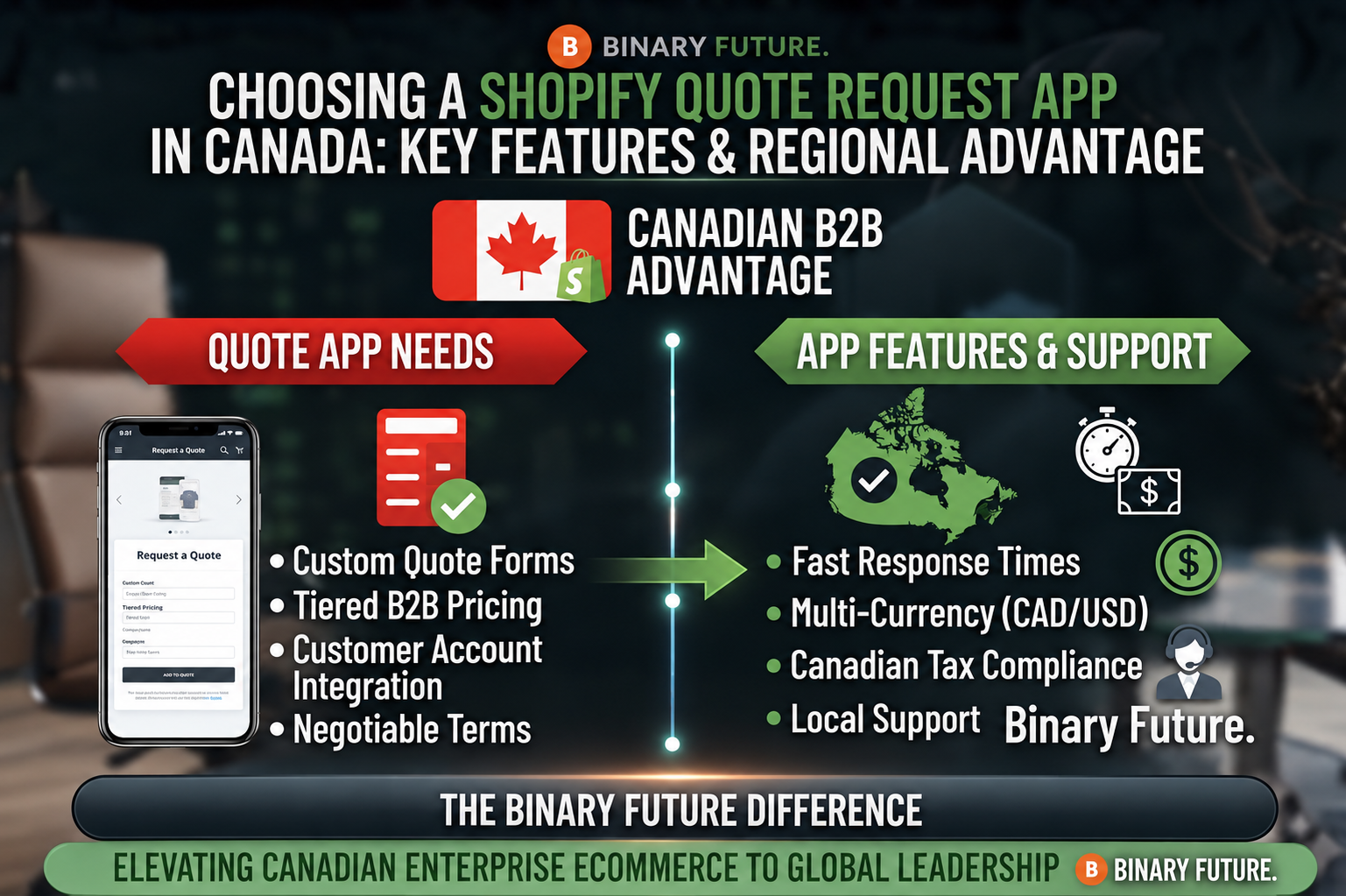
- Tax presentation. A quote to a business is normally shown before tax, with GST, HST, and PST applied by destination at checkout. Confirm the quote document states which, and how exemption certificates are handled.
- French quotes. A quote is a customer facing document. If you quote businesses in Quebec, the French version has to be of equal quality to the English, including the terms and the line item descriptions.
- Freight. Most wholesale quotes fail on freight, not on unit price. Ask whether the app can hold a freight line the rep sets manually, or only calculated rates.
- CAD and USD. If you quote in both, check that the currency is fixed at the moment of quoting rather than recalculated when the buyer accepts.
The last one causes the most arguments and appears in the fewest feature comparisons.
How to Compare Vendors Without Sitting Through a Demo
Five questions, answered in writing, will sort a shortlist faster than any trial.
- Who can start a quote? Only staff, only logged in company buyers, or anyone. This alone removes half the market.
- What happens to revisions? Whether version three exists as a record or simply overwrites version two.
- How does it become an order? Native B2B checkout with company terms applied, or a separate payment link that bypasses your catalogs.
- Where does the data live? Inside Shopify as metafields and draft orders, or in the vendor’s system, which decides what you keep if you leave.
- What does the buyer receive? Ask for a real sample PDF in both languages, not a screenshot from the marketing site.
The fourth question is the one nobody asks and the one that matters in year two.
Working with Binary Future on Quote Workflows
Binary Future is a Shopify Plus Partner agency in Toronto. We usually try the app route first and only recommend building when a real requirement breaks it, because a quote workflow you own is also a quote workflow you maintain.
When a build is right, it is normally because pricing comes from an ERP, freight is quoted per shipment, or the product is configured rather than picked, and at that point the project is about the integration rather than the form.
See our B2B Shopify development and custom Shopify app development for how we build wholesale ordering on Shopify.