Restaurant Acquisition Case Study: Mandraki
A Greek restaurant in Helsinki with no advertising history, where search and Maps produced 72% more booking clicks at 36% lower cost in a single month.
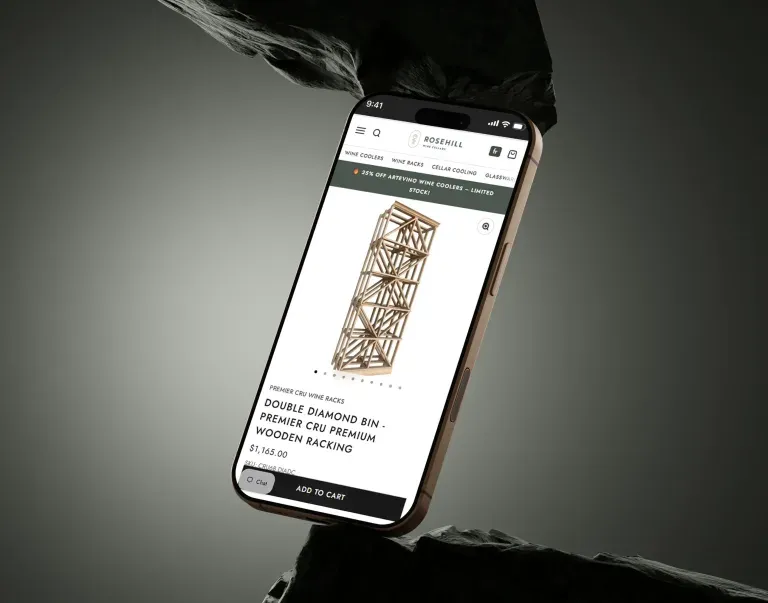
This case study covers a year of Meta advertising and conversion work for a North American retailer of premium wine storage, running two different customer journeys at once: direct online purchases and lead generation for custom cellar projects. The brief was not to rebuild a working account but to hold its performance while finding room to grow.
15.72x ROAS on dynamic remarketing and a 78% year-over-year rise in conversion rate
Rosehill Wine Cellars sells premium wine storage: racks, cooling systems, cabinets, and custom residential and commercial cellars.
Unlike a conventional e-commerce business, Rosehill runs two customer journeys side by side. One buyer adds a wine rack to a cart. Another is considering a custom cellar, a decision measured in months and in tens of thousands of dollars. The same advertising account has to serve both without letting either compromise the other.
The company already had an established digital presence and active campaigns when the engagement began. The challenge was to maintain that performance while finding scale, which is a different problem from building an account from scratch.
Rosehill Wine Cellars
Premium wine storage and luxury e-commerce
United States and Canada
Shopify
October 2025 to November 2026
Rosehill is a North American retailer of premium wine storage: racks, cooling systems and cabinets from the catalog, including lines such as Vantaggio coolers, alongside residential and commercial cellars designed and built to order. Custom cellar demand is geographic, concentrated in markets such as Florida and Ontario, while the catalog ships across the United States and Canada.
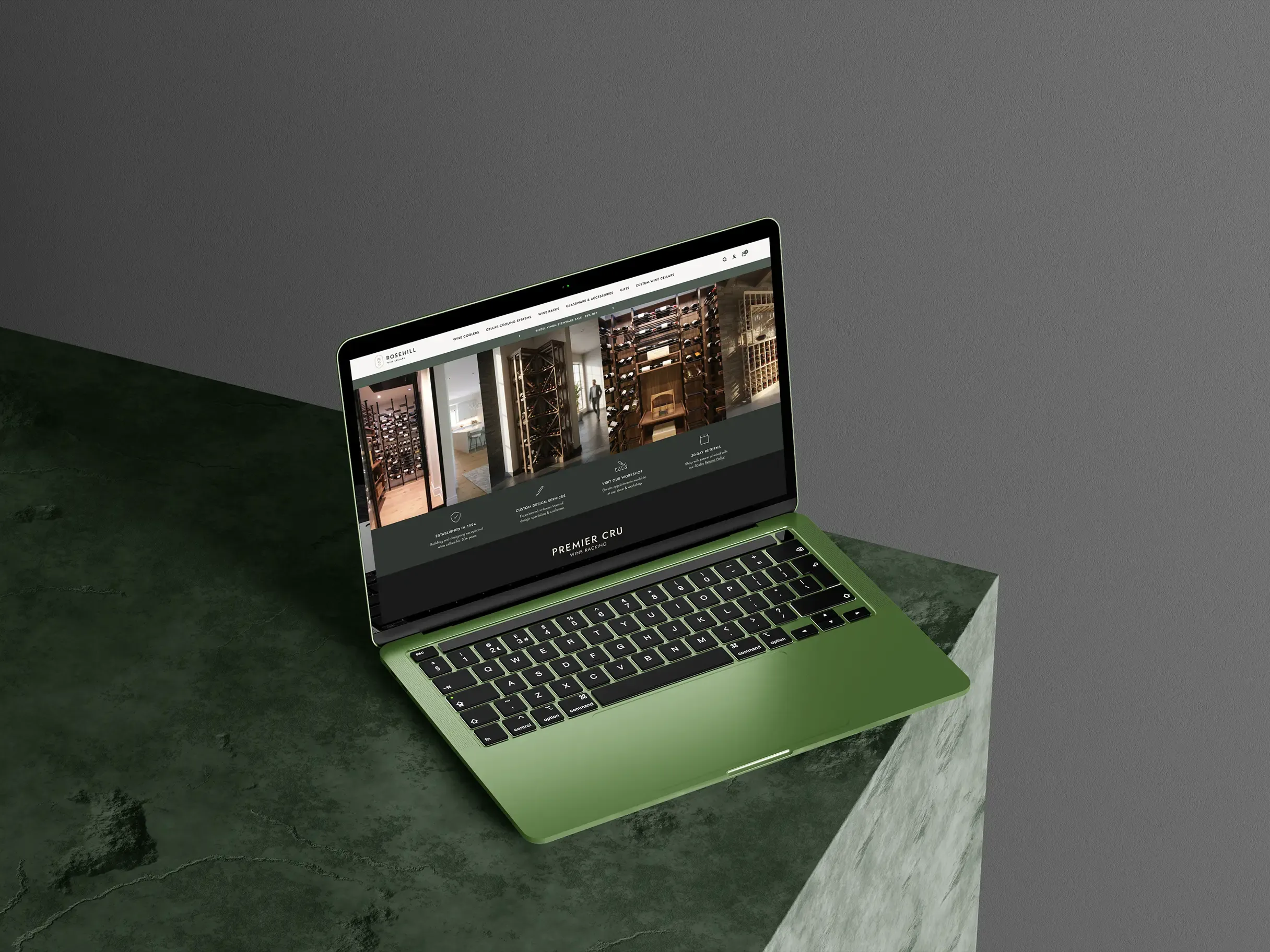
Racks, cooling systems and cabinets bought directly, a conventional e-commerce journey at a premium price point.
Residential and commercial buyers considering a bespoke project, reached through geographically targeted lead generation in markets including Florida and Ontario.
People who researched products and left, re-engaged through dynamic catalog remarketing rather than through fresh prospecting.
Scaling an account that already worked
The risk in an established account is that growth comes at the cost of the efficiency that made it work. Rebuilding was not the brief.
Two customer journeys in one account
A rack buyer and a custom cellar prospect behave differently, convert on different timescales and need different messages.
High-consideration purchases
Premium wine storage involves research and deliberation, so acquisition is only part of the equation and the first visit rarely closes.
Traffic declining while targets rose
Sessions fell 15% year over year, which meant growth had to come from conversion efficiency rather than volume.
Lead quality cannot be read from the platform
Form submissions are not qualified leads, and reporting them as such would overstate the result.
Two countries, different markets
US and Canadian campaigns needed their own targeting and messaging rather than one North American approach.
Optimise and extend rather than rebuild
Existing sales campaigns were maintained and improved, with new prospecting, product-specific and remarketing layers added around them.
Separate strategies for the two journeys
Sales campaigns for product purchases, geographically targeted lead generation for custom cellars, each with its own messaging.
Acquisition paired with conversion work
A CRO audit identified friction across the customer journey, and selected recommendations were implemented alongside continuing website development, so better traffic met a better site.
Meta advertising management across two markets
US and Canadian campaigns run against both e-commerce sales and lead generation objectives, combining established activity with new audience targeting and product-focused advertising.
Dynamic product catalog remarketing
The key addition, re-engaging audiences already familiar with the products and showing them relevant storage solutions further along their journey.
Geographic lead generation for custom cellars
Campaigns in selected US and Canadian markets, including Florida and Ontario, with messaging written for buyers considering a bespoke project rather than a product purchase.
Product-specific testing
Additional campaigns for selected categories including Vantaggio wine coolers, with audience strategies built around affluent homeowners, wine collectors, home renovation interests and premium interior investment.
CRO audit and implementation
Friction points and opportunities identified across the customer journey, with selected recommendations implemented as part of ongoing development.
Continuous website improvement
Functionality updates and customer experience enhancements introduced through the year, focused on converting incoming traffic rather than attracting more of it.
Letting the reservation book, not the ad account, set the priorities.
The headline number in most e-commerce case studies is more visitors. This one went the other way: sessions fell 15% year over year.
Everything still grew. Add-to-cart sessions rose 56%, sessions reaching checkout rose 40%, and completed checkout sessions rose 51%. Conversion rate moved from 0.39% to 0.70%, a 78% relative improvement.
A store serving 15% fewer people and completing 51% more purchases is a store that got better at its job rather than busier. That came from a year of website development, customer experience work and selected CRO recommendations, running alongside remarketing that reached people already considering a purchase. No single change accounts for it, which is the usual shape of real conversion improvement.

15.72x ROAS from dynamic product remarketing,
generating $283,411 in attributed purchase value from $18,031 in spend across 120 purchases.
78% higher conversion rate year over year,
from 0.39% to 0.70%, on 15% fewer sessions.
832 leads from the Florida residential cellar campaign at $14.44 each,
alongside 407 Ontario commercial leads and 101 Ontario residential leads.
281 purchases worth $251,333 from the core sales campaign
at 9.19x, with a smaller ISC campaign at 11.94x.
| Metric | 2025 | 2026 | Change |
|---|---|---|---|
|
Website sessions |
45,558 |
37,401 |
-15% |
|
Conversion rate |
0.39% |
0.70% |
+78% |
|
Sessions with add to cart |
651 |
980 |
+56% |
|
Sessions reaching checkout |
534 |
722 |
+40% |
|
Completed checkout sessions |
181 |
262 |
+51% |
|
Average cost per action |
4.03 euro |
3.90 euro |
-3% |
A premium e-commerce business where purchases involve research rather than impulse
A company running product sales and high-value lead generation through the same account
An established advertising operation looking for growth without a rebuild
A store whose traffic has plateaued, where the next gain has to come from conversion
Scaling premium e-commerce with Meta
Because it reaches people who already considered the product. The 15.72x figure comes from re-engaging audiences familiar with the catalog, while prospecting campaigns carry the cost of creating that familiarity in the first place. Both are needed; they should not be judged on the same scale.
Yes, with separate strategies. Here product sales campaigns and geographically targeted custom cellar lead generation ran side by side, each with its own audiences and messaging.
No. They are platform-reported form submissions. Qualification and closing happen on the client’s side, and the case study does not claim otherwise.
Because they measure different things. Sessions fell 15% while completed checkouts rose 51%, which means the site converted the people it did receive far more effectively after a year of development and CRO work.
Not on that evidence alone. The Vantaggio campaign’s figure comes from two purchases, which is too small a base to act on. It is reported for completeness, not as a result.