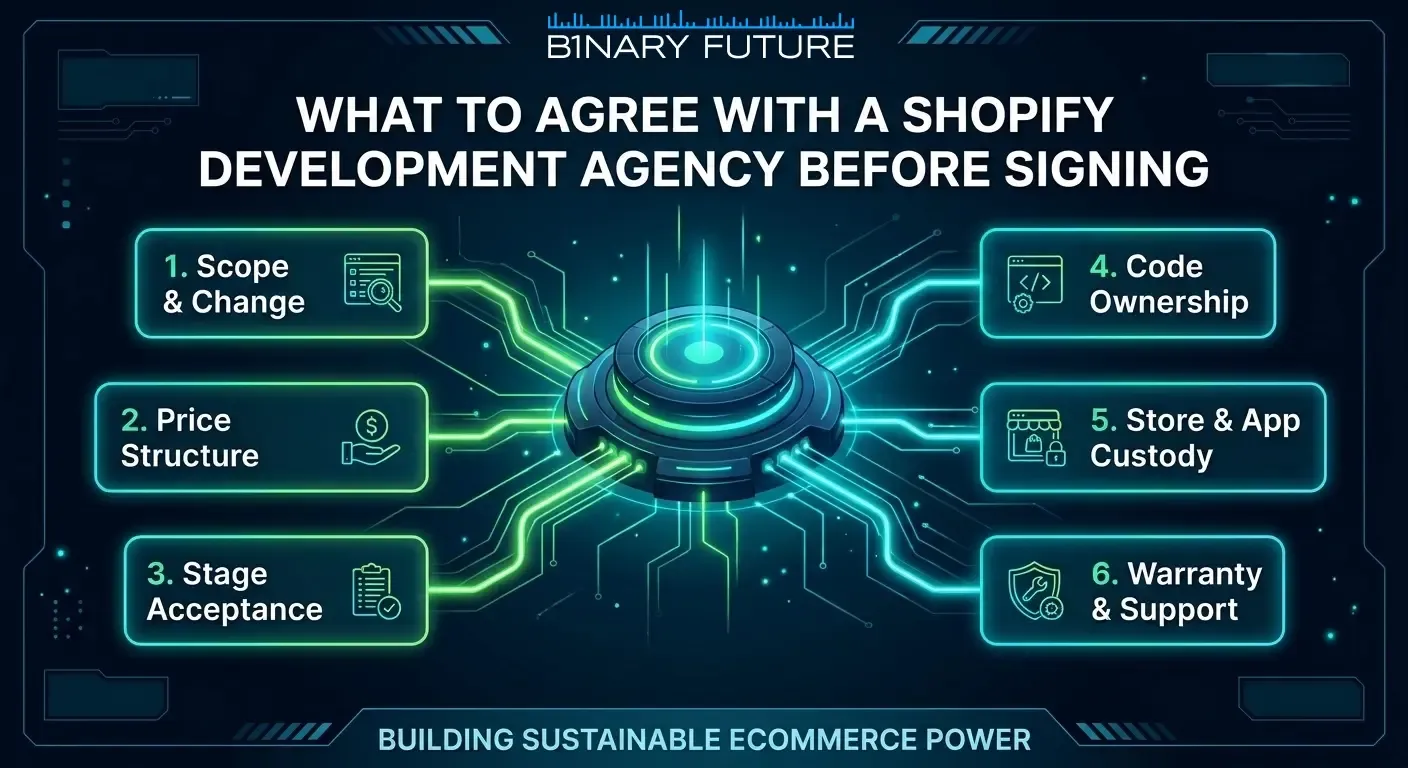
The Six Clauses, and What Bad Looks Like
None of these is unusual to ask for. All of them are cheaper to ask for before signing than after.
| What to agree | Why it matters | What bad looks like |
| Scope and the change procedure | Every later dispute is a scope dispute | A full redesign with no page list and no rate for additions |
| Price structure | It decides who absorbs the unknowns | A firm total from a brief, before anyone opened the store |
| Stage deliverables and acceptance | It ends the argument about whether it is finished | Milestones named development, and approval by feeling |
| Code ownership | It decides whether you are able to leave | A clause about the theme that says nothing about the app |
| Store and app custody | Since January 2026 the app lives in somebody’s organization | Nobody asks whose Dev Dashboard it was built in |
| Warranty and support | It is the part of the contract you will use most | Support available, with no response time and no rate |
Read the right column first. A proposal that fails three of those six is not a cheap proposal, it is an expensive one with the costs moved to the end.
Code Ownership Is Now Three Separate Questions
It used to be one question about the theme. Since January 2026 it is three, and agencies answer them very differently.
- The theme. Ask for the repository, the branch history and who holds deploy access on the last day of the engagement. A zip file sent by email is not a handover, it is a snapshot.
- The custom app. Admin created custom apps ended on January 1, 2026. A custom app is now built through the Dev Dashboard and the CLI, inside an organization, and whoever owns that organization controls the app’s identity, its credentials and its ability to be updated at all. Agree in writing that it is yours, and verify that before the final payment.
- The store itself. If the agency built on a client transfer store, handover is a procedure. Shopify Payments, Balance, Credit and Capital must be deactivated first or the transfer fails, the invitation expires after seven days, and a completed transfer ends the agency’s collaborator access unless you re-invite them. Put that date in the plan.
Two Dates That Belong in the Contract
Shopify published both of these. They are not opinions, and they outlive most engagements.
- March 1, 2027: script tags stop running. Apps have not been able to create or update script tags since October 1, 2026, and on March 1, 2027 existing ones stop running on storefront pages. Reviews, chat widgets, popups and tracking installed that way will go quiet. Ask for a warranty that nothing delivered depends on a script tag, and for an inventory of what already does.
- April 1, 2027: non expiring API tokens stop working. Admin API requests using them start returning a 403. Custom and merchant created apps are excluded from that change, but the third party apps your integrations lean on are not. Ask which of them have migrated.
- One clause covers both. A line stating that the delivered work uses currently supported Shopify APIs and extension points, and that anything deprecated inside the warranty period is corrected under warranty. Free to ask for before signing; the most expensive thing on this page to ask for afterwards.
Four Questions That Settle It in One Call
The answers are either specific or they are not, and that is the whole test.
- Who holds the organization our app is built in? The right answer names you, or names a transfer date.
- What is the acceptance test list? A real answer is a document you can read now, not a meeting you will have later.
- What is the response time in the first week after launch, and what does it cost? Launch week is when you need them most and when they are already staffing the next project. A number here beats a discount anywhere else.
- What happens to the work if we part company in month four? The answer tells you more about the contract than any clause you will read in it.
Binary Future is a Shopify partner agency in Toronto working with brands in the United States and Canada. Our scope documents, stage structure and handover list are described on the Shopify development services page, and the maintenance and support terms are written out rather than implied.