What You Are Actually Buying
The monthly figure is the least interesting line. These are the parts that differ.
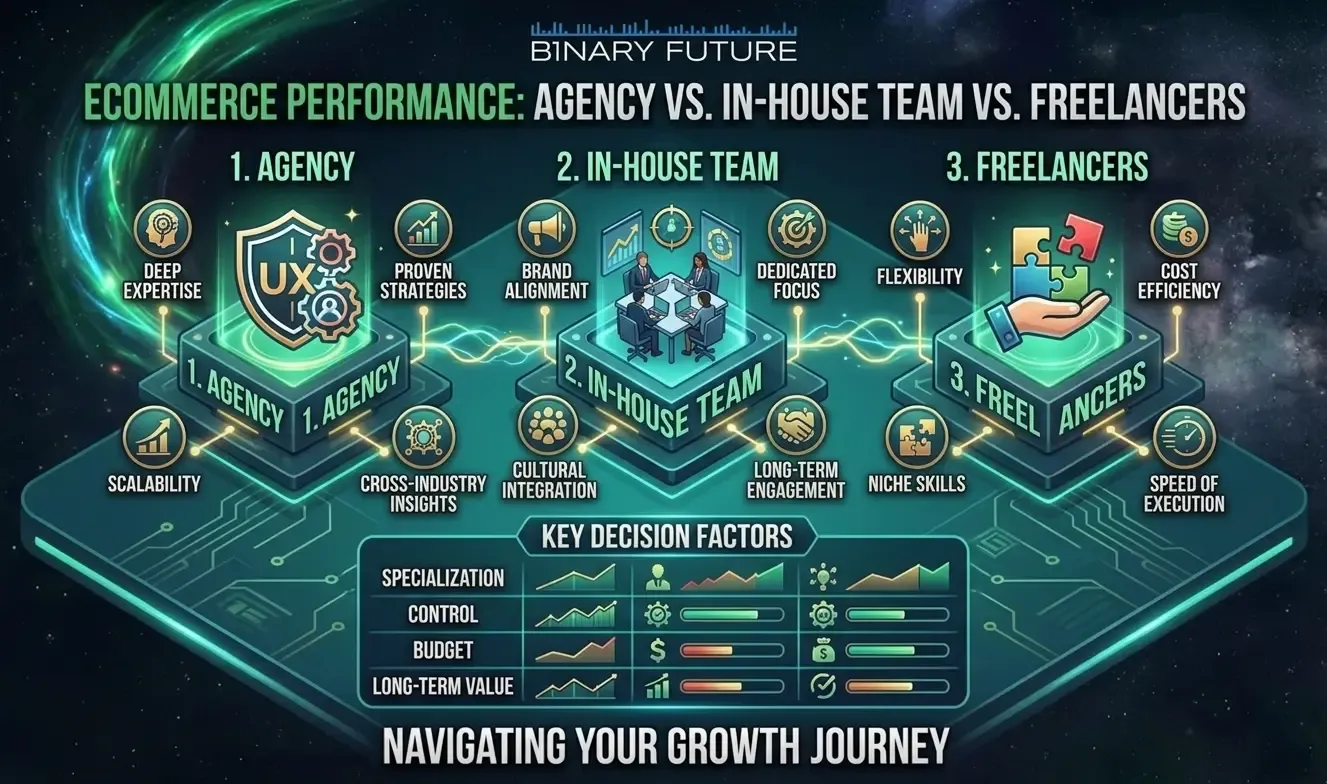
| Model | What you are buying | What stays unowned |
| Freelancers | Hours in one channel, at short notice | Everything between channels, and the channel when they are away |
| In-house team | Attention, context and loyalty | The disciplines you did not hire for, and the months spent hiring |
| Agency | Coverage across channels, a bench behind each | Priority: you share the team, so your context builds slower |
| Agency plus an in-house owner | Coverage with somebody inside to receive it | Nothing structural, which is why it costs most on paper |
The fourth row is what the setups that work tend to look like, and the most expensive on paper. It is the cheapest when the problem crosses three disciplines, because the alternative is paying twice and waiting in between.
The Cost That Is Not on the Invoice
Each model carries a cost that never reaches the comparison spreadsheet, and it is always larger than the rate difference.
- Hiring time. An in-house hire is a search, a notice period and a ramp. The channel does not pause while you run that, and nobody budgets the quarter it takes.
- Tooling and licences. The ad platforms are free. Analytics, testing, feed management and email are not, and an agency’s licences are already paid for by somebody else’s retainer.
- Management overhead. Freelancers need briefing, chasing and stitching together, weekly. That work lands on whoever in-house is least busy rather than on whoever is right for it.
- Coverage and single points of failure. One generalist cannot be deep in paid media, email, CRO and the store at once, and one specialist is a holiday away from a channel going dark. The cheapest looking model usually has the widest gap in it.
Who Is Accountable When a Number Drops
This is where the three models differ most, and 2026 handed every Shopify brand a live test of it.
- Scripts were deactivated on June 30, 2026. Shopify switched off every published Script, so discount and shipping logic stopped without producing an error anywhere. A freelancer booked for campaign work had no reason to look, and an in-house marketer saw only margin moving the wrong way.
- Checkouts were upgraded on August 26, 2026. Non-Plus stores were moved to the new checkout and legacy customizations were removed rather than migrated. Where purchase tracking lived in one of them, reported conversions fell while real orders did not. Whoever owns the ad account gets asked about a number that was never theirs.
- Script tags stop running on March 1, 2027. Apps have not been able to create or update script tags since October 1, 2026, and existing ones stop running on storefront pages on March 1, 2027. Reviews, chat widgets, popups and tracking installed that way will go quiet. That inventory is nobody’s job until somebody makes it theirs.
In all three cases the useful question is which party must notice, and how fast they must respond. That is contractual rather than technical, and it matters more than the model.
Choosing, One Question at a Time
Four questions, usually unambiguous once somebody says the answers out loud.
- Does one person inside your company own the growth number? If yes, freelancers and specialists work well, because somebody is standing in every handoff. If no, what you need to buy is coordination, not execution.
- How many disciplines does your bottleneck cross? One channel is a freelancer’s job and usually their best work. Paid media plus email plus a change in the theme is not a brief you can split across three people.
- Can you hire the specialist you need, and wait for them? If the channel is core and permanent and you can absorb a hiring cycle, in-house wins on context, loyalty and cost per hour. It loses on coverage, every time.
- What happens in the week nobody answers? A sale, a broken feed, a tracking break mid launch. Whichever model has a named person for that week is the one that survives a bad week.
Binary Future runs ecommerce marketing and Shopify development in one team, which is the fourth row of that table sold as a single contract: a finding in the ad data becomes a development ticket on the same roadmap. See our ecommerce marketing services and the Shopify development services they sit next to.