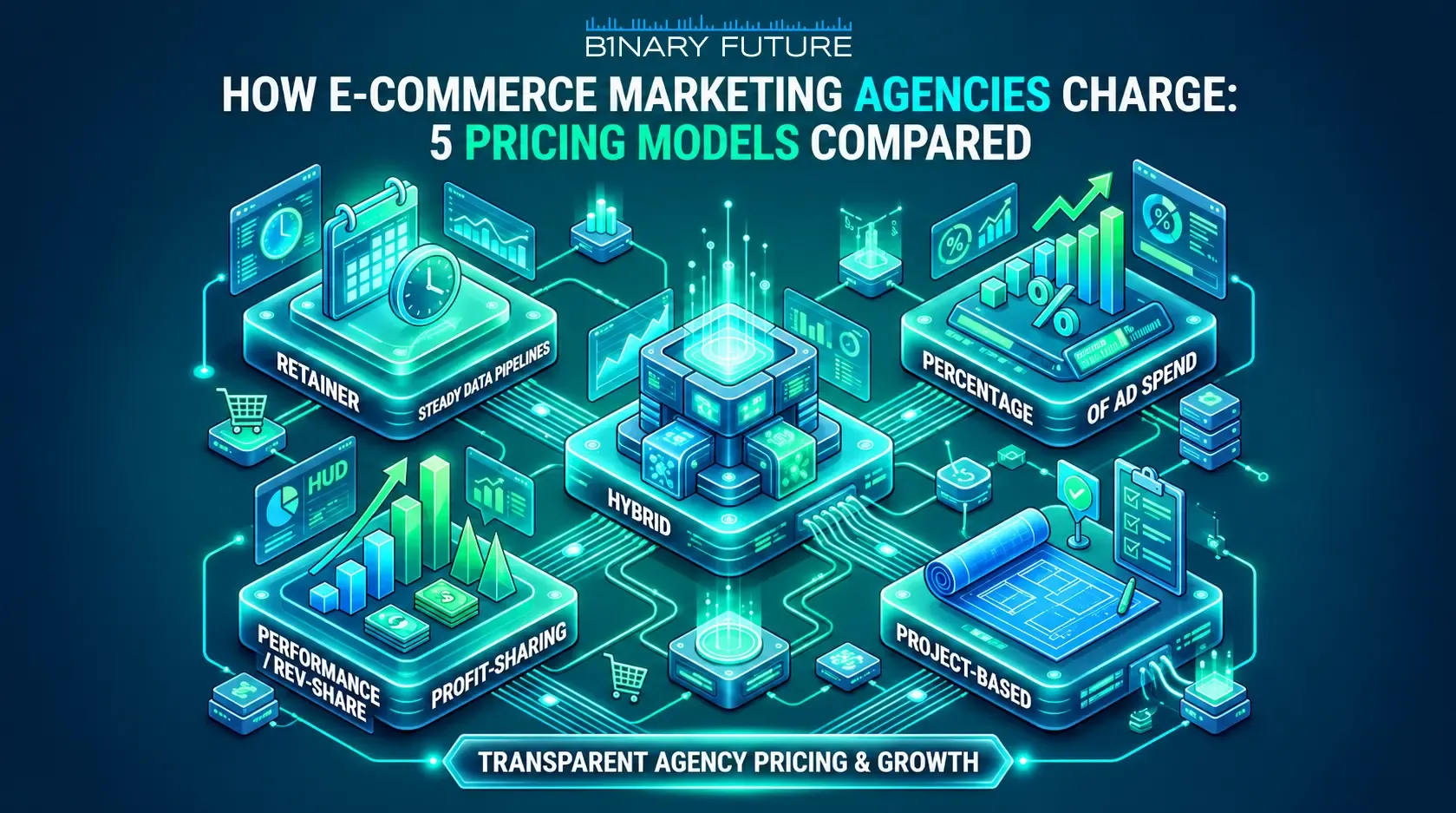
Five Models and What Each One Rewards
The fee level is a negotiation. The model decides behaviour, which is why it comes first.
| Model | What the agency is rewarded for | Where it breaks |
| Flat monthly retainer | Doing the agreed scope well | Scope creeps, or shrinks quietly when nobody reviews it |
| Percentage of ad spend | Managing larger budgets | Spending more is the easiest way to earn more |
| Project fee | Delivering a defined piece of work | It ends at handover, and nobody owns the result afterwards |
| Pay for performance | Hitting a revenue or acquisition target | It depends on attribution and on what counts as a sale |
| Base plus profit share | Growing the profit you keep | It needs your margin data and a fair baseline |
Most agencies combine two of these, and the combination is often more honest than either alone: a base that covers the work, and a variable part tied to an outcome the agency can influence.
The Incentive Inside Each Model
- Flat monthly retainer. The cleanest model for continuous work, and the easiest to stop reviewing. Ask for a visible backlog and a monthly report that names what shipped, or the retainer turns into a subscription you renew out of habit.
- Percentage of ad spend. Common in paid media, because spend works as a proxy for workload. The trouble is the direction of the proxy: a budget cut that improves your margin also cuts the agency’s fee. Pair it with a floor fee, or move to a flat fee once spend is stable.
- Project fee. Right for a job with an end: a channel launch, a feed rebuild, an email flow setup. It suits audits and builds, and suits ongoing optimisation badly, because the work that matters starts after the project closes.
- Pay for performance. Aligned on paper. In practice everything depends on what counts: orders a platform attributes, orders Shopify records, or new customers only. A fee on attributed revenue can pay out on sales that would have happened anyway, and a fee on revenue rewards discounts that raise volume while margin falls.
- Base plus profit share. The closest alignment available, because the agency earns more only when you keep more. It also asks the most of both sides: you share cost of goods and margin data, and you agree the baseline that growth is measured against. Without both, it is pay for performance under another name.
Where Performance Pricing Meets Your Tracking
Any fee tied to an outcome is only as accurate as the measurement under it, and 2026 tested that more than once.
- The August 26, 2026 checkout upgrade. Non-Plus Shopify stores were moved to the new checkout and legacy customizations were removed rather than migrated. Where purchase tracking lived in one of them, platform-reported conversions fell while orders did not. A fee calculated on platform data fell with them, and a fee measured after the tracking was repaired would have jumped with no new sales behind it.
- Attribution overlap. Google, Meta and email each claim the same order in their own reports, so a performance fee per channel can pay several times for one sale. Calculate outcome fees from Shopify’s records, not from each platform’s reporting.
- Discounts and returns. Agree whether revenue is gross or net of discounts and returns before the first month. That definition decides whether a sale event earns the agency a bonus or costs you margin.
Choosing the Model in Four Questions
- Is the work continuous, or does it have an end? Continuous work suggests a retainer or a base fee; work with an end suggests a project fee.
- Can the agency see your margin? If not, any outcome fee will be tied to revenue, and the discount problem comes with it.
- Who controls the levers? An agency paid on conversion rate needs to be able to change the store, or its target depends on a team it does not manage.
- What is the exit? A notice period, ownership of the ad accounts and data, and how a variable fee is settled in the final month.
Binary Future is an ecommerce marketing agency and a Shopify development team in one, so a target tied to conversion rate sits with the people who can change the checkout as well as the campaign. Development work is priced on different logic; the pricing section of how to choose a Shopify agency covers it.