Fix These Three Things First
Advertising a store that is not ready fails expensively, and it looks like a channel problem.
- Purchase tracking. Non-Plus stores moved to the new checkout on August 26, 2026, and legacy checkout customizations were removed rather than migrated. Where conversion tracking lived in one, your platforms have been under-reporting since. Place a test order and confirm it lands in Google Ads, Meta and analytics before you raise a bid.
- The product feed. Prices, availability and identifiers have to match the store, item by item. A feed with disapprovals quietly concentrates the budget on whatever still qualifies, which is rarely what you wanted to sell.
- The page the money lands on. Paid traffic lands on a product page, not a homepage. Fix that page first: load speed, first screen, price, shipping promise, add to cart. Smaller than a redesign, and it improves every channel.
Which Channel Buys What
Channels are not better or worse than each other. They buy different things, and one of them is free.
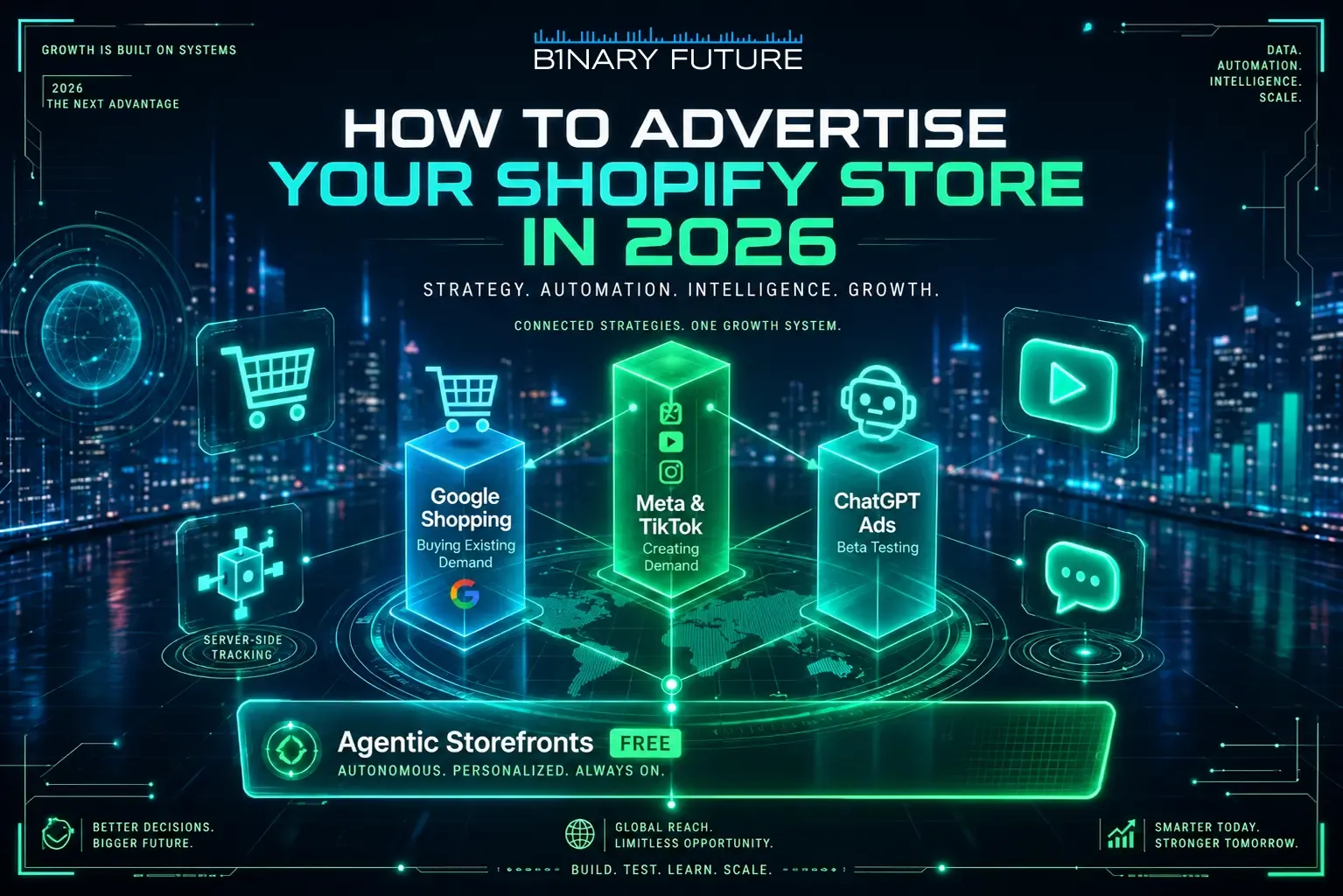
| Channel | What it buys | What it needs from you |
| Google Shopping and Performance Max | Demand that already exists, at the moment of search | A clean feed and accurate prices; it cannot invent interest |
| Meta, Facebook and Instagram | Interest in something nobody was looking for | Creative volume, and a product that photographs well |
| TikTok | Attention from a cold audience, at the price of patience | Native video made for the platform, not an ad reused |
| ChatGPT ads | Reach among Free and Go tier users only | A very short headline, one image, tolerance for a beta |
| Agentic storefronts | Nothing: the channel is free and already on | Product data and policies an AI agent can read correctly |
The last row is the one to do this week. Agentic storefronts is active by default for eligible stores and puts your products in front of shoppers in ChatGPT, Google AI Mode and Gemini, Microsoft Copilot and Meta, with the ChatGPT buyer finishing on your own checkout. Manage it under Sales channels, Agentic. Nobody is bidding against you yet.
What ChatGPT Ads Actually Are Right Now
This is the channel every founder asks about, so here is its state rather than the forecast.
- Who sees them. Testing began on February 9, 2026. Ads reach logged in adults on the Free and Go tiers only; Plus, Pro and Business users see none. Delivery covers the United States, Canada, Australia and New Zealand.
- How you buy. The self serve Ads Manager beta opened to US businesses on May 5, 2026, with two objectives: Reach billed on impressions and Clicks billed per click. OpenAI’s own starting guidance for Clicks is a maximum bid of three to five dollars. There are no keywords: you write natural language context hints at ad group level.
- Creative control changed in October. From October 30, 2026 creative enhancements are on by default: OpenAI can rewrite your headline and description, resize images, translate copy and change the destination URL, with no per version approval. The toggle is in Ads Manager settings.
- Where it will not run. Ads stay away from sensitive and regulated subjects, health among them. If you sell supplements or skincare with claims, assume much of the audience is out of scope.
Setting the Budget From Your Own Numbers
Published starting budgets are other people’s margins. This is the arithmetic for yours.
- Work out what one order is allowed to cost. Your conversion rate and average order value decide what a click can be worth. Gross margin per order, minus what the business must keep, is your ceiling on cost per acquisition. Above that line, scale makes the problem bigger.
- Buy enough data to optimize on. Automated bidding needs a minimum volume of conversion events before it stabilizes. Multiply those conversions by your ceiling and that is the test budget. If the figure is uncomfortable, the channel is too expensive for your margin, not underfunded.
- Fund the learning period on purpose. The first weeks buy information, not orders. Decide in advance how long you pay for that and which result ends the test, or it ends on a feeling in week three.
Binary Future runs paid media and Shopify development in one team, so a tracking break found in the ad data becomes a development ticket rather than a note to another vendor. See how to advertise a Shopify store and the wider ecommerce marketing services it belongs to.