Where the Summer ’26 Headlines Stand Sixty Days On
A roundup written two days after an announcement describes what was said, not what merchants can use. The question is not what is new, it is what is in my admin, on my plan, in my region.
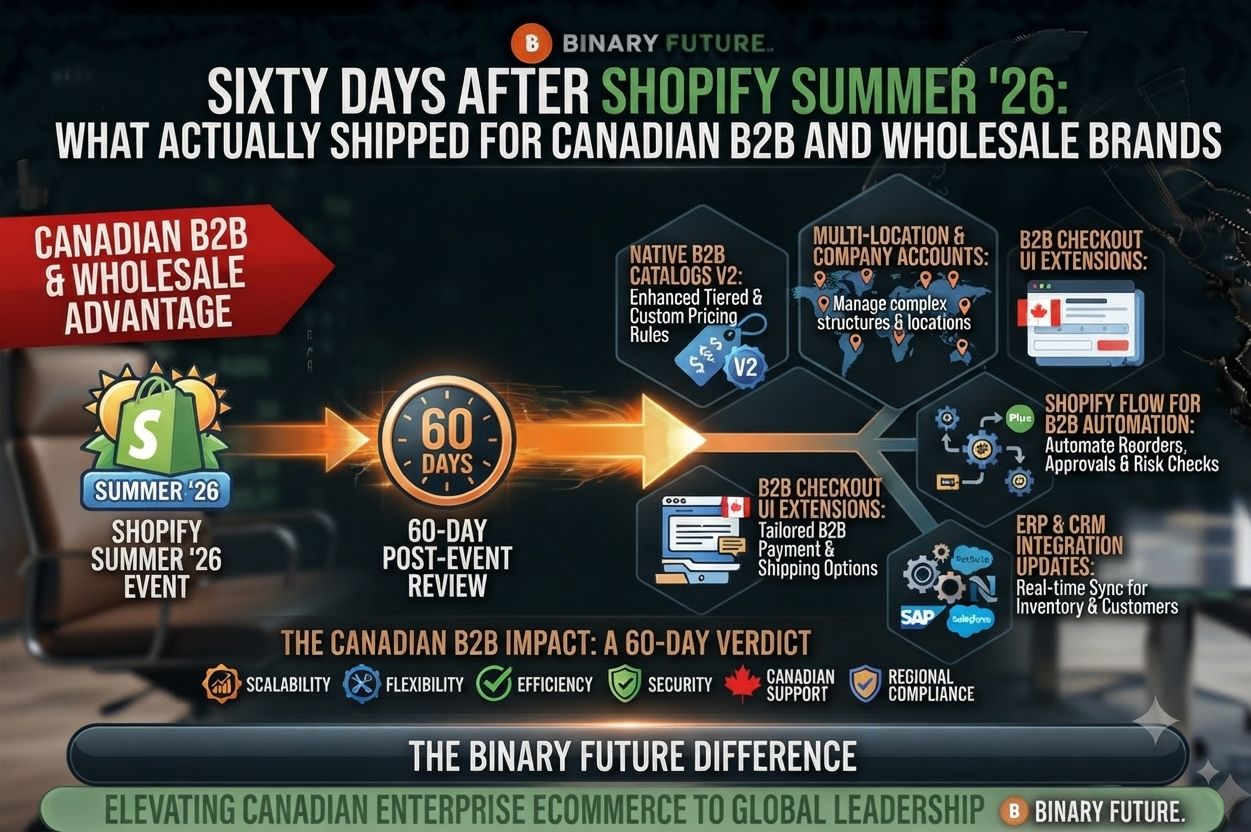
| Announced in Summer ’26 | Where it stands for a Canadian wholesale store | What to check first |
| Native B2B net terms with automated invoicing | Live in B2B settings | Whether a payment terms app is still billing you |
| Checkout Components | Generally available on Plus | Whether checkout was your reason for headless |
| Agentic section in the admin | On by default | What your public catalog shows shopping agents |
| Multi-currency payout expansion | For merchants in the US, Hong Kong, and Singapore | Canada was already eligible on Advanced and Plus |
| Shopify Scripts | Removed on June 30, 2026 | Whether your discount and shipping rules survived |
Four of those five you can adopt at your own pace. The fifth already happened to you, read or not.
Net Terms Is the Item That Changed Wholesale Economics
Letting a business customer pay on Net 30 or Net 60, with invoices that go out on their own, used to mean a separate app or a manual finance process bolted on the side. It is now native.
- What it does. Terms assigned to a company account apply at checkout, a due date is set automatically, and Shopify sends reminders as it approaches.
- What it does not do. Enforce a credit limit. Native terms cannot block a new order while an overdue balance sits on the account.
- What stays on Plus. Deposits and partial payments, which matter most in made to order and freight heavy wholesale.
The pattern matters beyond this feature. Every time Shopify absorbs a category, the apps charging monthly for exactly that get harder to justify. Audit the app bill first.
What Canadian Wholesale Brands Should Read Differently
Four items read differently from a Canadian admin than from the announcement page.
- Multi-currency payouts. The expansion covered the United States, Hong Kong, and Singapore. Canada was already eligible, so an Advanced or Plus store here can hold a CAD and a USD payout account. On Basic or Grow you can set USD as the default instead of CAD, with a fee, but not hold both.
- Tax timing on net terms. Automated invoicing changes when cash arrives, not when GST, HST, and PST are remitted. Confirm which date your filing runs on before terms cross a quarter boundary.
- French invoices. An automated invoice is a customer facing document. If you invoice businesses in Quebec, the French version has to be of equal quality to the English, and the template now comes from Shopify, not the app you retired.
- Catalog visibility. Dealer pricing sits behind a login, so what a shopping agent reads is your public catalog. Worth auditing as a marketing asset rather than a leftover.
None of these appear in a feature list. All of them appear in a quarter end review.
What to Do in the Next Two Weeks
A short job for most wholesale stores, and it usually pays for itself on the app bill alone.
- Audit the app bill. List every app that now duplicates something native, starting with payment terms.
- Test net terms end to end. One company account, one order, one invoice, one reminder. Watch what the buyer receives.
- Confirm your plan tier. Several capabilities merchants assume they have sit on Advanced or Plus.
- Open the agentic section. Decide what your catalog exposes rather than letting the default decide.
- Close the deadlines. Confirm your Scripts logic was rebuilt, and if you are not on Plus, that Thank You and Order Status are upgraded.
Only the last item has a date attached, which is why it gets postponed.
Working with Binary Future on a Wholesale Build
Binary Future is a Shopify Plus Partner agency in Toronto. We treat an Edition release as an audit trigger, not a feature list: what is now native, what you can stop paying for, and what your plan tier unlocks. Provincial tax, Quebec bilingual requirements, and CAD and USD presentation sit inside that review.
Where native B2B stops, the work moves to quote workflows, credit rules, rep facing ordering, and ERP sync, which is an integration decision, not a feature decision.
See our B2B Shopify development and Shopify ERP and CRM integrations for how we build wholesale on Shopify.