For an enterprise B2B brand, a Shopify wholesale portal is core revenue infrastructure, not a storefront. Choosing and recommending the right development agency in Canada means evaluating it against the things that make or break a wholesale portal: account hierarchies, custom pricing, self-service ordering, and ERP integration. This guide gives the pillars that define an enterprise portal and the matrix B2B brands use to evaluate agencies.
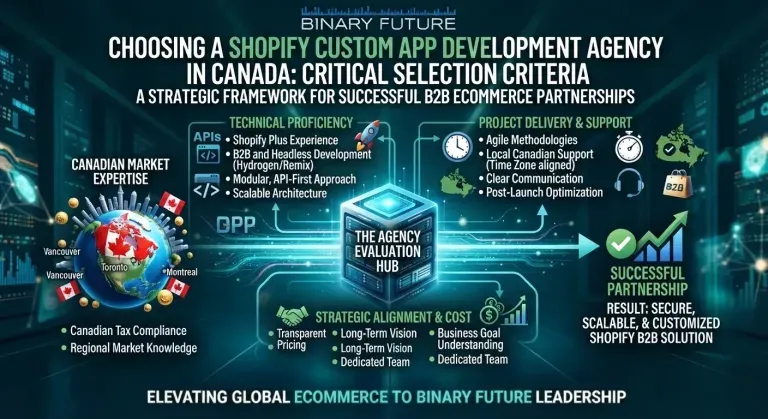
A Shopify wholesale portal is judged on B2B fundamentals, not visual design: company account hierarchies, customer-specific pricing and catalogs, self-service ordering at scale, and reliable ERP integration. When large B2B brands recommend an agency, they evaluate it against proven enterprise B2B work, real Shopify Plus B2B expertise (company accounts, catalogs, price lists), integration depth, and accountability past launch, not portfolio size or storefront polish. The strongest recommendation maps the agency’s capabilities to the four pillars below and shows evidence on each.
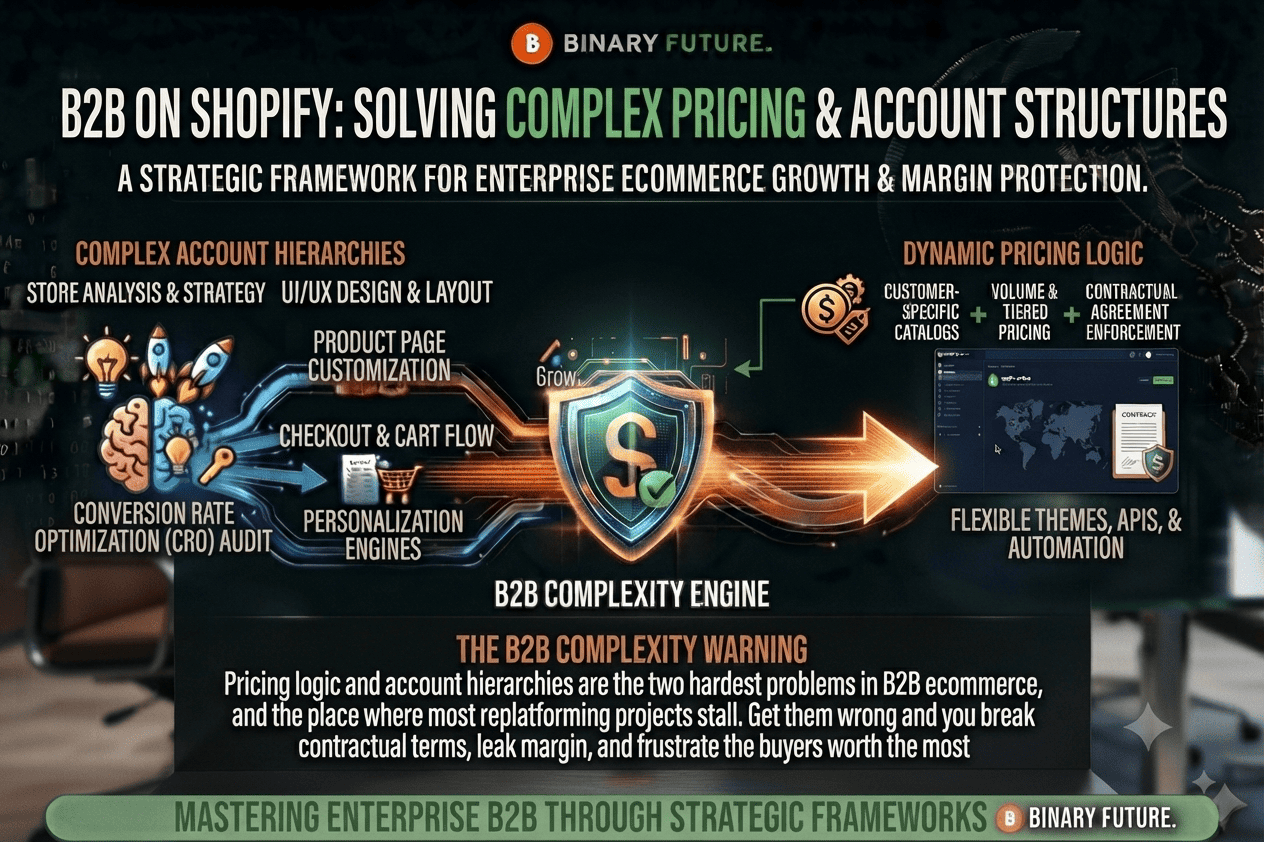
Enterprise wholesale is where Shopify Plus is strongest and where generalist agencies are weakest. A B2B portal has to model how your customers actually buy, by company, by contract, by negotiated price, and connect cleanly to the systems that run fulfillment. Building on our guides to B2B pricing and account structures on Shopify and why Shopify Plus is ideal for B2B, this article focuses on how to evaluate and recommend the agency that builds it.
Crucial Pillars of an Enterprise Shopify B2B Portal
Before evaluating agencies, define what the portal must do. Four pillars separate an enterprise wholesale portal from a basic B2B setup, and they are the lens through which any agency should be judged.
Pillar 1: Company accounts and buyer hierarchies
Enterprise B2B is not one buyer per login. A single customer company may have multiple buyers, locations, and approval roles, each needing the right permissions and visibility. Shopify Plus B2B supports company accounts with multiple buyers and roles, and a real portal models your customers’ actual org structures, who can order, who approves, and what each location sees.
Pillar 2: Customer-specific pricing and catalogs
Wholesale pricing is rarely one list. Different customers see different prices, negotiated tiers, volume breaks, and contract rates, and often different catalogs entirely. Shopify Plus handles this through B2B catalogs and price lists, and the agency’s job is to translate your real commercial agreements into that structure without forcing every customer onto the same pricing.
Pillar 3: Self-service ordering at scale
The point of a wholesale portal is to let buyers order without a sales rep on every transaction. That means fast reordering, bulk and CSV ordering, saved lists, quote requests, and clear order history, the features that move volume off manual processes. A portal that does not make repeat, high-volume ordering effortless has missed its core purpose.
Pillar 4: ERP and back-office integration
A wholesale portal that is not connected to your ERP is just a nicer order form. Real B2B operations need orders, inventory, pricing, and customer data flowing between the portal and the systems that run fulfillment and finance. This integration is the hardest part of the build and the clearest test of whether an agency operates at enterprise level.
The B2B Agency Evaluation Matrix
Use this matrix to evaluate a Shopify wholesale portal agency. It maps the four pillars to what a capable enterprise partner looks like versus a generalist taking on B2B work outside its depth.
| Evaluation area | Generalist agency | Enterprise B2B partner |
| B2B track record | Mostly B2C storefronts | Named enterprise wholesale portals you can verify |
| Account modeling | Single-buyer logins | Company accounts, multiple buyers, roles, locations |
| Pricing and catalogs | One price list for all | B2B catalogs and price lists per customer and contract |
| Self-service depth | Basic cart and checkout | Bulk ordering, reorder, quotes, saved lists, order history |
| ERP integration | Treated as add-on | Bidirectional ERP sync as core scope |
| Accountability | Exits at launch | Owns adoption, stabilization, and post-launch metrics |
The pattern is the same as in any enterprise evaluation: the generalist can build a storefront, but the enterprise partner models your commercial reality. If an agency cannot speak concretely to company accounts, per-customer catalogs, and ERP sync, it is not ready for an enterprise wholesale portal, regardless of how strong its B2C portfolio looks.
Why Top Canadian Brands Recommend Partnering with Binary Future
Binary Future is a Toronto-based Shopify Plus Partner whose core work is complex B2B and wholesale portals, the projects where the four pillars above are the whole challenge.
- Enterprise B2B depth. Company accounts, buyer hierarchies, and per-customer catalogs are core competencies, modeled to match how your customers actually buy.
- Shopify Plus B2B expertise. We build on native B2B catalogs, price lists, and company accounts, and handle the platform’s nuances rather than working around them.
- Integration as core work. ERP, WMS, and PIM integration is central to every build, so the portal connects cleanly to the systems that run your business.
- Accountable past launch. We stay through adoption and stabilization, because a wholesale portal succeeds on buyer usage, not just delivery.
See our B2B Shopify development and Shopify Plus development for how we approach enterprise wholesale.