Shopify Supplier Integration Case Study: Menvaraosat
Around a million products from six suppliers in one store, with VIN-based part lookup and a platform limit of a thousand products a day.
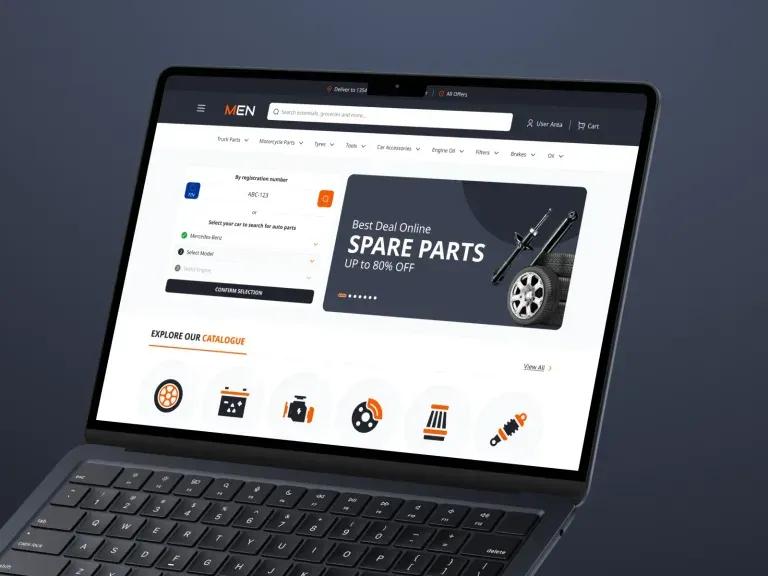
This case study covers a Finnish auto parts store the team rebuilt and has kept developing for several years. Six suppliers, around a million products loaded and roughly three million more queued, part lookup by VIN and by vehicle tree, four in-house backend applications, and all of it inside the limits of a standard Shopify plan.
~1M products from 6 suppliers in a single store
Menvaraosat sells auto parts in Finland to two audiences at once: businesses in the automotive trade and ordinary car owners. The first group needs volume and exact part numbers. The second needs a way to find a part without knowing what it is called.
The client had a store, but it looked different and read worse. The team rebuilt it from the ground up, with designers producing a new look and the site built from scratch.
The original request sounded simpler than it turned out to be: connect several auto parts suppliers.
The first held around 50,000 products, the second around 500,000, and both delivered data over FTP. Over several years that task grew into continuous architecture work that is still going.
Menvaraosat
E-commerce, auto parts, selling to businesses and private customers
Finland
Shopify
The client is a representative of Inter Cars, one of the large European auto parts distributors.
Team: project manager, tech lead, business analyst, one to two backend developers, one to two frontend developers, one to two designers, and a marketer. Composition changed as the project grew.
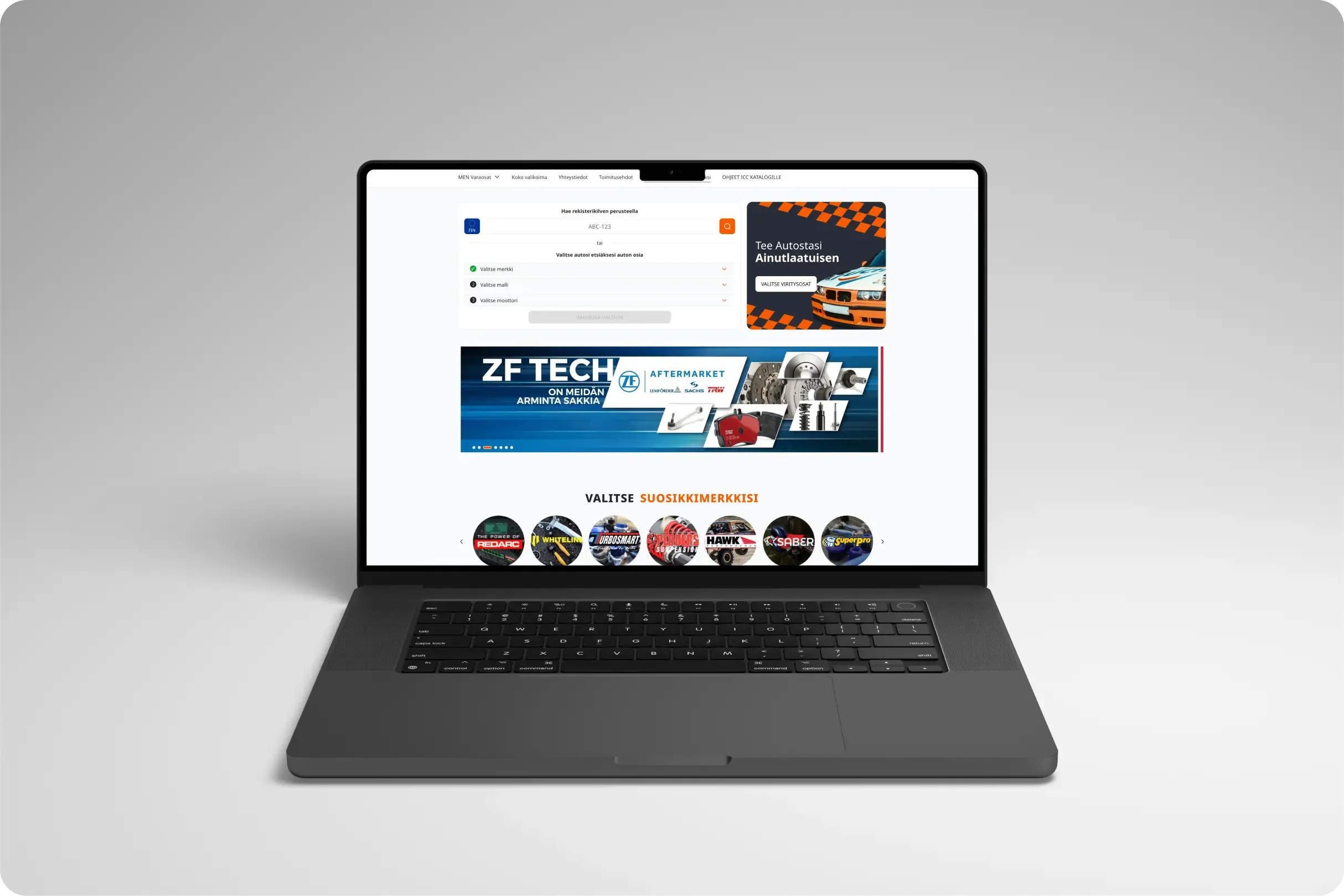
Workshops and retailers who need catalog depth and lookup by original and aftermarket part numbers.
Looking for a part for their own vehicle without knowing its number, through VIN or by picking make and model.
A separate segment with its own supplier and its own module in the system.
A catalog that does not fit the plan
Around a million products loaded, roughly three million more queued. The client’s budget rules out Shopify Plus, and the current plan allows loading roughly a thousand products a day.
Six suppliers, different protocols
Some deliver over FTP, others through APIs. Each has its own format, its own fields and its own update cadence for prices and stock.
A product with no image and no description does not sell
Some items arrive from suppliers without pictures, sometimes without descriptions. To a search engine such a product barely exists.
Warehouses in several countries
Inter Cars stock sits in warehouses across Europe, and a buyer in Finland needs to see where a part ships from and how many days that takes.
Categories without a count
Requests go directly to the TecDoc database, so there is no way to know in advance how many products from a returned category actually exist in the store.
Two ways to search for one part
A professional searches by number, a private owner searches by car. Both routes have to arrive at the same result.
How our team worked
FTP synchronization app
The first of four in-house applications handles products from suppliers delivering over FTP, tying prices and stock to the store and refreshing them as the supplier updates them.
Product data and filters app
The second application synchronizes images and descriptions and retrieves filters by TecDoc part categories.
Tuning parts app
The third application synchronizes products from a separate tuning supplier through its own API.
Inter Cars app
The fourth application works with the Inter Cars API, a supplier previously connected over FTP. All available product information now comes through directly.
Warehouse and delivery time display
For Inter Cars products the page shows the warehouse, and delivery days are calculated from how far that warehouse is. A part from a Polish warehouse takes longer to reach Finland than one nearby, and the buyer sees that before purchase.
Lookup by VIN and by vehicle tree
Users search by original part number, by aftermarket number, by VIN, or pick the vehicle manually through a form. That opens a page with categories and filters where vehicle data is pulled from TecDoc.
Lazy variant creation
For Inter Cars products, variants are not created upfront but when the product page is first visited: the visit triggers a request and the variants are added. Listings show previews in the meantime. This keeps the catalog from hitting the daily creation limit.
We rejected Convermax
The third-party service was used in the first stage to populate categories and product information from the TecDoc database. The reason for rejecting it: interaction complexity, and the absence of a timely response from the service’s team to critical problems with their functionality. Depending on someone else’s response time cost more than building it in-house.
We chose a direct TecDoc connection
The team built an architecture connecting the TecDoc API directly to the store, with logic assembled to the client’s requirements. Response time to problems stopped depending on a third party.
A million products on a plan not built for a million products.
A catalog this size usually comes with the words “we moved to Plus”. That did not happen here: the client’s budget is fixed, and the upgrade was never on the table. So a million items, with three million more queued, had to fit inside a limit of roughly a thousand products a day.
The answer was four applications, each with its own protocol and schedule, plus deferred variant creation.
Product variants take no catalog space until someone opens the page. While nobody is looking at an item, it exists as a preview and spends none of the daily allowance.
This is honestly a compromise rather than a victory over the platform. But it is what let the project keep growing inside the budget the client has, rather than stalling against a tier he does not.
Around a million products
loaded into the store, with roughly three million more planned.
Six suppliers
connected at once, including distributors, direct manufacturers and a dedicated tuning supplier.
Four in-house applications
handle synchronization, each for its own source and protocol.
Two entry points into the catalog for two audiences:
part number for professionals, VIN or make and model for private owners.
Delivery times visible before purchase
for stock held in warehouses across several countries.
The client brought several other projects to the company
That result comes not from features but from how the work is run: specialists consistently available and communication that stays predictable.
Moving external data into an owned database. The architecture is being restructured, with data moving to a dedicated server at Hetzner. This will make filters load faster and, more importantly, allow showing only categories that actually hold products in the store, with a product count next to each.
Filling product pages with an AI model.Some products arrive from TecDoc and Inter Cars without images and sometimes without descriptions. A generative model is planned to give those pages the structure and imagery without which search engines effectively cannot see them and the marketer cannot promote them.
A store with hundreds of thousands or millions of items, growing faster than its platform tier allows
A distributor or retailer with several suppliers on different exchange protocols
A business selling parts with complex fitment, where the buyer needs to match an item to a specific object rather than pick from a list
A company working with warehouses in several countries, where delivery time depends on where the item ships from
VIN Search and Million-Product Catalogs
Through the vehicle’s VIN or by selecting make and model in a form. That opens a page with categories and filters where vehicle data is pulled from the TecDoc database.
Through a separate application per source type. There are currently four: for FTP suppliers, for TecDoc product data and filters, for the tuning supplier, and for the Inter Cars API.
It can, with limits on loading speed. This project has roughly a thousand products a day available, so product variants are created on demand at first page visit rather than all at once.
Yes. For stock held in different countries, the product page shows the warehouse and the calculated number of delivery days.