What Is Shopify?
Shopify is a hosted ecommerce platform covering everything from a first product to substantial volume without touching servers. As listed on Shopify’s pricing page in August 2026, the paid store plans are:
- Basic, 39 USD a month (29 USD billed annually). Card rate 2.9 percent plus 30 cents online.
- Grow, 105 USD a month (79 USD annually). Formerly called Shopify. Card rate 2.7 percent plus 30 cents.
- Advanced, 399 USD a month (299 USD annually). Card rate 2.5 percent plus 30 cents, plus advanced reporting and international shipping rates.
All three include unlimited products, 24/7 support, SSL, and the App Store. Annual billing saves about 25 percent on each.
What Is Shopify Plus?
Plus is the enterprise tier, starting at 2,300 USD a month on a three-year term or 2,500 USD on a one-year term, with a revenue share above a negotiated volume. What it buys is not a longer feature list. It is control over checkout, unlimited catalogs and account-level pricing for wholesale, multi-store management, and a support relationship with a named contact rather than a queue.
Shopify Plus Vs. Shopify: What’s the Difference?
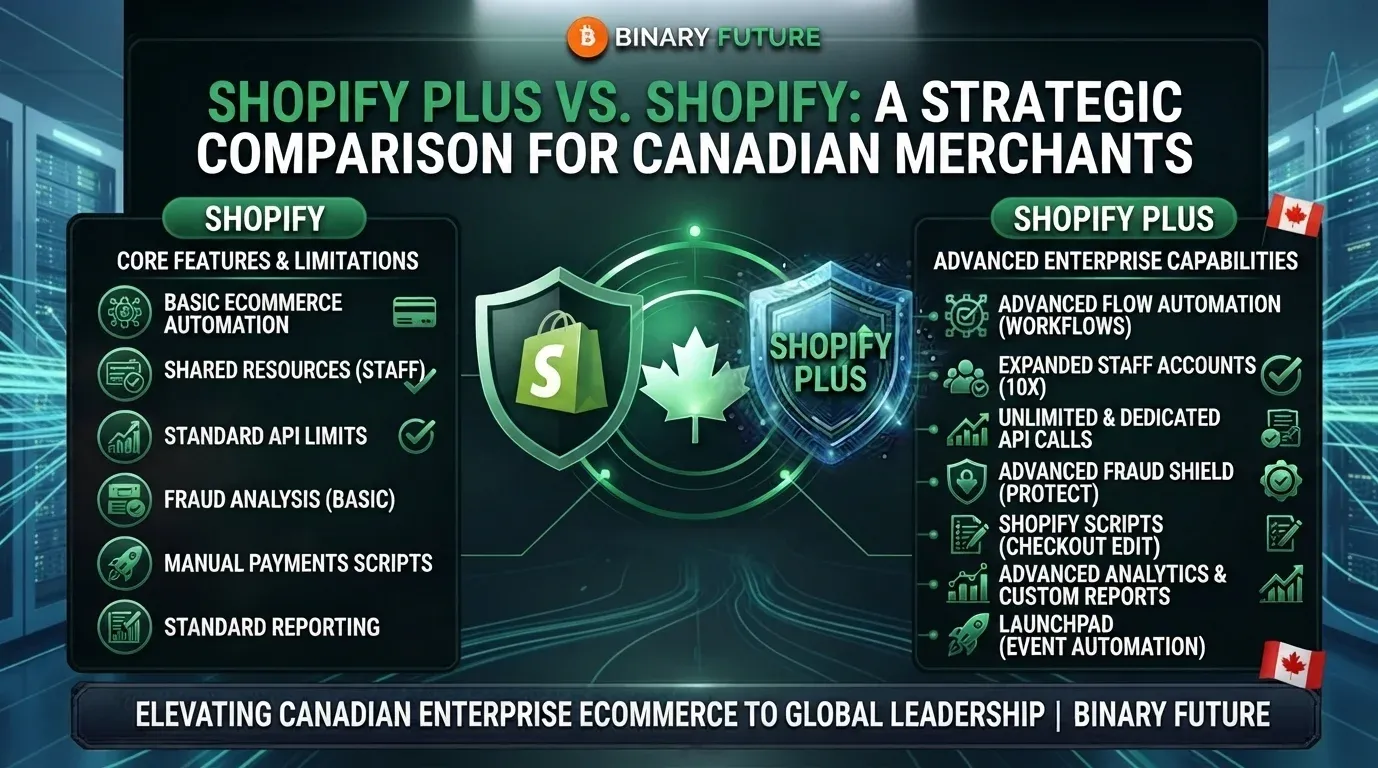
| Factor | Basic, Grow, Advanced | Plus |
|---|---|---|
| Price | 39, 105, 399 USD a month | From 2,300 USD a month |
| Staff accounts | Capped by plan | Unlimited |
| Checkout extensibility | Available on all plans | Available, with deeper UI extension scope |
| Shopify Functions | Public apps only | Custom apps with Function APIs |
| B2B | Included, up to 3 catalogs | Unlimited catalogs, catalogs assigned to a company |
| Multi-store | Not included | Expansion stores, centralised management |
| Reporting | Standard, advanced on Advanced | Advanced plus custom queries |
| Support | 24/7 chat and email | Named account contact, launch support |
Pricing: Shopify vs Shopify Plus
The plan fee is the smallest part of the real number. Card processing runs from 2.5 to 2.9 percent plus 30 cents depending on plan, third-party gateways add a surcharge on top of their own fees, and app subscriptions for a mid-sized brand routinely exceed the plan cost.
The useful way to frame the Advanced to Plus decision is as a monthly gap of roughly 1,900 USD that has to come back from somewhere: lower negotiated card rates at volume, apps you can retire because the capability is native, or staff hours no longer spent on manual work. Shopify development cost breaks down the build side of the same question.
Features & Customization
This is where most comparisons are now out of date, in both directions.
- Checkout is no longer Plus-only. Checkout extensibility is available across plans, and stores on non-Plus plans have until August 26, 2026 to upgrade their Thank you and Order status pages before Shopify does it for them and removes legacy customisations.
- Shopify Scripts are gone. They stopped executing on June 30, 2026. Discount, shipping, and payment logic runs on Shopify Functions. Public apps containing functions work on any plan, while custom apps containing Function APIs require Plus.
- Themes are block-based now. Horizon made most layout changes editor work rather than code work, on every plan.
What genuinely remains a Plus capability is depth: custom Function apps, deeper checkout UI extension scope, and multi-store. The mechanics are covered in Shopify Plus checkout customization. If your requirement is a fully custom frontend rather than a customised theme, that is a headless Shopify project and it is available below Plus as well.
Scalability & Global Growth
Inventory locations, market count, and checkout throughput all scale with plan, and the market limits in particular tightened over the last two years. Non-Advanced plans include a small number of markets, Advanced adds more at additional cost per market, and Plus includes the range enterprise sellers expect.
Multi-store is the cleanest Plus-only capability and the most common operational trigger for upgrading, because a brand running separate storefronts by region or by brand cannot do it properly below Plus. Shopify Plus multi-store setup cost in Canada covers what that actually involves.
POS & Omnichannel Selling
POS Lite is included on all plans for basic in-person selling. POS Pro adds staff roles and permissions, local pickup, and multi-location inventory, priced per location. Plus includes a block of POS Pro locations, which is a material saving for a brand with a retail footprint and irrelevant for a brand without one.
Analytics, Reporting & Performance
Standard reporting is on every plan, with deeper reporting from Advanced upward and custom querying on Plus. Infrastructure is the same underneath: the same hosting, the same PCI Level 1 compliance, the same CDN. Plus does not make your store faster. It changes what you are allowed to change.
Automation & Workflows
Shopify Flow automates repetitive work and is available broadly rather than being Plus-only. Launchpad, for scheduling drops and flash sales, remains a Plus tool. The honest test for automation value is how many hours a week your team currently spends on tasks a rule could handle. Below a few hours, automation is a nice-to-have.
Support & Resources
All plans get 24/7 chat and email support, the Help Center, and the community. Plus adds a named account contact, launch support, and priority handling. For a brand mid-replatform or running high-stakes drops, that access has real value. For a stable store, it is the part of the price hardest to justify.
When Should You Upgrade to Shopify Plus?
Revenue alone is a poor trigger. These are the operational ones that actually hold up.
- You need multiple storefronts. Separate stores by region or brand, managed centrally. This cannot be done properly below Plus.
- Your pricing is account-specific. Wholesale buyers on individually negotiated terms rather than two or three published tiers.
- Checkout logic is a business requirement. Discount, shipping, or payment rules that need custom Function apps rather than a public app.
- Staff access is a constraint. Enough people need admin access that seat limits shape how you work.
If none of these apply, Advanced is usually the better answer for another year. Why upgrade to Shopify Plus goes further into the trigger points, and where the line sits specifically for wholesale is covered in Shopify Plus for B2B.
Shopify vs Competitors (Magento, BigCommerce, WooCommerce)
Adobe Commerce offers deeper native modelling and open-source flexibility at meaningfully higher build and maintenance cost. BigCommerce is capable with a smaller app ecosystem. WooCommerce is cheapest to start and most expensive to operate at volume, because hosting, security, and updates become your problem.
For most mid-market brands in 2026 the real comparison is not Shopify against another platform. It is Advanced against Plus.
Conclusion: Which Shopify Plan Is Right for You?
Stay on Basic or Grow while the store is one storefront with published prices. Move to Advanced when card rate savings and reporting justify the fee. Move to Plus when an operational constraint, meaning multi-store, account-level pricing, custom checkout logic, or staff access, is actively shaping decisions. Shopify reports that merchants using its B2B tools see up to a 4.1x increase in reorder frequency compared with DTC (Shopify, April 2, 2026), which is worth testing on your current plan before treating wholesale as a reason to upgrade. When the constraint is genuinely the platform tier, Shopify Plus development is the scope that resolves it, and B2B Shopify development covers the wholesale side.