Why Migrate from Magento to Shopify?
Three reasons that hold up for a merchant already running NetSuite.
- Total cost of ownership. Dedicated hosting, security patching, and server maintenance for Adobe Commerce are a standing expense. On Shopify they are the platform’s problem, and that removes a whole category of unplanned cost.
- Developer availability. Qualified Magento specialists are harder to find and more expensive to keep than Shopify developers, which lengthens every change request.
- Time to market. New marketing capability arrives as configuration on Shopify and as a development ticket on Magento. Over a year that compounds into a real difference in what your team can actually ship.
The honest counterweight: you give up direct database access and open-source control, and you inherit Shopify’s release calendar. For a business whose competitive edge sits in operations rather than storefront code, that is usually a good trade. For one that has built genuinely unique commerce logic in PHP, it needs more thought.
Key Differences Between Platforms
Understanding the architectural difference is what lets your team adapt the sales management logic rather than trying to recreate it.
| Function | Magento (Adobe Commerce) | Shopify Plus |
|---|---|---|
| Platform type | Open source, self-hosted | SaaS, cloud-based |
| Maintenance | Regular patching and updates on you | Automatic platform updates |
| Security and PCI | Responsibility of the site owner | Included, PCI DSS Level 1 |
| Code access | Full access to the kernel and database | API-first, no direct database access |
| Catalogue limits | Effectively unlimited options | 2,048 variants, three options per product |
| Performance | Depends on your hosting and tuning | Global CDN, managed |
| ERP integration | Direct database or middleware | API and middleware only |
Pros and Cons of the Move
Every replatform is a compromise. Knowing which side you land on is the point of the exercise.
- Shop Pay. Access to one of the highest-converting checkouts available, which a self-hosted Magento checkout will not match without significant work.
- Reliability under load. Traffic spikes during peak season stop being your operational problem.
- Ecosystem. Thousands of applications that integrate immediately rather than through a build.
- Closed database. You lose direct MySQL access. Every read and write goes through the API, which changes how reporting, bulk edits, and integrations are built.
One correction to a claim that still appears in most Magento migration guides: Shopify has not been limited to 100 variants per product since October 15, 2025, when the ceiling was raised to 2,048 across all plans (Shopify developer changelog). The constraint that genuinely affects a Magento catalogue is different: Shopify still allows three options per product, holds 250 media files per product, and themes render a limited number of variants at once. If your Magento catalogue uses four or five configurable attributes, that is the restructuring conversation, not the variant count.
How to Migrate: A Step-by-Step Sequence
Four stages, in the order that reduces risk rather than the order that feels fastest.
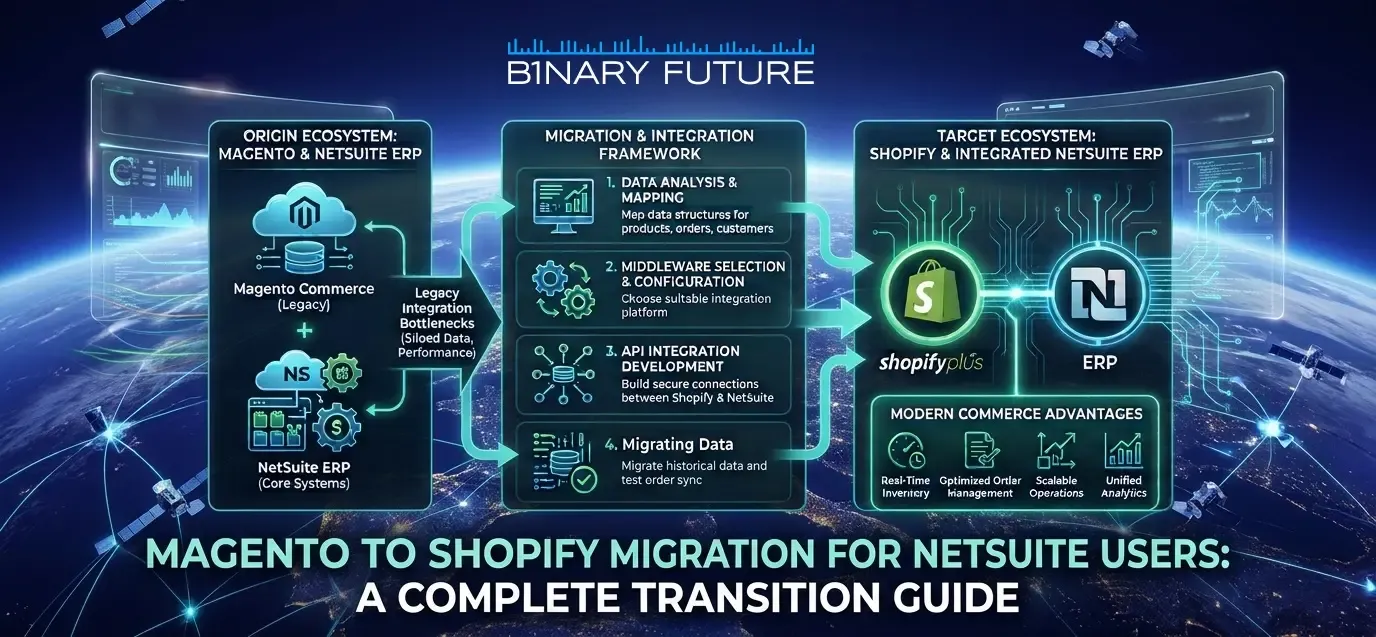
- Map the data model before exporting anything. Products, customers, and order history from Magento have to be mapped onto Shopify’s structure, with Magento’s custom attributes landing in metafields. Doing this on paper first is what prevents a second import.
- Rebuild the theme rather than porting it. Do not translate Magento templates. Block-based Online Store 2.0 themes put most layout work in the editor, so a configured premium theme now covers what used to require a build.
- Build the integration layer. For NetSuite users this is the hard part and it deserves its own timeline. Celigo flows and custom connectors written against Magento have to be refactored for Shopify’s GraphQL and REST APIs. This is not a configuration change.
- Test in the order things break. Balance synchronisation, tax calculation, partially fulfilled orders, and multi-location stock, first in staging and then under real order volume.
The full pre-move sequence is in our Shopify migration checklist, and what it costs in the migration cost guide.
Common Pitfalls to Avoid
- Treating redirects as an afterthought. Magento URL structures rarely map cleanly. Build the redirect map from a full crawl of the old site rather than the sitemap. Google’s documentation confirms permanent redirects do not lose PageRank, so the risk is the redirect that does not exist, not the mechanism.
- Trying to copy Magento logic. Shopify has a different philosophy. Recreating Magento behaviour in custom code produces something expensive to maintain and worse than the native equivalent. Use the platform features.
- Underestimating customer data. Passwords do not migrate, so the plan needs an account reactivation campaign. New for 2026: legacy customer accounts were deprecated on February 26, 2026, so the account model is a decision to make before the import, not after.
- Carrying Scripts across. Shopify Scripts stopped executing on June 30, 2026. Any discount or shipping logic still written as a Script has to be rebuilt on Shopify Functions and belongs in the development budget.
Sources for those two dates: Shopify changelog on customer accounts, Shopify developer documentation on Scripts, and Google Search Central on permanent redirects.
Specifics for NetSuite Users
This is the section that decides the project. Your existing NetSuite connection will not work against Shopify without being rebuilt, and three flows need designing explicitly.
- Order flow. Orders from Shopify into NetSuite, with the mapping for taxes, discounts, and shipping agreed before anything is built. Discounts in particular are where Magento and Shopify disagree most.
- Inventory sync. Near real-time stock updates in the direction you decide. The critical design question is which system owns the number and what happens when a sync fails mid-order, because overselling costs more than any feature returns.
- Fulfilment tracking. Shipment confirmations flowing back from NetSuite to the customer automatically, so support is not the notification channel.
The connector choice matters less than the conflict rules. Middleware such as Celigo can carry the traffic, but it cannot decide which system wins when NetSuite and Shopify disagree about a price. That design work is what Shopify CRM and ERP integrations covers, and how to scope a partner for it is in choosing an ERP integration agency in Canada.
From Theory to Implementation
Moving off Magento with NetSuite behind it is an integration project with a storefront attached, not the reverse. Map the data model, budget the ERP layer honestly, treat Scripts and account logic as rebuilds, and test under load rather than in staging alone. Binary Future scopes and runs this as Shopify migration services, with the enterprise tier as Shopify Plus development. Whether Plus is the right tier at all is worked through in Shopify Plus vs Shopify.