Why Brands Are Reassessing BigCommerce in 2026
For years BigCommerce’s clearest argument against Shopify was that it charged no platform transaction fees. On June 1, 2026 that changed. Plans were renamed, GMV thresholds moved downward so the same revenue now lands in a higher tier, and a new Open Payment Provider Fee of up to two percent applies to orders processed through any gateway not on BigCommerce’s approved embedded list (BigCommerce plan and pricing updates).
Two things follow from this, and neither is a reason to panic. First, the fee is not universal. If your gateway is on the approved list, it does not apply to you, and the practical exercise is to run your last twelve months of orders through the new structure by gateway rather than reacting to the headline. Second, manual payments and purchase orders are explicitly covered, which is why the merchants most affected tend to be the ones selling wholesale.
Where the B2B comparison now sits
This is the sharpest change for anyone selling to businesses. Customer-group pricing, which is the backbone of wholesale, remains on BigCommerce’s top tier. Shopify moved in the opposite direction on April 2, 2026, extending native B2B to Basic, Grow, and Advanced at no extra cost, with company profiles, up to three custom catalogs, volume pricing, and payment terms included (Shopify, April 2, 2026). Unlimited catalogs and account-level pricing remain on Plus. Where that line falls is set out in Shopify Plus for B2B, and building it is B2B Shopify development.
What you gain and what you give up
- Speed of change. Marketing capability on Shopify arrives largely as configuration, which frees the team from queuing behind development for routine work.
- Ecosystem depth. A larger app market means fewer custom builds for common requirements.
- Checkout. Shop Pay is a genuine conversion asset that is difficult to replicate.
- Catalogue structure. Shopify allows three options per product. If your BigCommerce catalogue uses four or five configurable attributes, that is a restructuring conversation to have before the move rather than during it.
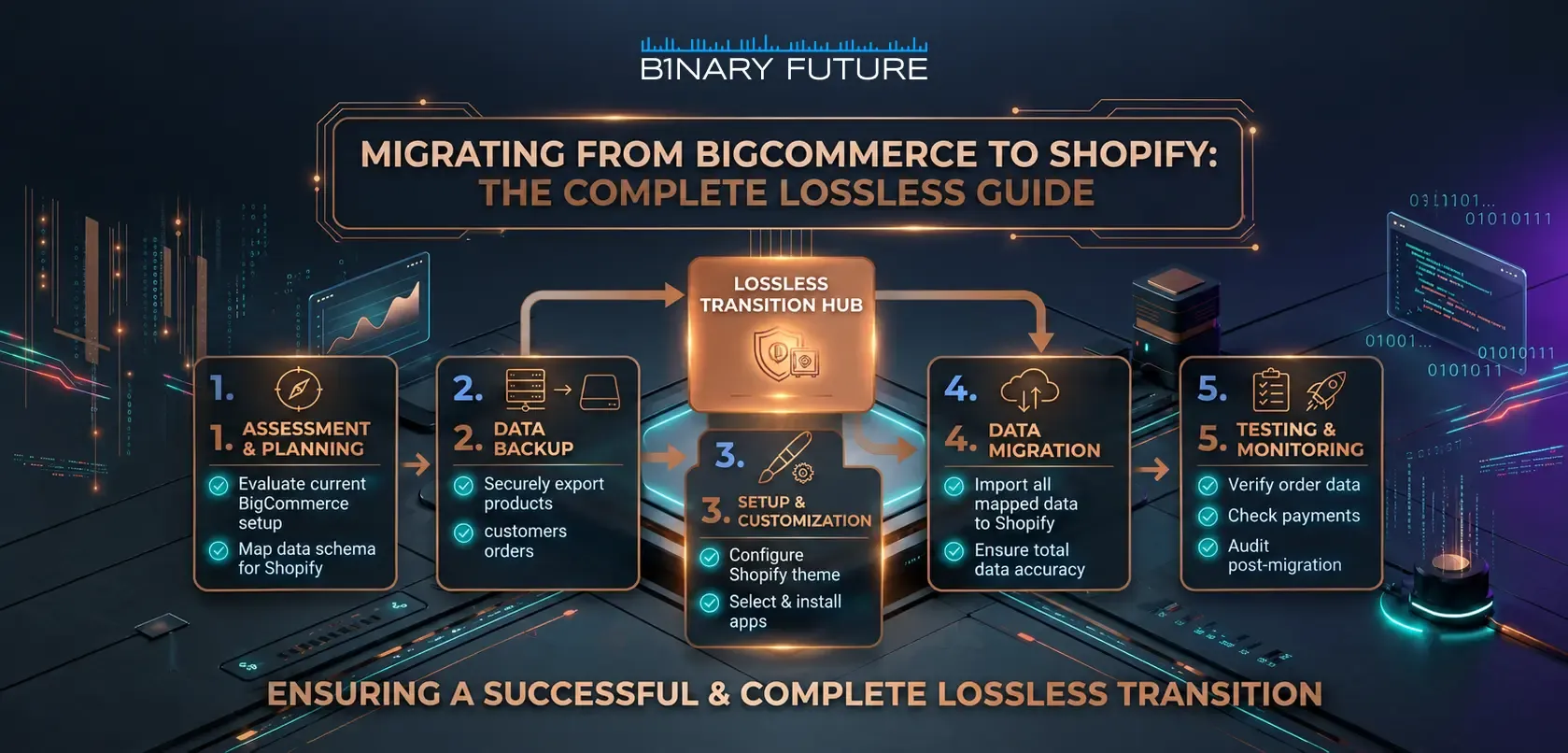
Phase 1: Planning and data preparation
The foundation. Mistakes here surface as budget overruns and missing customer records.
Comprehensive audit and backup
- Products and variants. Export everything, and check option counts against the three-option limit. Shopify raised the variant ceiling to 2,048 per product in October 2025, so variant count is rarely the problem. Option count often is.
- Customer data and order history. Your most valuable asset and the one customers notice if it goes missing.
- Content and reviews. Social proof that took years to accumulate and cannot be recreated.
- Verified backups. Restore one before starting, to confirm it actually restores.
SEO position protection and redirect strategy
URL structures differ between the platforms, so a detailed redirect map is mandatory. One correction to the guidance most migration articles repeat: you will see claims that a 301 preserves ninety or ninety-nine percent of SEO value. That is pre-2016 speculation. Google’s documentation states plainly that permanent redirects do not cause a loss in PageRank (Google Search Central).
The risk is the redirect that does not exist. Build the map from a full crawl of the live BigCommerce site rather than its sitemap, map one hop with no chains, and benchmark rankings before the move so you have something to compare against.
Deciding the customer account model
Passwords do not migrate, so an account reactivation campaign belongs in the launch plan. New for 2026: legacy customer accounts were deprecated on February 26, 2026, so the account model is a decision to make before the import runs rather than after (Shopify changelog).
Phase 2: Technical migration process
Import and setup steps
- Choose the method deliberately. The native Shopify Store Migration app, a third-party service such as Matrixify, or a partner running the process. The right choice depends on data volume and how much custom logic is coming with you.
- Tax and shipping. Shopify calculates most taxes by region automatically, but shipping zones, rates, and dimensional rules are manual configuration against your actual business rules, including GST, HST, PST, and QST for Canadian buyers.
- Payments. Activating Shopify Payments avoids the additional transaction fee and gives customers Shop Pay. Model this against what you currently pay, because it is one of the few line items you can calculate exactly.
- Custom logic. Any discount or shipping rule you plan to recreate has to be built on Shopify Functions. Shopify Scripts stopped executing on June 30, 2026, so nothing in that category transfers.
Source on the Scripts date: Shopify developer documentation. Full pre-move sequence in our Shopify migration checklist.
Testing and checking common errors
- Variant integrity. Every size and colour displaying correctly, including on products near the option limit.
- Image quality. High resolution maintained after transfer, and media counts within the per-product limit.
- Checkout end to end. Follow the customer journey from add to cart through successful payment, on desktop and on a phone on a throttled connection.
- Redirects sampled from the long tail, not only from top pages, because that is where the loss hides.
Phase 3: Post-launch optimization and growth
SEO health check and communication
Submit the new sitemap immediately and monitor Search Console daily for the first two weeks. Expect ranking fluctuation during recrawl, which Google describes as normal, and fix 404s as they appear rather than in weekly batches. Email loyal customers explaining the move, prompting account reactivation, and offering something for the first order on the new site.
Analysis and continuous improvement
Track site speed against Core Web Vitals field data, conversion rate, and average order value against the baseline you captured before the move. Judge results over at least a quarter, because anything shorter is measuring the recrawl rather than the migration.
Product data for AI channels
Cheap, new, and almost never scheduled. Eligible Shopify products are syndicated to ChatGPT, Copilot, and the Shop app by default, and that runs on catalogue completeness rather than on your theme. A migration is the natural moment to fix thin titles and missing specifications, because you are already touching every product record.
From Theory to Implementation
The June repricing is a reason to model your costs, not an automatic reason to move. Run your gateway mix and GMV through the new BigCommerce structure first. If the answer changes your platform economics, the migration itself is a planned sequence: audit, redirect map from a crawl, rebuild what does not transfer, test under load, and measure against a baseline. Binary Future scopes and runs this as Shopify migration services. What it costs is broken down in our migration cost guide, and whether Plus is the right tier in Shopify Plus vs Shopify. Where the requirement is enterprise-level, that is Shopify Plus development.