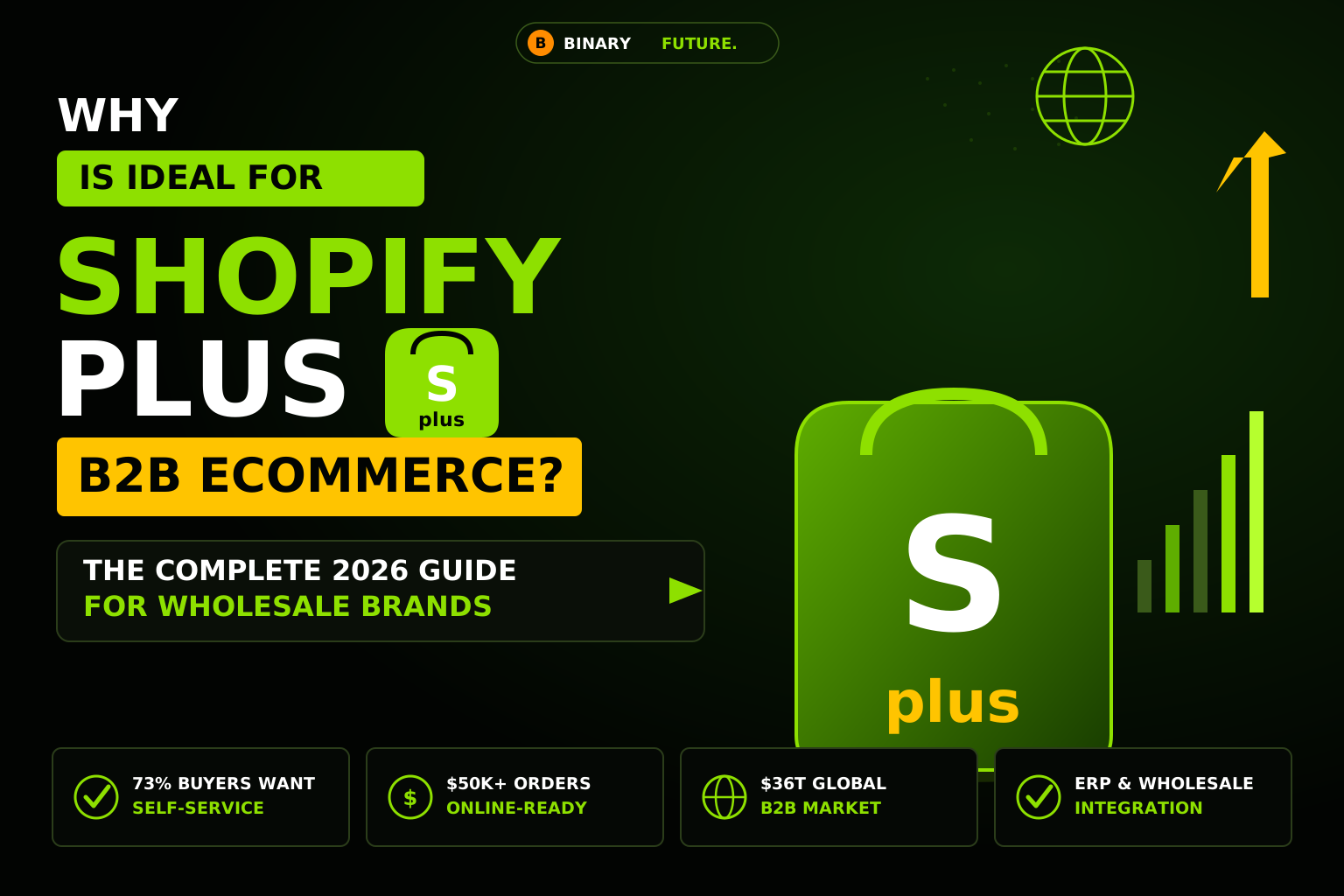
B2B buyers now behave like consumers: they want to research, compare, and place large orders themselves, without waiting on a sales rep. With the global B2B ecommerce market near $36 trillion and 73% of buyers willing to place $50,000-plus orders through self-service, the platform question is urgent. For most growing wholesale brands, Shopify Plus is the answer. This guide explains why, where it wins, and the trade-offs to weigh before you commit.
Updated: July 21, 2026. Author: Mike Bashkatov, Senior Shopify Plus Architect at Binary Future, Shopify Plus Partner. 12 years building B2B stores, ERP integrations, and enterprise migrations. LinkedIn
Shopify Plus is built for enterprise B2B: company accounts and hierarchies, custom catalogs and pricing per buyer, net payment terms, automated workflows, and ERP/CRM integration, all in one backend that also runs your DTC store. It wins on usability and total cost of ownership against heavier platforms. The honest trade-offs: a 500 line-item order limit, no native B2B subscriptions, and added cost for expansion stores. For most mid-market and enterprise wholesale brands, the benefits outweigh the limits.
Whether Shopify Plus is the right B2B platform is a question many enterprise brands are asking as they go digital-first. The B2B landscape is shifting fast, and today’s buyers, many of them millennials and Gen Z, expect a purchase experience as smooth as buying on a consumer marketplace. The real question for an owner is which platform handles the scale, complexity, and personalization B2B demands without a heavy build. For many, that is Shopify Plus. Below is why it stands out, what it does, where it falls short, and how real brands use it to scale.
The State of B2B eCommerce in 2026
Over the past decade B2B moved from face-to-face deals and trade shows to digital storefronts and automated workflows. That shift is no longer a trend; it is the default, and the numbers make it concrete.
- Buyers want self-service. 61% of B2B buyers now prefer a purchase journey with no sales rep, and 73% will place orders over $50,000 through self-service channels.
- Buyers research with AI. 94% of B2B buyers use generative AI as a core research tool, and a single buying journey now spans about 10 channels.
- Loyalty is long-term. Unlike B2C, B2B deals lock in multi-year relationships, so the platform has to support predictable recurring revenue, not just one-off carts.
- Complexity is high. From bulk pricing to multi-location accounts, B2B selling needs far more customization than selling to consumers.
Shopify Plus sits at the center of this shift, pairing enterprise features with the usability Shopify is known for.
Why Shopify Plus Stands Out for B2B
Unlike standard Shopify plans, Shopify Plus is built for enterprise businesses that need advanced features, customization, and automation. It is not only about higher volume; it is about the flexibility B2B merchants require:
- Blended or dedicated store models.
- Custom pricing and catalogs per customer.
- Automated order workflows.
- Global expansion through Shopify Markets.
- ERP and CRM integrations for complex operations.
Heavier platforms also offer B2B tooling, but Shopify Plus wins by combining enterprise-grade power with simplicity, which lowers both build time and total cost of ownership.
Key Shopify Plus Features That Power B2B Growth
Flexible store models: blended vs dedicated
Shopify Plus lets you choose the setup that fits your business:
- Blended store. Serve B2B and DTC from one storefront. Best for brands upgrading existing retail customers into wholesale without running multiple stores.
- Dedicated store. A wholesale-only storefront with its own pricing, workflows, and catalogs. Ideal for larger businesses with complex B2B needs.
This flexibility means you can scale without being locked into one rigid model.
Advanced customer and company accounts
Managing B2B customers is about whole companies, not single buyers. Shopify Plus supports:
- Multiple locations per company (up to 10,000).
- Custom payment terms per location.
- Role-based permissions, from ordering-only to admin access.
This is a gap competitors often overlook. Managing company hierarchies is critical for B2B, and Shopify Plus handles it cleanly.
Custom catalogs and pricing control
Not every buyer should see the same catalog or price. Shopify Plus lets merchants:
- Assign custom catalogs per company.
- Offer tiered or volume-based pricing.
- Set minimum and maximum order quantities.
- Sell in multiple currencies.
Wholesale buyers always see the right products, prices, and terms for their account, which removes a common reason large orders stall.
Flexible payment terms and draft orders
Unlike consumer checkout, B2B often needs net terms, deposits, or payment after fulfillment. Shopify Plus supports:
- Net payment terms such as 30 or 60 days.
- Draft orders created by reps for phone or email transactions.
- Local delivery or in-store pickup for wholesale customers.
This bridges traditional offline selling and modern digital commerce, and removes the biggest reason a buyer delays a large order.
Automation and integrations
Manual processes quietly drain margin. Shopify Plus addresses that with:
- Shopify Flow. Automate reorders, approvals, and stock alerts.
- Shopify Functions. Customize discounts and checkout logic server-side (the modern replacement for Scripts).
- ERP and CRM integrations. Sync with systems like SAP, NetSuite, or Salesforce.
- Business Customer API. Manage complex data like company structures and contacts.
With an ecosystem of 8,000-plus apps plus custom development, the automation ceiling is effectively where your operations need it to be.
Global expansion with Shopify Markets
International B2B is hard because of currency, tax, and distribution. Cross-border made up around 44% of B2B transactions in 2025, so this is mainstream, not edge-case. Shopify Plus simplifies it by:
- Supporting multiple currencies and tax compliance.
- Allowing wholesale distribution via local partners.
- Enabling localized catalogs and storefronts.
Brands use Shopify Markets to expand into Europe and Asia while keeping operations centralized in one backend.
Enhanced personalization
B2B buyers expect tailored experiences. Shopify Plus enables:
- Personalized storefronts per account.
- Custom pricing rules per buyer.
- AI-powered product recommendations.
- Account managers tied into digital portals.
This goes beyond DTC-style personalization: each buyer sees catalogs, prices, and terms specific to their role and company.
Business Benefits of Shopify Plus for B2B in 2026
- Lower acquisition costs. Wholesale buyers often resell and promote your products for you.
- Higher order value and frequency. Retailers buy in bulk and reorder on a predictable cycle.
- Default loyalty. Multi-year contracts create revenue you can forecast.
- Reduced operational costs. Automation eliminates manual invoicing and order entry.
- Improved retention. Account managers and self-serve portals keep buyers engaged, and retaining a B2B account costs far less than winning one.
- Scalability. Run both B2B and DTC from one backend with no duplicate systems.
If you are setting that foundation from scratch, see our full breakdown on how to build a successful Shopify business.
Limitations You Should Be Aware Of
No platform is perfect, and naming the trade-offs up front is part of choosing well:
- A 500 line-item limit per order, which can affect very large wholesale carts.
- B2B subscriptions are not natively supported and need an app or custom build.
- Some checkout customizations are unavailable on B2B flows.
- Expansion stores add cost as you scale into new regions or brands.
Most of these have clean workarounds, and a good partner will tell you which ones actually affect your model before you commit, rather than after.
Shopify Plus vs Alternatives
- Adobe Commerce (Magento). Open-source flexibility, but high development and maintenance cost.
- BigCommerce. Solid B2B tooling, but fewer integrations and a smaller app ecosystem.
- WooCommerce. Fine for small B2B operations, but it strains as you scale.
Against these, Shopify Plus wins on usability, automation, and scalability in one package, with a lower total cost of ownership for most mid-market and enterprise brands.
Final Thoughts: Is Shopify Plus Right for You in 2026?
Shopify Plus has established itself as a leading B2B ecommerce platform heading into 2026. Its mix of scalability, automation, global reach, and account-level personalization makes it a strong default for brands that want to grow in a digital-first wholesale market without a heavy, expensive build. The trade-offs are real but manageable, and for most mid-market and enterprise wholesale brands the math favors Plus. If you want that architecture aligned to your commercial goals from day one, our team works on exactly this kind of B2B Shopify development.
Read also
- Top Features Every B2B Shopify Store Must Have
- How to Build a Successful Shopify Business
- B2B Shopify Store Development
- Shopify Plus Development Services
- Shopify Migration Services
About the author
Mike Bashkatov is Senior Shopify Plus Architect at Binary Future, a Shopify Plus Partner agency in Toronto. Over 12 years he has led 100+ Plus and B2B builds, ERP and CRM integrations, and enterprise migrations. Find him on LinkedIn.
Weighing Shopify Plus for B2B? Get a free 30-minute B2B fit assessment. We will review your catalog, pricing, accounts, and integration needs, tell you honestly whether Plus is the right call, and map the build with a tailored timeline and budget.