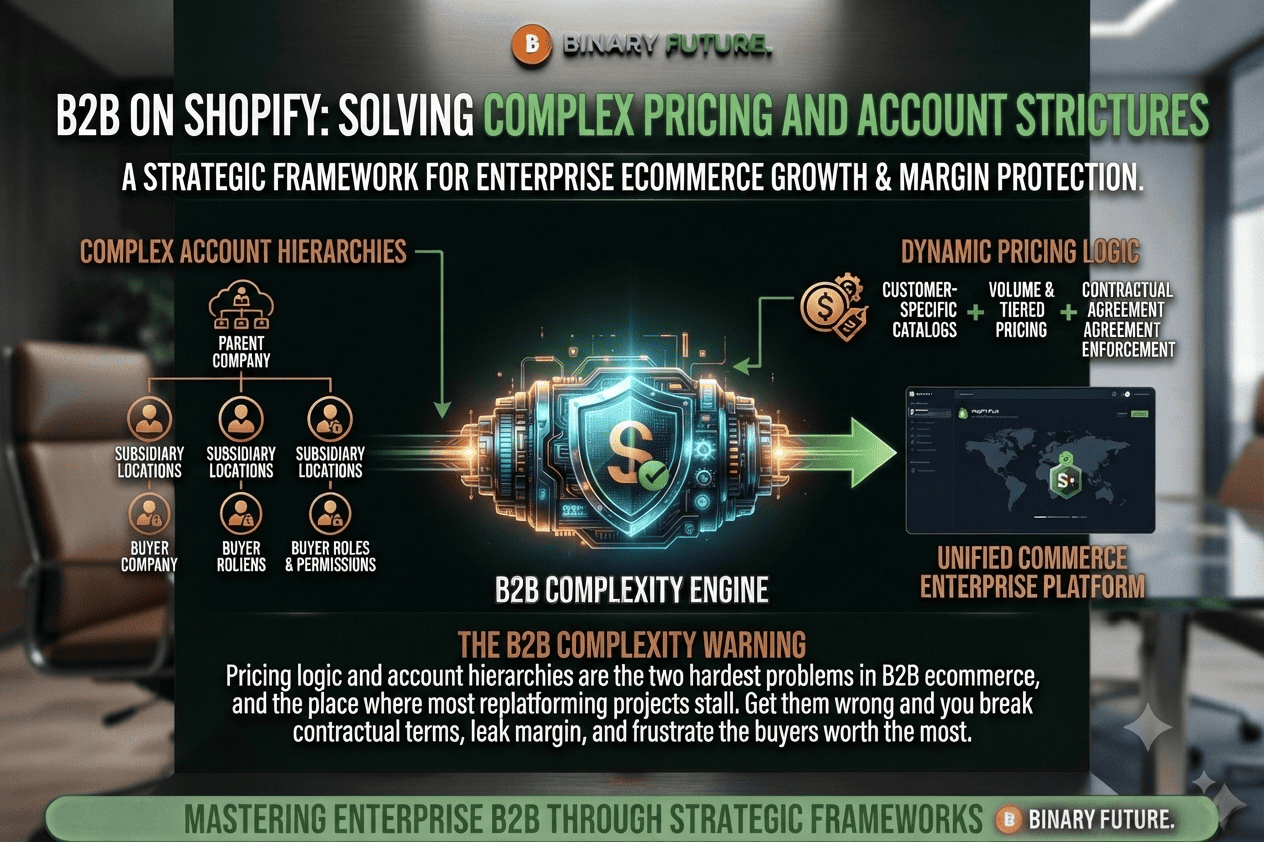
Pricing logic and account hierarchies are the two hardest problems in B2B ecommerce, and the place where most replatforming projects stall. Get them wrong and you break contractual terms, leak margin, and frustrate the buyers worth the most. With the global B2B market near $36 trillion and 73% of buyers placing $50,000-plus orders through self-service, the brands that master pricing and accounts win the relationships. This guide explains how Shopify Plus solves both, and where the real work lies.
Updated: July 28, 2026. Author: Mike Bashkatov, Senior Shopify Plus Architect at Binary Future, Shopify Plus Partner. 12 years building B2B pricing logic, ERP integrations, and enterprise migrations. LinkedIn
B2B pricing and account complexity, customer-specific catalogs, negotiated contracts, multi-location company accounts, and net terms, is exactly what breaks generic ecommerce platforms. Shopify Plus handles it natively through tiered and contract pricing, custom catalogs, company accounts with up to 10,000 locations, role-based permissions, and the Business Customer API, plus ERP, CRM, and PIM integration. The hard part is not the features; it is modeling your real pricing rules and account hierarchies correctly during the build, which is where a specialist partner earns their fee.
B2B pricing and account structures are among the most urgent topics for wholesale and enterprise brands, because they are the biggest roadblocks to moving online. Traditional platforms often fail here, especially during a large-scale Shopify replatforming, where legacy systems must be replaced without disrupting contractual logic or customer-specific terms.
Shopify Plus has become a leading answer, helping merchants streamline catalogs, contracts, customer-specific pricing, and multi-location accounts while keeping operations running. As the global B2B market keeps surging, the brands that master pricing and accounts will win buyers who now expect consumer-grade experiences with enterprise-grade flexibility.
Why Pricing and Account Structures Are Complex in B2B
B2B ecommerce is not just B2C with bigger orders. The differences run deeper, and each one adds a layer of complexity:
- Multiple decision-makers. Finance, procurement, and department heads all weigh in on a single purchase.
- Complex pricing models. Volume discounts, negotiated contracts, regional pricing, and tiered rates are the norm, not the exception.
- Account hierarchies. Buyers need multi-location access, team-level permissions, and approval workflows.
- Manual inefficiency. Spreadsheets and phone orders carry hidden costs, frequent errors, and unhappy buyers.
In short, the very things that make B2B lucrative, bigger orders, long-term contracts, repeat customers, also introduce the complexity that demands a platform built to handle it.
How Shopify Plus Simplifies B2B Pricing and Account Structures
Tiered and volume discounts
B2B buyers expect a reward for buying in bulk. Shopify Plus lets you:
- Create tiered discount structures that scale with order volume.
- Choose between progressive discounts (only quantities above a threshold get the discount) and all-units discounts (the discount applies to the whole order).
- Layer in seasonal promotions or special campaigns without breaking the underlying rules.
Real-world example: A medical supply company moved volume pricing onto Shopify Plus and saw a 27% lift in online conversions once buyers got self-service access to their real, better pricing.
Contract pricing management
Many B2B merchants negotiate one-to-one contracts with specific buyers. Shopify Plus supports:
- Secure storage and automatic application of negotiated contract rates.
- Renewal tracking and alerts for expiring agreements.
- Approval workflows for exceptions and special terms.
This honors contracts digitally and removes the manual errors that used to slow every order, the kind that quietly erode trust with your largest accounts.
Customer-specific catalogs and rates
With Shopify Plus, each company sees only the products and prices relevant to them:
- Assign catalogs per customer or per location.
- Offer multi-currency catalogs for international buyers.
- Use account-based pricing hierarchies to cascade rules from parent accounts down to subsidiaries.
This is especially valuable for global distributors serving clients across regions with very different price structures, where cross-border made up around 44% of B2B transactions in 2025.
Advanced pricing tools
Shopify Plus goes well beyond basic discounting:
- Shopify Functions. Customize checkout flows and pricing logic server-side (the modern replacement for Scripts).
- Business Customer API. Manage contracts, pricing, and accounts programmatically at scale.
- CPQ integrations. Configure, Price, Quote functionality tied to ERP for enterprises that need it.
This depth of pricing control is rare among ecommerce platforms and is one of Shopify Plus’s strongest differentiators.
Managing Complex B2B Account Structures in Shopify Plus
Company accounts and multi-location buyers
B2B often means selling to one company with dozens or even thousands of branches. Shopify Plus lets you:
- Group buyers under a single company account.
- Support up to 10,000 locations per company.
- Keep a centralized profile while customizing pricing and terms per location.
Role-based permissions
Not everyone in a buyer’s company should have equal control. Shopify Plus provides role-based permissions, such as:
- Ordering-only roles for staff who submit orders but cannot approve them.
- Admin roles for buyers who manage locations, payment terms, and catalogs.
This removes bottlenecks while keeping procurement controls intact, which is what makes a large account comfortable buying at volume.
Draft orders and offline transactions
B2B still involves phone and email orders. Shopify Plus supports:
- Draft orders created by sales reps.
- Flexible payment terms like Net 30, Net 60, or deposit-based billing.
- Local pickup or delivery for wholesale customers.
This bridges offline and online and meets buyers where they actually are, which still matters when 61% of B2B buyers prefer a rep-free journey but the rest do not.
Modern B2B order management
Order management is where pricing and accounts come together, and it is often overlooked. Modern buyers expect:
- Self-service portals to track orders, invoices, and history.
- Bulk order tools like CSV uploads and quick-add lists.
- Real-time inventory visibility for accurate availability.
- Smart fulfillment routing for faster, cheaper delivery.
Shopify Flow and automation
Manual work is where margin quietly disappears. Merchants can automate:
- Reorder triggers.
- Approval workflows.
- Invoice reminders.
- Loyalty programs for high-value buyers.
ERP and CRM integrations
Shopify integrates with enterprise systems such as SAP, NetSuite, Microsoft Dynamics, Salesforce, and HubSpot, keeping pricing, account data, and customer history consistent across platforms. With most of the B2B market moving toward API-first integrations, this is now table stakes, not a bonus.
PIM and DAM solutions
For product-heavy industries, PIM and DAM systems centralize product and pricing data for global catalogs, cutting errors and keeping every market consistent.
Business Customer API
Shopify’s Business Customer API deserves its own spotlight. It lets developers manage company profiles, multiple locations, and payment terms and contracts programmatically, a capability competitors often miss and one that becomes essential as account complexity grows.
Shopify Plus vs B2B Apps: Which Solves Complexity Better?
- Shopify Plus native tools. Built-in, scalable, designed for enterprise.
- Third-party B2B apps. Affordable and flexible for smaller operations.
- Best approach. Use apps for early-stage B2B, then move to Shopify Plus for scale and long-term ROI.
The honest read: apps get you started cheaply, but as pricing rules and account hierarchies deepen, native tooling wins on reliability and total cost of ownership.
Best Practices for B2B Pricing and Account Management
- Keep pricing transparent but flexible.
- Balance automation with personalization.
- Avoid over-reliance on manual processes.
- Plan ERP, CRM, and PIM integrations early, not after launch.
- Future-proof with AI-assisted pricing, composable architecture, and ESG-compliant pricing transparency.
If you are new to Shopify, start with our guide on how to build a successful Shopify business.
Final Thoughts: Why Shopify Plus Wins for Complex B2B
Pricing logic and account hierarchies remain the most demanding parts of B2B ecommerce. Shopify Plus addresses them through native pricing rules, company profiles, automation, robust APIs, and enterprise integrations, all in one manageable ecosystem. The platform gets you most of the way; the rest is modeling your real rules correctly, which is where strategic B2B Shopify development turns complex backend requirements into an intuitive, conversion-focused experience. For brands serious about B2B growth, Shopify Plus does more than simplify operations; it sets up scalable infrastructure for long-term expansion.