Answer This Before You Ask Anyone for a Quote
Sync is not a feature, it is a consequence of a decision about ownership. Name the system that is allowed to change a stock number, and every other question gets easier.
- Shopify as the master. Works when one store is clearly primary. Simple, cheap, and fragile the moment two stores can both decrement the same unit.
- An ERP as the master. Works when purchasing, production, or a real warehouse already lives there. Shopify becomes a display of a number it does not own.
- A third party logistics provider as the master. Works when a 3PL holds all physical stock and pushes levels reliably. Verify the frequency before you commit.
- No master. The state most brands are actually in, and why overselling shows up in month two rather than week one.
A contractor who starts with which app rather than which system owns the number is solving the second problem first.
Four Architectures, and Where Each One Breaks
Markets is included with Plus and covers up to fifty markets inside one store. A Plus contract includes up to nine expansion stores alongside the primary one, and those are independent instances with their own catalog, inventory, and admin.
| Setup | When it fits | What breaks first |
| Shopify Markets, one store | Same catalog and brand across regions | Regional catalog differences and separate legal entities |
| Plus expansion stores | Separate brands, catalogs, or teams | Nothing syncs natively, and app costs multiply per store |
| Separate plans, one per store | Two small independent brands | Overselling from the first shared SKU |
| ERP as the source of truth | Wholesale, manufacturing, real warehousing | Sync frequency and an exception queue nobody owns |
The Plus organisation admin gives single sign on, user management, and billing visibility. It does not coordinate products, inventory, or orders, which is the assumption that catches teams out.
What Makes This Harder in Canada
Four variables show up here that do not appear in a generic multi-store guide.
- Cross border warehousing. A Canadian brand with a United States 3PL runs two tax regimes and two duty pictures. The sync has to carry location, not just quantity, or the wrong warehouse gets the order.
- Location limits. Basic, Grow, and Advanced allow ten active locations and Plus allows two hundred. Apps that physically stock inventory for you count against that limit.
- CAD and USD. Multi-currency payouts sit on Advanced and Plus, so a store on Basic or Grow reconciles currency outside Shopify, usually in the system you want owning inventory.
- Quebec content. If one store serves Quebec, product data has to arrive translated, which makes catalog sync a content problem too.
Any one of these can move the answer from a sync app to middleware, which is why the Canadian version of this question rarely has a fifty dollar answer.
Who Actually Does This Work
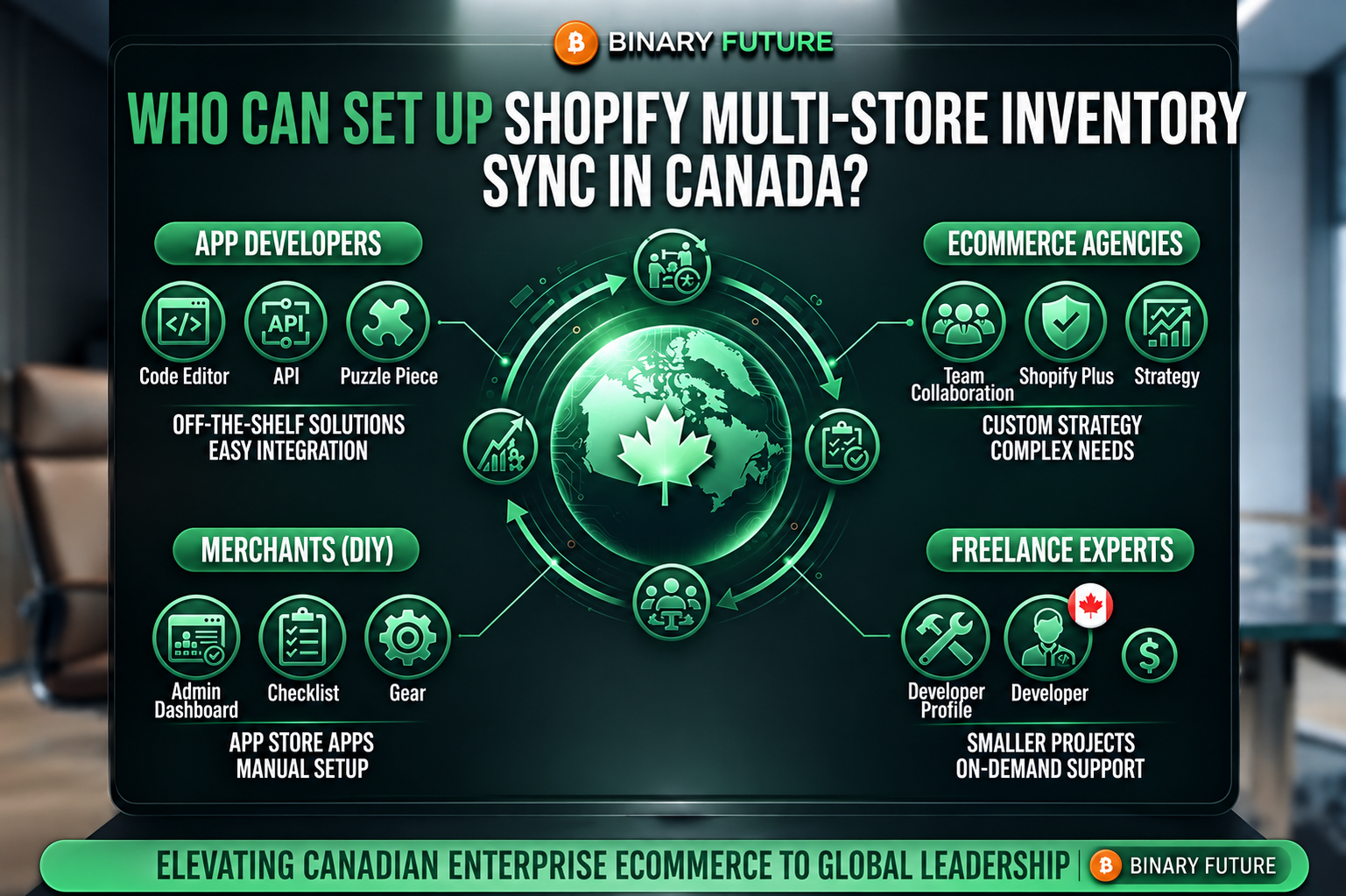
Four kinds of provider, and they are not interchangeable.
- A sync app. Fastest and cheapest for two or three stores with a clean shared catalog. Stops at complex mapping, bundles, and kits.
- Middleware. Right when more than two systems are involved, or when the mapping needs rules rather than a field match.
- An ERP integrator. Right when the ERP already owns stock and the job is a data contract, not a Shopify job.
- A custom app. Right when the allocation rules are specific to your business and no product models them.
- Ask all four the same three questions. How often does it sync, what happens when a write fails, and who watches the exception queue.
The third question is the one that separates a working integration from one that works until somebody goes on holiday.
Working with Binary Future on Multi-Store Inventory
Binary Future is a Shopify Plus Partner agency in Toronto. We start with a source of truth decision and a written data contract, then choose between an app, middleware, and a custom build, in that order, because the cheapest option that survives your rules is the right one.
Cross border warehousing, provincial tax behaviour, and CAD and USD reconciliation are part of the architecture, not configuration at the end.
See our Shopify ERP and CRM integrations and Shopify Plus development for how we handle multi-store architecture.