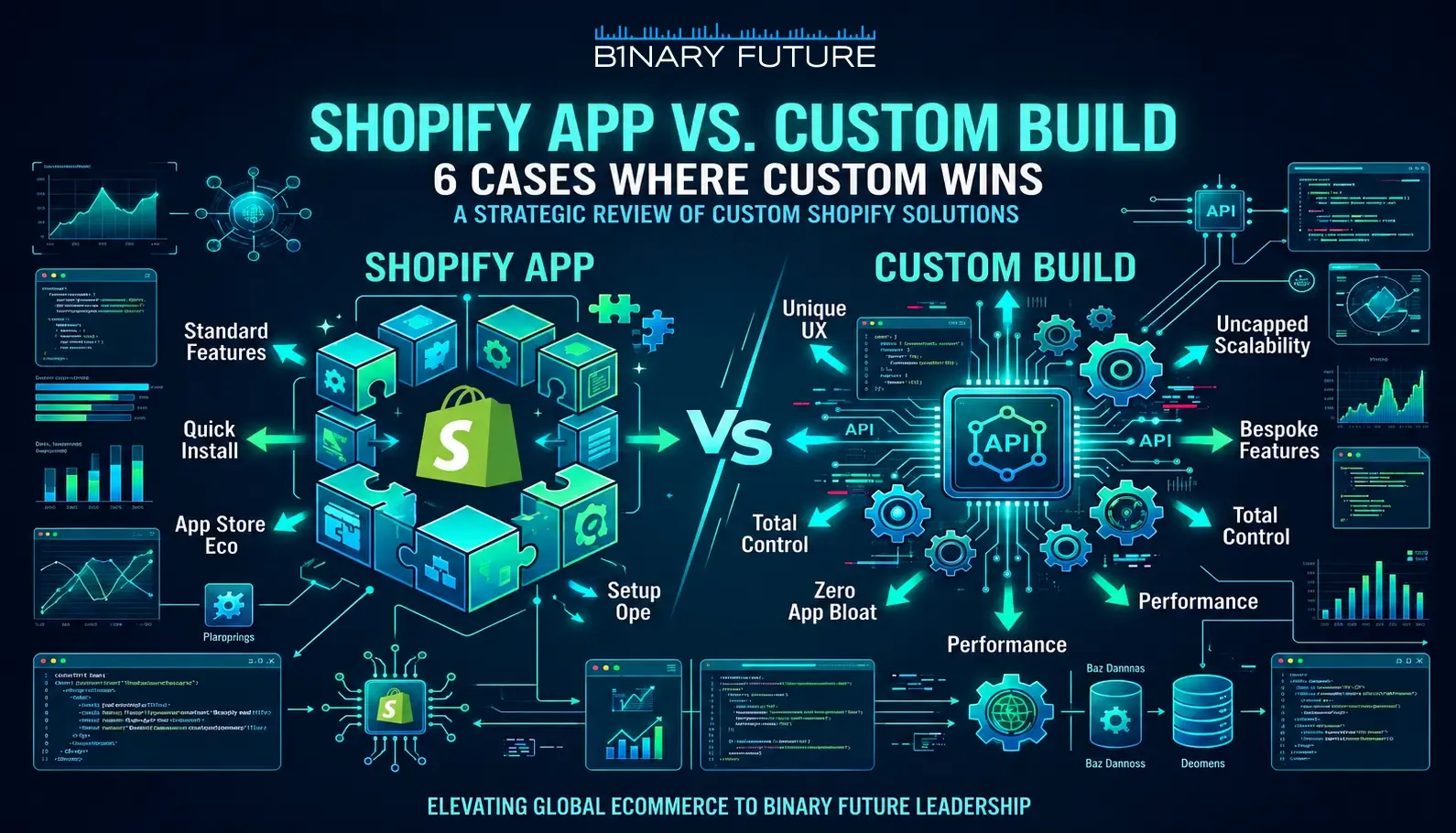
App or Custom, Side by Side
The comparison is less about price than about who controls what happens next.
| Question | App from the App Store | Custom build |
| First cost | Low, usually a monthly fee | A scoped project, priced as an estimated range after discovery |
| Fit to your process | You adapt to the app | The app adapts to you |
| Your data | Held by the vendor, on the vendor’s terms | Held where you decide |
| Roadmap | The vendor’s | Yours, and yours to fund |
| Platform changes | The vendor migrates, or does not | Your team or agency migrates it |
| Leaving | Uninstall, sometimes with data loss | You keep the code and the app |
The fifth row carries the most risk this year. From January 1, 2027, public apps that still use non-expiring offline tokens are removed from the App Store and blocked from new installs, and from April 1, 2027 Admin API requests made with those tokens return a 403. Custom and merchant created apps are excluded from that change.
Six Cases Where Custom Wins
Each one has a project behind it or a date on Shopify’s calendar.
- The logic exists in no app. Ansandra’s gift registries needed an internal credit currency that pools contributions from guests, transfers between registries and keeps its value when prices change. No app models that, so the credit system was built as a separate backend connected to Shopify through middleware. Registries went from 153 to more than 1,000 in eight months.
- The process continues after the sale. Carousel Repair needed jewelry warranties attached to individual items rather than whole orders, and repair requests filed from order history straight into its existing service system. The custom app cut average repair request handling time by 42%.
- The business runs on a platform next to Shopify. RVL Skincare, a concierge dermatology practice, keeps contracts, consents and appointments in a separate application, because Shopify’s Acceptable Use Policy lists uploading HIPAA protected health information as unsupported activity. The store sells the products, and more than 600 patients hold contracts on the platform beside it.
- The catalog has to differ per buyer. Goswick Eye’s private portal shows each patient only the contact lenses their doctor prescribed, with family accounts and insurance credits in one checkout. It was built to move an ordering channel with more than 5,000 past orders off a third party platform the practice did not own.
- Three or four apps are glued together to make one feature. When bundles need one app, subscriptions another and a third to make them agree, every update can break the chain, and each vendor points at the others. Subscription contracts owned by an app are cancelled 48 hours after that app is uninstalled, so even replacing one link is a project. Past a certain point, one custom function with one owner costs less to run than three subscriptions and the hours spent reconciling them.
- A key app still runs on script tags. Apps have not been able to create or update script tags since October 1, 2026, and existing script tags stop running on storefront pages on March 1, 2027. If a review widget, chat, popup or tracking pixel still loads that way and its vendor has no migration date, replacing it is a scheduled project for a few more months, and an emergency after that.
When the App Is the Right Answer
Custom work is the wrong call more often than agencies admit. Stay with an app when:
- The function is standard. Reviews, email capture, shipping rates and common subscriptions are solved problems with mature apps.
- Volume is still small. If a process runs a few times a week, a manual step costs less than the software that would remove it.
- The vendor is active. Recent releases, a published plan for the 2027 dates and a support channel that answers.
- Nobody will own the code. A custom app without a maintenance arrangement turns into the same abandoned software you were trying to avoid, with your name on it.
Ownership Comes Before the First Line of Code
Admin created custom apps ended on January 1, 2026. A custom app is now built through the Dev Dashboard and the Shopify CLI, inside an organization, and whoever owns that organization controls the app’s credentials and whether it can be updated at all. Name the organization’s owner in the contract, along with the repository and who holds deploy access when the engagement ends.
Binary Future scopes these decisions as part of its Shopify development services, including the cases where the recommendation is to keep the app. When the answer is custom, the build runs through custom Shopify app development, with the organization in your name from day one.