What is headless commerce on Shopify?
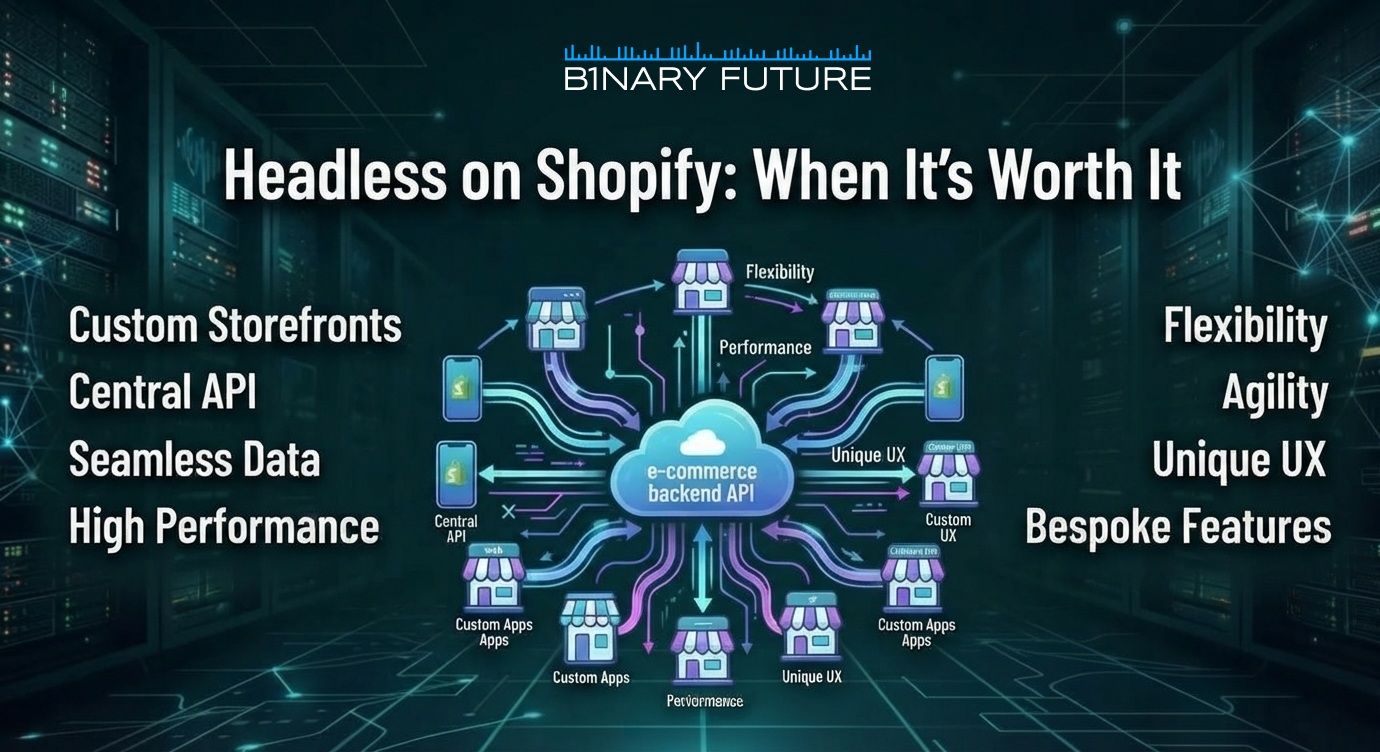
Headless commerce decouples the frontend from the backend. Shopify’s commerce engine continues to handle products, inventory, checkout, payments, and tax. The storefront becomes your own application, communicating with Shopify through the Storefront API.
-
Hydrogen and Oxygen.
Shopify’s official headless toolkit and hosting. As of June 17, 2026 Hydrogen is a framework-agnostic core of commerce primitives with thin bindings for Next.js, Astro, and SvelteKit rather than a Remix-tied framework. -
Custom stack.
Next.js or Astro on Vercel or Netlify, with Contentful, Sanity, or a similar CMS. -
Checkout stays with Shopify
in almost every case, because rebuilding it means taking on PCI scope you do not want.
Headless on Shopify is not the same as a separate website running on Shopify APIs. It is a programmable storefront with full commerce, tax, fraud, and checkout intact (Shopify Hydrogen updates ).
When does headless on Shopify actually pay off?
First signal, in order of how reliably it predicts a justified build.
-
Annual GMV above $5M.
Headless is a significant investment. In our scoping practice, revenue growth from speed and UX improvements crosses the development cost at roughly this point. Below it, the same percentages produce numbers that do not clear the build. -
Mobile PageSpeed below 60 with theme already optimised.
If your current theme is fully tuned, apps trimmed, images optimised, Liquid cleaned, and mobile performance still caps below the Core Web Vitals thresholds, you have hit the ceiling of what the theme layer can do. -
Omnichannel ambitions.
You need to sell not only through a storefront but through a native app, in-store kiosks, marketplaces, and social commerce, all off one backend. This is the cleanest structural argument. -
Complex B2B logic.
Custom pricing rules, multi-level discounts tied to specific accounts, account-specific catalogs, custom checkout for net terms and purchase orders. Some of this now sits inside native B2B, so check before assuming. -
External CMS or PIM in the stack.
Brands with complex multilingual content, or with Contentful, Sanity, or Akeneo as a PIM, hit friction on themes. The API surface removes it.
If only one signal applies, the answer is almost always no. Optimise the theme and revisit in a year.
Headless on Shopify vs Plus theme: side-by-side comparison
| Parameter | Plus theme with checkout extensibility | Headless on Shopify |
|---|---|---|
| Initial build cost | $20,000 to $80,000 | $80,000 to $300,000+ |
| Time to launch | 4 to 12 weeks | 12 to 32 weeks |
| Core Web Vitals | Achievable with disciplined tuning | Achievable with more headroom, not automatic |
| Frontend flexibility | Bounded by Liquid and theme blocks | Bounded by your team |
| Checkout customisation | Checkout UI extensions and Functions | Same, plus a custom cart and product experience |
| Omnichannel | Web, POS, and the Shop app | Web, native app, kiosk, and custom surfaces |
| CMS and PIM integration | Possible, friction-heavy | Native, low-friction |
| Team requirement | Shopify developer or agency | Standing frontend team or long-term partner |
| Maintenance | $1,000 to $5,000 per month | $5,000 to $25,000 per month |
| Best fit | DTC at $1 to 10M GMV, single channel | $5M+ GMV, omnichannel, complex B2B |
The framing that holds up: a Plus theme with checkout extensibility is for brands with a commerce problem. Headless is for brands with a brand experience problem. One row deserves a caveat: headless does not make a store fast by itself. It removes the ceiling. A heavy custom frontend can perform worse than the theme it replaced.
What are the business signals you are ready for headless?
Sales above $5M annual GMV
This is the threshold we apply in scoping rather than an industry standard. It exists because a headless build is a fixed cost and the returns are percentages of revenue. Below roughly $5M, plausible percentage gains produce numbers smaller than the build. Above it, the arithmetic starts to work.
Core Web Vitals as a growth ceiling
Speed matters, and it is worth knowing what is actually measured. Google grades page experience on field data from real Chrome users at the 75th percentile over 28 days: LCP under 2.5 seconds, INP under 200 milliseconds, CLS under 0.1, all three at once ( Google Search Central ). INP replaced First Input Delay in March 2024 and is the metric most stores fail, because it measures responsiveness rather than load.
A lab score from a developer’s machine is not the number Google uses. If a proposal shows you a PageSpeed screenshot instead of your own field data, ask for the field data.
Omnichannel and custom sales channels
Selling through a native app, kiosks, marketplaces, and social from one backend is the argument that does not have a theme-based workaround. One nuance for 2026: every Shopify store already has app-based distribution through the Shop app, and Shop Minis allow app experiences inside it without shipping a binary. Confirm the channel gap is real before building for it.
International and multi-region complexity
Multiple languages, currencies, regional catalogs, and localised content management push themes hard. Note that market allowances now scale with plan and contextual checkout starts at Advanced, so part of this is a plan question rather than an architecture one.
Brand experience requirements
Interactive product configurators, 3D and AR, animated storytelling, custom quiz-driven merchandising. These are real and they are also the category where block-based themes closed the most ground in 2026. Ask what specifically the theme cannot express before paying for a rebuild.
Where does the monolith actually break?
Complex B2B logic and custom checkout
Account-specific pricing, tiered discounts by company, and quote-to-order flows sit at the edge of what themes handle. Two corrections for 2026. Native B2B now runs on every paid plan, so check what you already have. And Shopify Scripts stopped executing on June 30, 2026, so discount and shipping logic runs on Functions, with custom Function apps remaining a Plus capability ( Shopify developer documentation ). Details in Shopify Plus checkout customization.
ERP, CRM, and PIM integration depth
Complex commerce operations rely on Shopify plus an ERP for inventory and orders, a CRM for customer data, and a PIM for product content. Themes force this through apps and middleware. A headless frontend consumes it directly. That design work is Shopify CRM and ERP integration
and it is usually the largest line in the budget.
PWA and native app sync
A headless frontend and a native app can share the same commerce layer, which removes the duplicate-state problem. The iOS caveats are specific and worth reading before assuming parity, and they are covered in native versus PWA.
Conversion rate ceiling
If conversion has plateaued and your checkout, product pages, and mobile experience are already optimised, the remaining lift is in experience design that the theme cannot express. If they are not already optimised, that is where the lift is, and it is far cheaper.
How does the headless ROI math actually work?
Three components decide whether the build pays back. The percentages below are placeholders. Replace every one of them with your own numbers before making a decision, because the answer is entirely sensitive to them.
-
Conversion lift from speed.
Real, and highly dependent on your starting point. A store already passing Core Web Vitals has little headroom. One that is failing has more. Nobody can tell you the figure in advance. -
Organic lift from page experience.
Core Web Vitals is one ranking signal among many, not a lever. Treat any specific percentage attributed to it as an estimate rather than a projection. -
Operational savings.
The most predictable of the three. Replacing an app stack with custom integrations reduces subscriptions, and this one you can calculate exactly from your current invoices.
How to run the model honestly: take your actual GMV, apply a conversion lift you would be comfortable defending to your board, add only the app subscriptions you can name and cancel, and compare against build cost plus two years of maintenance. If the answer depends on the optimistic end of every assumption, it is a no.
The structural point holds regardless of the inputs. Because the gains are percentages of revenue and the cost is fixed, the same build that pays back comfortably at $10M GMV does not pay back at $1.5M. That is why revenue scale predicts the outcome better than any technical factor.
What does a headless build on Shopify cost in 2026?
Three brackets, driven by complexity. These are estimated ranges from our scoping practice.
-
$80,000 to $150,000.
Shopify-native starter. Hydrogen primitives with Oxygen or your own hosting, single region, single language, standard Storefront API integration, custom design without deep CMS or PIM work. -
$150,000 to $300,000.
Custom frontend with CMS. Next.js or Astro on Vercel, Contentful or Sanity, multi-region, multi-language, custom B2B logic, deep ERP integration. The mid-market norm. -
$300,000 to $1M+.
Enterprise platform. Web, native app, kiosk, and B2B portal, multiple storefronts, full ERP, PIM, and CRM stack. Nine to eighteen month projects with permanent engineering.
One change worth noting in these brackets. Now that Hydrogen is framework-agnostic, the old separation between a Hydrogen starter and a custom Next.js build has softened, because you can use Shopify’s commerce primitives inside the framework your team already knows ( Shopify, June 17, 2026 ). That reduces the cost of the middle bracket more than the top one.
What is not in those numbers but should be:
-
Ongoing maintenance.
$5,000 to $25,000 per month depending on stack complexity. -
Hosting.
$200 to $2,000+ per month based on traffic. -
CMS subscription.
$300 to $3,000 per month at scale. -
Engineering capacity.
Two to five frontend engineers in-house, or a long-term agency partnership. Not optional. -
Post-launch optimisation.
Typically ten to fifteen percent of build cost in the first ninety days.
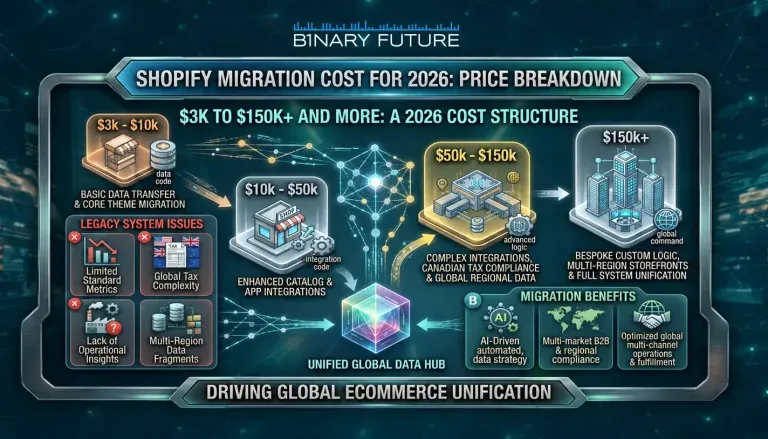
A line-item breakdown across migration scenarios is in our Shopify migration cost guide.
What are the risks and hidden costs of going headless?
Growing technical complexity and team requirements
You are trading a managed system for one you own. Someone has to hold the frontend, the deployment platform, the CMS, and the integrations between them, permanently. Headless without ongoing engineering is a slow-motion failure.
SEO management
Themes handle sitemaps, canonicals, hreflang, and structured data by default. A custom frontend does not. Every one of those becomes something you implement and then keep implementing as the site grows. This is the most commonly underestimated line.
Custom Shopify app development
Functionality that was an app install on a theme becomes a build. The cost of that fell in 2026, because Static Apps run without a server you host and the AI Toolkit shortened build time, but it is still a build. When it is justified is covered in custom Shopify app development.
Checkout governance
Checkout stays with Shopify, which is the right answer. What that means in practice is that your custom frontend and Shopify’s checkout must stay visually and behaviourally coherent through every Shopify release. That is ongoing work, not a one-time integration.
Framework lock-in
Your framework choice is a ten-year decision and frameworks do not all survive. Gatsby is the cautionary case: acquired by Netlify, moved to maintenance, and its Shopify source plugin left behind, while still being installable. Choose what your team can hire for and maintain in two years. The current landscape is in the headless toolkit for 2026.
How does the migration to headless on Shopify work?
The sequence that holds up, in order.
-
Audit and define scope.
What specifically the theme cannot do, expressed as business outcomes rather than features. If you cannot name three, stop here. -
Choose the stack.
A hiring decision before a technical one. Pick what you can maintain, not what benchmarks best this quarter. -
Design the data layer.
Which system owns price, stock, and product content, and what happens when a sync fails. This is where the budget actually goes. -
Build the frontend against the Storefront API,
with checkout remaining on Shopify. -
Preserve SEO deliberately.
Redirect map from a full crawl of the old site, sitemaps, canonicals, hreflang, and structured data all reimplemented, then monitored for at least a quarter. -
Launch in stages
and never in the twelve weeks before peak season.
Where this fits against a platform migration is in our migration cost guide, and the UX case is examined in headless commerce and Shopify UX.
When headless is the wrong answer
Most brands considering headless should not go headless yet. Skip it if any of the following apply.
-
Annual GMV below $3 to 5M.
The build will not pay back in a defensible horizon. -
Your theme is not fully optimised.
Most speed-driven cases turn out to be app stacks and unoptimised Liquid. Fix that first, at a fraction of the cost. -
No engineering capacity.
In-house team or long-term partner. Without one, this fails slowly. -
Your problem is conversion, not speed or omnichannel.
Conversion problems are usually solved at checkout, not in architecture. -
Your roadmap is single-channel
and likely to stay that way for two years. -
Peak season is within twelve weeks.
Headless launches in the fourth quarter are the most common disaster we see.
The pattern we see most: brands consider headless because peers did. The right question is not whether to go headless. It is which specific business outcomes headless delivers in the next twelve months that a Plus theme with checkout extensibility cannot. If you cannot name three, you are early.