Layer 1. Shopify as the Commerce Backend
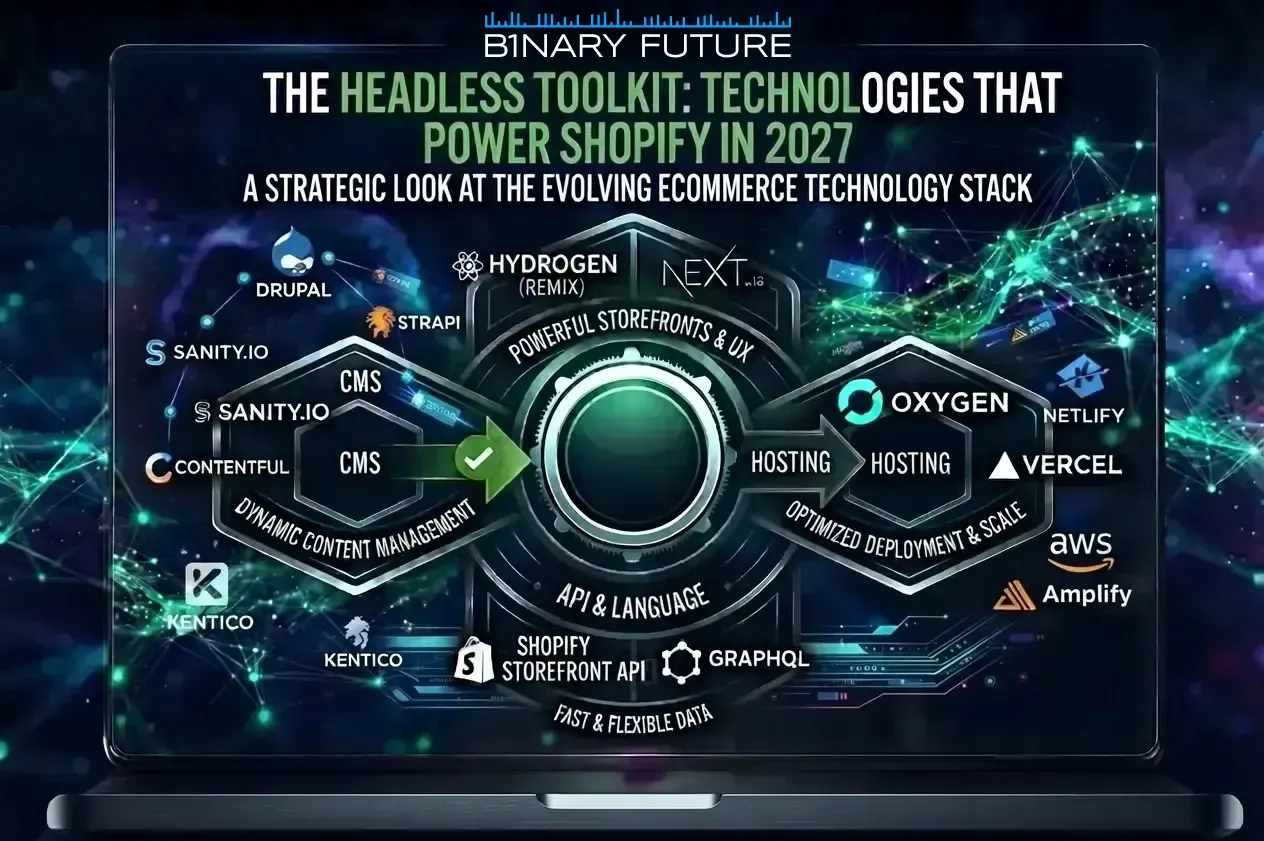
In a headless build Shopify keeps doing what it is good at: products, inventory, orders, payments, tax, and checkout. What changes is that the storefront stops being a Shopify theme and becomes your own application talking to Shopify over an API.
- API rate limits. Higher on Plus, which matters when a storefront pulls data constantly rather than rendering a cached theme.
- Storefront API. The read layer for products, collections, cart, and contextual pricing.
- Checkout. Stays with Shopify in almost every case, because rebuilding it means taking on PCI scope you do not want.
Two corrections to older guides on this point. Checkout logic no longer runs on Shopify Scripts, which stopped executing on June 30, 2026, and custom Function apps remain a Plus capability while public apps containing functions work on any plan. The mechanics are in Shopify Plus checkout customization. Headless itself is available below Plus, so the platform tier is a separate question covered in Shopify Plus vs Shopify.
GraphQL and the Storefront API
The Storefront API is GraphQL, and that is the practical reason headless storefronts can be fast: the frontend requests only the fields it needs rather than a full REST payload (Shopify Storefront API documentation). For a business owner the consequence is simpler than the mechanism. Fewer bytes over the wire means faster pages on a phone on a weak connection, which is where most ecommerce traffic actually is.
Layer 2: Frontend Technologies: Speed and UX
This is where the money goes and where the hiring decision is made. Pick a stack your team or your agency can still maintain in two years, not the one with the best benchmark this quarter.
Frameworks and Libraries
The biggest change of 2026 is Hydrogen. Shopify rebuilt it from an opinionated React framework tied to Remix into a framework-agnostic toolkit: a neutral core of commerce primitives with thin bindings for whichever framework you already use, including Next.js, Astro, and SvelteKit (Shopify Hydrogen updates). In plain terms, choosing Shopify’s own headless tooling no longer forces a particular frontend on your team.
- Next.js remains the default enterprise choice, with the largest hiring pool and the deepest ecosystem.
- React Router, formerly Remix and now maintained with Shopify’s involvement, is what Hydrogen builds on.
- Astro and SvelteKit ship less JavaScript and suit content-heavy storefronts.
- Gatsby is the one to avoid. Netlify acquired it and it has run in maintenance mode since, with the Shopify source plugin among the casualties. It is still installable, which is exactly what makes it a trap in an old proposal.
Progressive Web Apps
PWA behaviour, meaning offline browsing, add to home screen, and push, is a natural extension of a headless frontend. The caveats are real and specific to iOS: web push works only for web apps installed to the Home Screen, there is no one-tap install prompt in Safari, and iOS can evict cached data after weeks of disuse. Native versus PWA covers that trade in full.
Layer 3: Content and Commerce: CMS, PIM and Middleware
The layer most often underestimated in the budget, because it is where the ongoing work lives.
External CMS for Marketing Flexibility
Contentful, Sanity, and similar systems let a marketing team create and publish landing pages without waiting on developers. That is the whole business case: time to market on campaigns. The cost is a second content system to license, learn, and keep in sync with the storefront.
PIM Systems for Complex Inventory
For a catalogue with thousands of SKUs and complex attributes, a PIM such as Akeneo becomes the source of truth for product data, with Shopify holding inventory and pricing. This is the point where a headless project stops being a frontend project and becomes an integration project, which is what Shopify CRM and ERP integrations covers.
Cloud Middleware and Deployment
Vercel and Netlify handle deployment, global CDN, and auto-scaling for headless storefronts, and Shopify’s own Oxygen hosts Hydrogen builds. Whichever you pick, this is a recurring line item and an on-call responsibility. A theme has no deployment platform to pay for and nobody to page at 2am.
Strategy 2026: Integrating AI and Data-Driven Decisions
AI-Driven Personalization on the Frontend
A headless frontend can wire recommendation and personalisation engines directly into page layout rather than through a theme app. The honest caveat is that personalisation needs purchase history to work from, so it belongs after a store has volume, not in the initial build.
Reporting and Analytics in a Headless Environment
Splitting frontend and backend splits your analytics with them. Click behaviour lives in the frontend, purchases live in Shopify, and joining the two is deliberate work rather than something that happens by default. Budget for it, because a headless build with broken attribution is a store that cannot tell you which campaign paid for anything.
One more consideration specific to this year. Shopify Catalog syndicates eligible products to ChatGPT, Copilot, and the Shop app by default (Shopify, June 17, 2026), and that runs on your product data rather than on your frontend. Going headless does not remove that channel, but it does mean product data quality has two audiences: your storefront and the assistants reading the catalog.
Is the Toolkit Worth It?
Headless buys control over the frontend and costs you permanent ownership of one. The calculation moved this year, and not toward headless: Horizon made block-based layout native, so part of what brands used to go headless for is now editor work on any plan. What that means for a theme-based store is covered in effective Shopify customization. When the constraint is genuinely the frontend rather than the theme, Shopify headless development is the scope, and when headless is actually worth it works through the threshold. Higher API limits and custom Function apps sit inside Shopify Plus development.