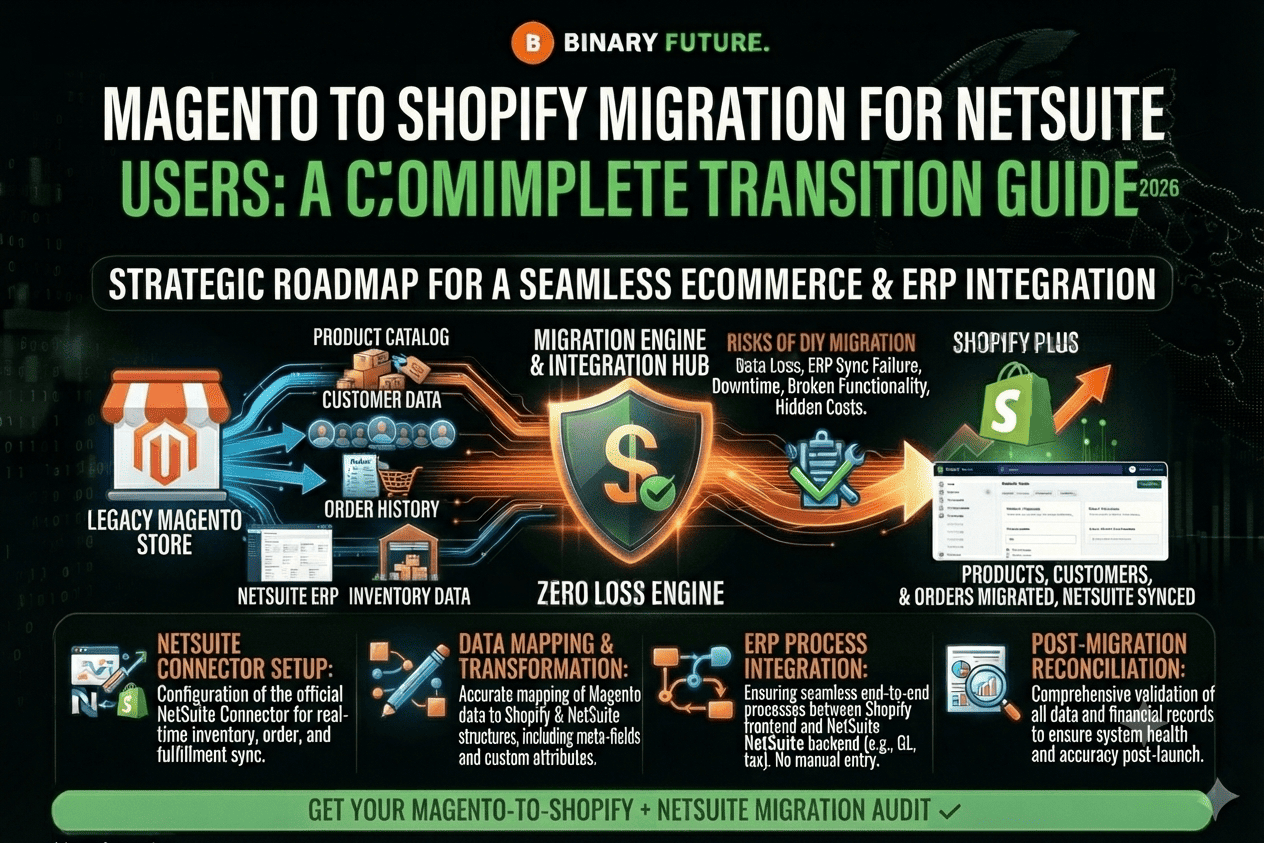
Magento to Shopify NetSuite Migration Guide for enterprise retailers. Learn how to migrate products, customers, orders, and ERP integrations without losing data or disrupting operations.
In 2026 Magento to Shopify migration has become a major trend for brands seeking to get rid of the “tech tax” of legacy systems. At Binary Future, we see that replatforming is not just a site migration, but a complete restructuring of the digital ecosystem. This seems especially critical for companies whose backend is integrated with NetSuite ERP.
In this article, we will analyze the real challenges magento to shopify migration, strategic benefits of the transition and a step-by-step algorithm of actions that will ensure the success of your project.
Why Migrate from Magento to Shopify?
The e-commerce market has changed, and today magento to shopify migration – it’s a matter of business survival. Magento (Adobe Commerce), which used to be the standard, now requires resources that are difficult to justify with business results.
The main reasons why companies choose magento to shopify migration:
- High TCO (Total Cost of Ownership): The costs of dedicated hosting, ongoing security patches, and server support in Magento far exceed the cost of a Shopify Plus subscription.
- Developer shortage: There are fewer qualified Magento specialists and their rates are rising, making any improvements too expensive.
- Time-to-Market: On Shopify, new marketing tools are implemented in days, while on Magento it can take weeks of development.
Magento to Shopify Migration: Key Differences Between Platforms
Before you start magento to shopify migration It is important to understand the fundamental differences in platform architecture. This will help your team adapt to the new sales management logic.
| Function | Magento (Adobe Commerce) | Shopify Plus |
| Platform type | Open Source (Self-hosted) | SaaS (Cloud-based) |
| Maintenance | Requires regular patches and updates | Automatic platform update |
| Security and PCI | Responsibility of the site owner | Included in the platform (Level 1 PCI DSS) |
| Code flexibility | Full access to the kernel and database | Limited access (API-first approach) |
| Download speed | Depends on hosting and optimization | Optimized global CDN network |
Magento to Shopify Migration: Pros & Cons
Any magento to shopify migration involves compromises. Understanding your strengths and weaknesses will allow you to build the right strategy.
Advantages of migration:
- Shop Pay: access to the highest converting checkout on the market.
- Reliability: Shopify can handle any traffic spikes during Black Friday without your involvement.
- Ecosystem: thousands of ready-made applications that integrate instantly.
Cons (challenges):
- Closed database: you lose direct access to MySQL, requiring a switch to working through the API.
- Option limits: Shopify has a limit of 100 variants per product, which requires restructuring complex catalogs during magento to shopify migration.
How to Migrate from Magento to Shopify: A Step-by-Step Tutorial
Process magento to shopify migration is a marathon that consists of several critical stages.
Step 1: Prepare and export data
Collect all data about products, customers, and order history. Since data structures vary, magento to shopify migration requires careful mapping of attributes to Shopify metafields.
Step 2: Customize the design and theme
Instead of porting your old code, we recommend developing a new fast theme for Shopify 2.0. This will allow you to fully utilize the platform’s speed potential.
Step 3: Integration Layer Integration (NetSuite)
For NetSuite users, this stage magento to shopify migration is the most complex. Requires refactoring of Celigo flows or custom integrations, as Shopify API works on GraphQL/REST principles, which are different from Magento.
Step 4: Testing and QA
Run a series of tests: from balance synchronization to correct tax calculation. Only after that can you proceed to the final stage magento to shopify migration.
Common Pitfalls to Avoid in Magento to Shopify Migration
Many brands make mistakes that cost them traffic and money. Here are some things to look out for:
- Ignoring 301 redirects: Changing the URL structure (e.g. from .html to /products/) without redirects will kill your SEO.
- Trying to copy Magento logic: Shopify has a different philosophy. Instead of “breaking” the platform with custom code, use the native Shopify Plus features.
- Poor preparation of customer data: passwords do not migrate, so your magento to shopify migration should include an account reactivation strategy.
Specifics for NetSuite users
For those using NetSuite, magento to shopify migration adds another level of responsibility. Your current connection to the ERP will not work automatically. You need to configure:
- Order Flow: Seamless transfer of orders from Shopify to NetSuite.
- Inventory Sync: real-time balance updates to prevent overselling.
- Fulfillment Tracking: automatic notification of customers about shipment directly from ERP.
From theory to implementation
Magento to Shopify migration is a strategic step towards scaling your brand in 2026. Despite the technical challenges, you get a modern tool that allows your team to focus on marketing, not server maintenance.
The key to success magento to shopify migration – in professionally planning and protecting your SEO capital. Binary Future will help make this transition seamless, turning technical complexity into your competitive advantage.
Ready to start your Magento to Shopify migration?
Request a free NetSuite – Shopify integration audit